Alternatives for Production of Agave durangensis Gentry in Nursery in Non-Conventional Substrates
DOI:
https://doi.org/10.28940/terralatinoamericana.v44i.2347Keywords:
fresh pine sawdust, germination, morphology, maize cob, composted agroindustrial residuesAbstract
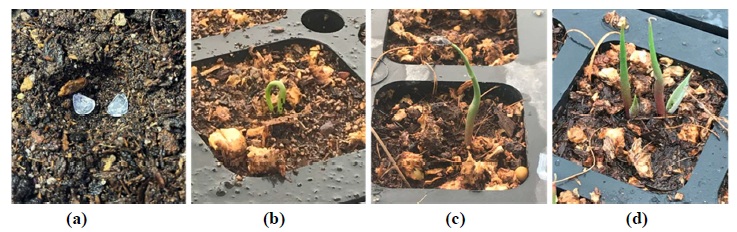
Within the nursery production process, some conventional substrates present significant limitations, such as limited availability, high cost, and the environmental impact resulting from their extraction. Therefore, identifying alternative substrates can expand production possibilities by taking advantage of local inputs with lower ecological impact. The ef fect of four substrates on the germination and development of Agave durangensis Gentry plants under nursery conditions was evaluated. The trial consisted of six treatments based on mixtures of composted agave bagasse, crushed corncob, fresh pine sawdust, and enlame soil in dif ferent proportions, as well as a control treatment with a conventional mixture of peat, vermiculite, and perlite. The percentage of emergence and cumulative germination were determined, and ten months af ter planting, plant height, root ball length, root length, rosette diameter, stem diameter and root collar diameter, dry aboveground and root biomass, and the number of expanded leaves were evaluated. The results showed an emergence rate greater than 80% in most treatments, and maximum cumulative germination was reached at 42 days. A significant ef fect of substrate type on final cumulative germination was observed (p < 0.001); however, dif ferences were only detected for the substrate composed of composted agave bagasse, fresh pine sawdust, and enlame soil (S5-BAE), which showed the lowest germination (51.7%) compared with the other treatments, which reached values between 80 and 92.5%. The mixture of composted agave bagasse, fresh pine sawdust, and enlame soil (1:1:1) favored the morphological development of agave plants compared with the conventional substrate. It is concluded that non-conventional substrates allow adequate development of high-quality Agave durangensis Gentry plants at the nursery stage; therefore, they represent a viable alternative for use in both container and traditional bag production systems.
Downloads
Publication Facts
Reviewer profiles N/A
Author statements
- Editor & editorial board
- profiles
- Academic society
- Terra Latinoamericana
- Publisher
- Mexican Society of Soil Science, C.A.

To learn about these publication facts, click 
PF is maintained by the Public Knowledge Project
References
Acosta-Durán, C. M., Gallardo, C. S., Normann Kämpf, A., & Carvallo Bezerra, F. (2008). Materiales regionales utilizados en Latinoamérica para la preparación de sustratos. Investigación Agropecuaria, 5(2), 93-106. https://scholar.google.es/scholar?q=Materiales+regionales+utilizados+en+Latinoam%C3%A9rica+para+la+preparaci%C3%B3n+de+sustratos&hl=es&as_sdt=0,5
Aguilera-Rodríguez, M., Aldrete, A., Sánchez-Velázquez, J. R., & Prieto-Ruíz J.A. (2023). Instalaciones e insumos para la producción. En: Aldrete, A., Sánchez-Velázquez, J. R., Aguilera-Rodríguez, M., Cibrián-Tovar, D., & García-Díaz, S. E. (Eds.). Manual de buenas prácticas para el manejo de la salud de planta en viveros forestales (pp. 41-90). Universidad Autónoma Chapingo. Estado de México, México. https://isbnmexico.indautor.cerlalc.org/catalogo.php?mode=detalle&nt=412918
Bernaola Paucar, R. M., Zamora Natera, J. F., Vargas Radillo, J. J., Cetina Alcalá, V. M., Rodríguez Macías, R., & Salcedo Pérez, E. (2016). Calidad de planta en etapa de vivero de dos especies de pino en sistema doble-trasplante. Revista Mexicana de Ciencias Forestales, 7(33), 74-93. https://www.redalyc.org/pdf/634/63445804006.pdf
Camacho, A. D., Martínez, L., Ramírez Saad, H., Valenzuela, R., & Valdés, M. (2014). Potencial de algunos microorganismos en el compostaje de residuos sólidos. Terra Latinoamericana, 32(4), 291-300. http://www.scielo.org.mx/scielo.php?script=sci_arttext&pid=S0187-57792014000400291&lng=es&tlng=es
Candia-Acosta, J. A. Díaz-Vasquez, M. A., Torres Herrera, S. I., Quiroz-Arratia, J. A., & Domínguez-Calleros, P. A. (2019). Germinación de semillas de Agave durangensis bajo diferentes coberturas en Durango, México. Revista Mexicana de Agroecosistemas, 6(1), 18-27. https://revistaremaeitvo.mx/index.php/remae/issue/view/14/12
Comisión Nacional Forestal. (2021). Estado que guarda el sector forestal en México 2020. Recuperado el 7 de marzo de 2025, de https://www.gob.mx/conafor/documentos/estado-que-guarda-el-sector-forestal-en-mexico-2020
Comisión Nacional Forestal. (2023). Estado que guarda el sector forestal en México 2022. Recuperado el 5 de marzo de 2025, de https://www.gob.mx/conafor/documentos/estado-que-guarda-el-sector-forestal-en-mexico-2022-349939
Consejo Mexicano Regulador de la Calidad del Mezcal. (2024). Informe estadístico 2024. Recuperado el 10 de mayo de 2025, de https://comercam-dom.org.mx/wp-content/uploads/2024/04/PUBLICO_INFORME_2024.pdf
Consejo Nacional de Evaluación de la Política de Desarrollo Social. (2022). Evaluación de Procesos del Programa Sembrando Vida. Recuperado el 11 de mayo de 2025, de https://www.coneval.org.mx/SalaPrensa/Comunicadosprensa/Paginas/Comunicados-2022.aspx
Crespo González, M. R., González Eguiarte, D. R., Rodríguez Macías, R., Rendón Salcido, L. A., del Real Laborde, J. I., & Torres Morán, J. P. (2013). Evaluación de la composta de bagazo de agave como componente de sustratos para producir plántulas de agave azul tequilero. Revista Mexicana de Ciencias Agrícolas, 4(8), 1161-1173. http://www.scielo.org.mx/scielo.php?script=sci_arttext&pid=S2007-09342013000800004&lng=es&tlng=es
Chairez-Aquino, J., Enríquez-del-Valle, J. R., Ruíz-Luna, J., Campos-Ángeles, G. V., & Martínez-García, R. (2015). Uso del bagazo de Agave spp y hojas de maíz para cultivar el hongo Pleurotus ostreatus. Revista Mexicana de Agroecosistemas, 2(1), 23-28. https://revistaremaeitvo.mx/index.php/remae/article/view/292
Flores-Ríos, P. A., Celerino, R., & Castañeda-Hidalgo, E. (2020). Generación y caracterización básica de bagazos de la agroindustria del mezcal en Oaxaca. Revista Mexicana De Ciencias Agrícolas, 11(6), 1437–1445. https://doi.org/10.29312/remexca.v11i6.2615
Fregoso-Madueño, J. N., Goche-Télles, J. R., Rutiaga-Quiñones, J. G., González-Laredo, R. F., Bocanegra-Salazar, M., & Chávez-Simental, J. A. (2017). Usos alternativos de los desechos de la industria del aserrío. Revista Chapingo serie ciencias forestales y del ambiente, 23(2), 243-260. https://doi.org/10.5154/r.rchscfa.2016.06.040
García-Rodríguez, J. L., Sarmiento López, H., Sigala Rodríguez, J. Á., & Monárrez González, J. C. (2023). Producción de planta y establecimiento de plantaciones comerciales de Agave durangensis Gentry. Folleto Técnico Núm. 128. Campo Experimental Valle del Guadiana. INIFAP. https://www.researchgate.net/publication/378179556_PRODUCCION_DE_PLANTA_Y_ESTABLECIMIENTO_DE_PLANTACIONES_COMERCIALES_DE_Agave_durangensis_Gentry
Gobierno del Estado de Durango. (14 de marzo de 2023). Plan Estatal de Desarrollo 2023-2028. https://www.durango.gob.mx/ped.pdf
González Orozco, M. M., Prieto Ruíz, J. A., Aldrete, A., Hernández Díaz, J. C., Chávez Simental, J. A., & Rodríguez Laguna, R. (2018). Sustratos a base de aserrín crudo con fertilización y la calidad de planta de Pinus cooperi Blanco en vivero. Revista Mexicana De Ciencias Forestales, 9(48), 203-226. https://doi.org/10.29298/rmcf.v8i48.125
González-Castillo, M. P., Quintos Escalante, M., & Castaño-Meneses, G. (2011). Arthropods in natural communities in mescal agave (Agave durangensis Gentry) in an arid zone. American Journal of Applied Sciences, 8(10), 933-944. https://www.researchgate.net/publication/286726231_Arthropods_in_Natural_Communities_in_Mescal_Agave_Agave_durangensis_Gentry_in_an_Arid_Zone
Landis, T. D., Tinus, R. W., McDonald, S. E., & Barnett, J. P. (1990). The Container Tree Nursery Manual (Vol. 2.) Containers and growing media. United States Department of Agriculture. https://rngr.net/publications/ctnm/volume-2
Loera-Gallegos, H. M., Corral-Rivas, J. J., Montiel-Antuna, E., Solís-Moreno, R., Chávez-Simental, J. A., & González-Cervantes, G. (2018). Calidad de sitio para Agave durangensis Gentry en la Sierra de Registrillo, Durango. Revista Mexicana de Ciencias Agrícolas, 9(6), 1171-1180. https://www.scielo.org.mx/scielo.php?script=sci_arttext&pid=S2007-09342018000601171
Martínez-Estrada, S. C., Narváez-Zapata, J. A., Rodríguez-Herrera, R., Grijalva-Ávila, J., Gurrola-Reyes, J. N., Larralde-Corona, C. P., & Chairez-Hernández, I. (2024). Diversity of culturable yeasts associated with the technification level in the process of mezcal production in the state of Durango. Fermentation, 10(3), 147. https://doi.org/10.3390/fermentation10030147
Monsalve Camacho, O. I., Henao Toro, M. C., & Gutiérrez Díaz, J. S. (2021). Caracterización de materiales con uso potencial como sustratos en sistemas de cultivo sin suelo. Ciencia y Tecnología Agropecuaria, 22(1), e1977. https://doi.org/10.21930/rcta.vol22_num1_art:1977
Morales-Campos, B. K., Sánchez-Santillán, P., Torres-Salado, N., Saavedra-Jiménez, L. A., Herrera-Pérez, J., & Ayala-Monter, M. A. (2024). Actividad de celulasas y lacasas de Pleurotus ostreatus por fermentación en medios sólidos con subproductos del maíz (Zea mays L.). Revista internacional de contaminación ambiental, 40, 231-240. https://doi.org/10.20937/RICA.54531
Orea Lara, G., Cifuentes Días de León, A., Gómez Ortiz, S., & Hernández Vargas, V. (2006). Germinación de semillas (Agave durangensis) a diferentes temperaturas y efecto de la fertilización en el desarrollo de las plántulas. Vidsupra, 1(2),51-56. https://repositoriodigital.ipn.mx/handle/123456789/8289
Pineda Pineda, J., Moreno Roblero, M. de J., Colinas León, M. T., & Sahagún Castellanos, J. (2020). El oxígeno en la zona radical y su efecto en las plantas. Revista Mexicana de Ciencias Agrícolas, 11(4), 931–943. https://doi.org/10.29312/remexca.v11i4.2128
Quiroz Marchant, I., Chung Guin-po, P., García Rivas, E., & Soto Guevara, H. (2009). Vivero forestal: producción de plantas nativas a raíz cubierta. INFOR. https://doi.org/10.52904/20.500.12220/17366
Roblero-Mejía, D. O., Aguilar-Marcelino, L., & Sánchez, J. E. (2021). Efecto de la variación del sustrato en la productividad de dos cepas de Pleurotus spp. Scientia fungorum, 52, (e1377), 1-11. https://doi.org/10.33885/sf.2021.52.1377
Rodríguez-Martínez, N., Lucas-Ciriaco, D. J., Nogez-Estrada, J., & Sánchez-Herrera, S. G. (2016). Evaluación del sustrato de olote en la retención de humedad en el suelo para el cultivo de tomate (Lycopersicum esculentum Mill). Revista de Ciencias Naturales y Agropecuarias, 3(7), 25-34. https://www.ecorfan.org/bolivia/researchjournals/Ciencias_Naturales_y_Agropecuarias/vol3num7/Revista_Ciencias_Naturales_V3_N7_5.pdf
Rosales-Serna, R., Ríos-Saucedo, J. C., Rodríguez-Varga, J. H., Nava-Berumen, C. A., Sierra-Zurita, D., Santana-Espinoza, S., & Romo-Alanís, C. (2022). Ambientes de selección para obtener plantas de maguey cenizo con crecimiento acelerado en plantaciones comerciales. Agrofaz, 4(1), 20-28. https://dialnet.unirioja.es/servlet/articulo?codigo=8708018
Salas-Pérez, L., González Fuentes, J. A., García Carrillo, M., Sifuentes-Ibarra, E., Parra-Terrazas, S., & Preciado-Rangel, P. (2016). Calidad biofísica y nutracéutica de frutos de tomate producido con sustratos orgánicos. Nova scientia, 8(17), 310-325. http://www.scielo.org.mx/scielo.php?script=sci_arttext&pid=S2007-07052016000200310&lng=es&tlng=es
Salinas Sanhueza, J., Gaudig, G., Krebs, M., Moya Navarro, I., & Silva Labbé, F. (2024). Turberas y cosecha de Sphagnum en la región de Aysén, Chile. Ciencia & Investigación Forestal, 30(1), 43-63. https://doi.org/10.52904/0718-4646.2024.606
Secretaría de Economía. (2016). Norma Mexicana NMX-AA-170-SCFI-2016: Certificación de operación de viveros forestales. https://www.dof.gob.mx/normasOficiales/6281/seeco3a13_C/seeco3a13_C.html
Statistical Analysis System Institute. (2009). SAS Ver. 9.2 [Software]. SAS Institute Inc. https://www.scirp.org/reference/referencespapers?referenceid=590544
Torres-Morán, M.I., Hormaza, J.I. & Larranaga, N. (2024). DNA analyses reveal high heterozygosity values and low differentiation among populations of mezcal-producing Agave durangensis. Genetic Resources and Crop Evolution, 71(7), 3419–3431. https://doi.org/10.1007/s10722-023-01850-y
Vazquez Elorza, A., Rivera Ramírez, J., Gutiérrez Mora, A., Olvera Vargas, L. A., Romero Romero, Y., Rodríguez Peralta, C. M., & García Pérez, L. (2019). Fundamentos del ecosistema agave mezcalero para los hacedores de políticas públicas. CIATEJ. https://www.researchgate.net/publication/343205844_Fundamentos_del_ecosistema_agave_mezcalero_para_los_hacedores_de_politicas_publicas
Zúñiga-Estrada, L., Rosales Roble, E., Yáñez-Morales M. de J., & Jacques-Hernández C. (2018). Características y productividad de una planta MAC, Agave tequilana desarrollada con fertigación en Tamaulipas, México. Revista Mexicana De Ciencias Agrícolas, 9(3), 553–564. https://doi.org/10.29312/remexca.v9i3.1214