Optimizing Ammonium Concentration in the Irrigation Solution of Pot-Grown Blueberry (Vaccinium corymbosum L.) Plants for Yield and Quality
DOI:
https://doi.org/10.28940/terralatinoamericana.v43i.2103Keywords:
biloxy, growth, hydroponic, nitrogen, productivityAbstract
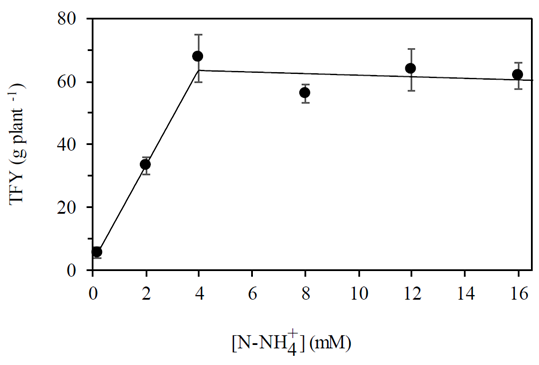
The aim of this work was to optimize the ammonium concentration in the irrigation solution of pot-grown blueberry plants for fruit yield and quality, under protected conditions. An experiment was developed with blueberry (Vaccinium corymbosum L.) plants var. Biloxi, with six treatments of ammonium concentrations in the irrigation solutions: 0.2 mM, 2.0 mM, 4.0 mM, 8.0 mM, 12.0 mM, and 16.0 mM, which were repeated four times, generating 24 experimental units (EU), with four plants each. At 200, 215, and 231 days af ter treatments application the fruits were harvested to evaluate fruit yield (FY), total fruit yield (TFY), proportional fruit yield for each harvest date (PFY), fruit diameter (FD), and soluble solid content (ºBrix). The results showed that TFY increased with ammonium concentration until 4.0 mM and beyond slightly decreased; the pattern displayed by PFY showed that plants irrigated with solutions with ammonium concentrations higher or lower than 8.0 mM and 4.0 mM, respectively, delayed their fruit ripening. The ef fect of increasing N concentration on FD passed from a slight increase to a null ef fect and to an evident decrease for the first, second, and third harvest dates, respectively. The fruit ºBrix increased with ammonium concentration, but decreased 24.0% and varied only 4.6% for the treatments 2.0 mM and 16.0 mM of ammonium, respectively, from the first to the third harvest date. It was concluded that the optimum ammonium concentration in the irrigation solution of blueberry plants grown in pots under protected conditions was 4.0 mM.
Downloads