Estimation of the Carbon Sequestration Potential of Conservation Tillage Systems in Soils of Nayarit, Mexico
DOI:
https://doi.org/10.28940/terralatinoamericana.v44i.2225Keywords:
Cambisol, Fluvisol, Luvisol, Remote sensing, RothC-26.3Abstract
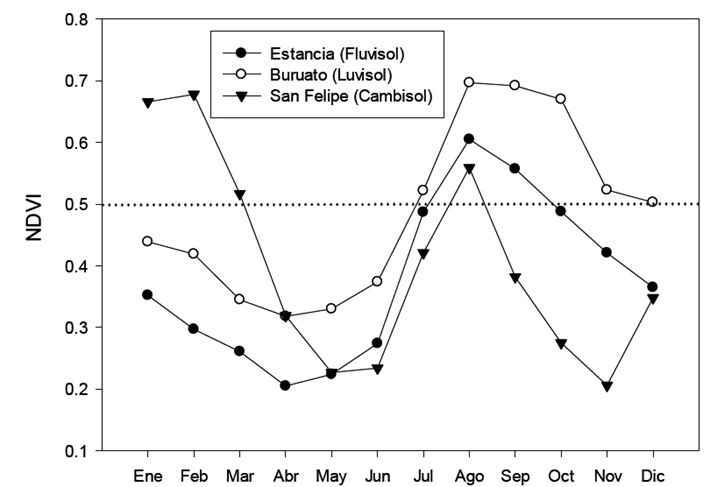
Greenhouse gas emissions have unequivocally caused global warming and climate change, as documented in recent decades. The implementation of conservation tillage (CT) practices has been promoted to reduce soil degradation and as a climate change mitigation strategy through soil recarbonization. The objective of this study was to estimate the potential for soil organic carbon (SOC) sequestration under CT with 35% soil cover (2 Mg crop residues ha–¹) or 100% soil cover (4.66 or 5.64 Mg crop residues ha–¹), compared with traditional tillage (TT). In the state of Nayarit, Mexico, three study sites managed under a mixed crop–livestock system were located in soil units most suitable for agricultural production (Fluvisol, Luvisol, and Cambisol). The RothC-26.3 model was used to simulate SOC dynamics over a twenty-year period. The c factor of this model was determined through multitemporal analysis of satellite images from the Landsat platform. The results showed that, at the three sites/soils, TT would lead to an average SOC loss rate ranging from 0.119 to 0.341 Mg ha–¹ year–¹, whereas under CT, the model predicted average SOC accumulation rates ranging from 0.084 to 0.650 Mg ha–¹ year–¹, except in the Fluvisol under CT with 35% cover, where simulations indicated an average SOC loss of 0.129 Mg ha–¹ year–¹. The study concluded that SOC sequestration depended mainly on clay content and the amount of residues used as soil cover, particularly in Fluvisols, where residue cover must exceed 35% (> 2 Mg crop residues ha–¹ year–¹) to achieve positive SOC sequestration rates.
Downloads
References
Arévalo, P., Bullock, E.L., Woodcock, C.E. & Olofsson, P. (2020). A suite of tools for continuous land change monitoring in Google Earth Engine. Frontiers in Climate 2, 1–19 https://www.frontiersin.org/journals/climate/articles/10.3389/fclim.2020.576740 DOI=10.3389/fclim.2020.576740
Amundson, R. & Biardeau, L. (2018). Soil carbon sequestration is an elusive climate mitigation tool. PNAS 115, 11652–11656. https://doi.org/10.1073/ pnas.1815901115
Blanco-Canqui, H, & Ruis, S.J. (2018). No-tillage and soil physical environment. Geoderma 326, 164-200.
Brevik, E.C., Cerdà, A., Mataix-Solera, J., Pereg, L., Quinton, J.N., J. Six, J. & K. Van Oost. (2015). The interdisciplinary nature of SOIL. SOIL 1, 117–129.
Cerri, C.E.P., Easter, M., Paustian, K., Killian, K., Coleman, K., Bernoux, M., Falloon, P., Powlson, D.S., Batjes, N. & Milne, E. (2007). Simulating SOC changes in 11 land use change chronosequences from the Brazilian Amazon with RothC and Century models. Agriculture, Ecosystems and Environment 122 46–57, doi: 10.1016/j.agee.2007.01.007.
CNA (Comisión Nacional Del Agua). 2022. Estación: Normales Climatológicas 1971-2000. https://smn.conagua.gob.mx/es/informacion-climatologica-por-estado?estado=nay
Coleman, K., Jenkinson, D.S., Crocker, G. J., Grace, P.R., Klír, J., Körschens, M., Poulton, P.R. & Richter, D.D. (1997). Simulating trends in soil organic carbon in long-term experiments using RothC-26.3. Geoderma 81 (1–2), 29-44.
Coleman, K., & Jenkinson, D.S. (2005). ROTHC-26.3 – a model for the turnover of carbon in soil: model description and Windows users guide. Harpenden, Rothamsted Research 1-43 pp.
Cotler, H., M. Martínez & J. D. Etchevers. (2016) Carbono orgánico en suelos agrícolas de México: Investigación políticas públicas. Terra Latinoamericana 34: 125-138.
Crowther, T.W., van den Hoogen, J., Mayes, M.A., Keiser, A.D., Mo, L., Averill, C. & Maynard, D.S. (2019). The global soil community and its influence on biogeochemistry. Science 365, eaav0550
CTIC Conservation Technology Information Center. (2023). Tillage type definitions. https://www.ctic.org/resource_display/?id=322&title=Tillage+Type+Definitions
Chappell, A., Baldock, J., & Sanderman, J. (2016). The global significance of omitting soil erosion from soil organic carbon cycling schemes. Nature Climate Change, 6 (2), 187-191. DOI: 10.1038/NCLIMATE2829
Chen, S.Y., Zhang, X.Y., Pei, D., Sun, H.Y. & Chen, S.L. (2007). Effects of straw mulching on soil temperature, evaporation and yield of winter wheat: field experiments on the North China Plain. Annals of Applied Biology, 150 (3), 261-268. https://doi.org/10.1111/j.1744-7348.2007.00144.x
Dai, Z., Ding, Y., Xu, C., Chen, Y. & Liu, L. (2022). Evaluation of the impact of crop residue on fractional vegetation cover estimation by vegetation indices over conservation tillage cropland: a simulation study. International Journal of Remote Sensing, 43(17), 6463–6482. https://doi.org/10.1080/01431161.2022.2139649
Dendooven, L., Patiño Z., N. Verhulst, M. Luna G., R. Marsch, & B. Govaerts. (2012). Global warming potential of agricultural systems with contrasting tillage and residue management in the central highlands of Mexico. Agric. Ecosyst. Environ. 152, 50-58.
El-Shater, T. & Yigezu A. (2021). "Can Retention of Crop Residues on the Field Be Justified on Socioeconomic Grounds? A case study from the mixed crop-livestock production systems of the Moroccan drylands" Agronomy 11, no. 8: 1465. https://doi.org/10.3390/agronomy11081465
Erenstein, O. 1997. ¿Labranza de conservación o conservación de residuos? Una evaluación del manejo de los residuos en México. Natural Resources Group Reprint Series 97-02. Centro Internacional de Mejoramiento de Maíz y Trigo. México, D.F.
Falloon, P., Smith, P., Coleman, K. & Marshall, S. (1998). Estimating the size of the inert organic matter pool from the total organic carbon content for use in the Rothamsted carbon model. Soil Biology and Biochemistry, 30 (8-9), 1207-1211. https://doi.org/10.1016/S0038-0717(97)00256-3.
Falloon P. & Smith P. (2002). Simulating SOC changes in long-term experiments with RothC and CENTURY: Model evaluation for a regional scale application. Soil Use and Management 18, 101–111. doi: 10.1079/SUM2001108.
FAO. (2001). Soil carbon sequestration for improved land management. Food and Agriculture Organization of the United Nations. World Soil Resources Reports 96. Rome, Italy.
FAO. (2017). Soil Organic Carbon: the hidden potential. Food and Agriculture Organization of the United Nations. Rome, Italy
FAO & ITPS. (2021). Recarbonizing global soils – A technical manual of recommended management practices. Volume 1: Introduction and methodology. Rome, FAO. https://doi.org/10.4060/cb6386en
FAO. (2022). Global Soil Organic Carbon Sequestration Potential Map – GSOCseq v.1.1. Technical report. Rome. https://doi.org/10.4060/cb9002en
Farage, P.K., Ardö, J., Olsson, L., Rienzi, E.A., Ball, A.S. & Pretty, J.N. (2007). The potential for soil carbon sequestration in three tropical dryland farming systems of Africa and Latin America: A modelling approach. Soil and Tillage Research, 94 (2), 457-472. https://doi.org/10.1016/j.still.2006.09.006
Gee, G.W. & Bauder, J.W. (1986). Particle-size análisis. p. 383-411. In A. Klute (ed.) Methods of soil análisis Part I. Physical and mineralogical methods. Agronomy Monograph no. 9 (2nd Edition).
Ghidey, F. & E. E. Alberts, E.E. (1998). Runoff and soil losses as affected by corn and soybean tillage systems. Journal of Soil and Water Conservation 53 (1), 64-70;
González-Molina, L.; Carrillo-Anzures, F.; Acosta-Mireles, M.; Baéz-Pérez, A.; Espitia-Rangel, E.; Etchevers-Barra, J. & Paz-Pellat, F. (2022). Experiencia mexicana en la implementación del modelo RothC-26.3 de la dinámica del carbono orgánico en suelos: alcances y limitaciones. Terra Latinoamericana, 40, 1-23. e1386. https://doi.org/10.28940/terra.v40i0.1386
Guillaume, T., Makowski, D., Libohova, Z., Bragazza, L., Sallaku, F. & Sinaj, S. (2022). Soil organic carbon saturation in cropland-grassland systems: Storage potential and soil quality. Geoderma, 406 (115529).
Haddaway, N. R., Hedlund, K., Jackson, L. E., Kätterer, T., Lugato, E., Thomsen, I. K., Jørgensen, H. B. & Isberg, P.E. (2017). How does tillage intensity affect soil organic carbon? A systematic review protocol. Environmental Evidence, 6:30 DOI 10.1186/s13750-017-0108-9
Helgason, B.L., Gregorich, E.G., Janzen, H.H., Ellert, B.H., Lorenz, N. & Dick, R.P. (2014). Long-term microbial retention of residue C is site-specific and depends on residue placement. Soil Biology and Biochemistry 68, 231-240. https://doi.org/10.1016/j.soilbio.2013.10.002.
Hellin, J., Erenstein, O.; Beuchelt, T.; Camacho, C., & Flores, D. (2013). Maize stover use and sustainable crop production in mixed crop–livestock systems in Mexico. Field Crops Research, 153, 12–21.
Hernández, N. & Soto, F. (2012). Influencia de tres fechas de siembra sobre el crecimiento y rendimiento de especies de cereales cultivadas en condiciones tropicales. Parte I. Cultivo del maíz (Zea mays L.). Cultivos Tropicales, 33 (2) 44-49
Huang, Y., Ren, W., Wang, L., Hui, D., Grove, J.H., Yang, X., Tao, B. & Goff, B. (2018). Greenhouse gas emissions and crop yield in no-tillage systems: A meta-analysis, Agriculture, Ecosystems & Environment, 268, 144-153, https://doi.org/10.1016/j.agee.2018.09.002
Hyun, J. & Yoo, G. (2024). Modification of the RothC model to evaluate the inconsistent effect of conservation tillage on SOC stock and a suggestion of a national-scale assessment framework. Science of The Total Environment, 907, 168010. https://doi.org/10.1016/j.scitotenv.2023.168010.
INEGI. s.f. Conjunto de Datos Vectorial Edafológico, Escala 1:250 000, Serie II (Continuo Nacional). https://www.inegi.org.mx/temas/edafologia/
INEGI. (2004). Información Nacional sobre Perfiles de Suelo v.1.2. Aguascalientes, Ags. https://www.inegi.org.mx/app/biblioteca/ficha.html?upc=702825266707
IPCC. (2018). Summary for policymakers. In V. Masson-Delmotte, P. Zhai, H. O. Pörtner, D. Roberts, J. Skea, P. R. Shukla, A. Pirani, W. Moufouma-Okia, C. Péan, R. Pidcock, S. Connors, J. B. R. Matthews, Y. Chen, X. Zhou, M. I. Gomis, E. Lonnoy, T. Maycock, M. Tignor, & T. Waterfield (Eds.), Global warming of 1.5°C. An IPCC Special Report on the impacts of global warming of 1.5°C above pre-industrial levels and related global greenhouse gas emission pathways, in the context of strengthening the global response to the threat of climate change (pp. 32). World Meteorological Organization Technical Document.
IPCC (2023): Summary for Policymakers. In: Climate Change 2023: Synthesis Report. Contribution of Working Groups I, II and III to the Sixth Assessment Report of the Intergovernmental Panel on Climate Change [Core Writing Team, H. Lee and J. Romero (eds.)]. IPCC, Geneva, Switzerland, pp. 1-34, doi: 10.59327/IPCC/AR6-9789291691647.001
Jiménez, A. (1989). La producción de forrajes en México. Universidad Autónoma Chapingo. 100 p
Kuzyakov, Y. & Domanski, G. (2000). Carbon input by plants into the soil. Review. Journal of Plant Nutrition and Soil Science 163(4) 421-431.
Lal, R. (2004). Soil carbon sequestration impacts on global climate change and food security. Science 304(5677), 1623-1627. https://doi.org/10.1126/science.1097396.
Lal, R. (2016). Soil health and carbon management. Food and Energy Security 5, 212–22. doi: 10.1002/fes3.96
Lal, R., Smith, P., Jungkunst, H.F., Mitsch, W., Lehmann, J., Nair, P.K.R., McBratney, A.B., de Moraes Sá, J.C., Schneider, J., Zinn, Y.L., Skorupa, A.L.A., Zhang, H.L., Minasny, B., Srinivasrao, C., & Ravindranath, N.H. (2018). The carbon sequestration potential of terrestrial ecosystems. Journal of Soil and Water Conservation, 73(6): 145A–152A.
Lessmann, M., Ros, G.H., Young, M.D. & de Vries, W. (2022). Global variation in soil carbon sequestration potential through improved cropland management. Global Change Biology 28, 1162-1177 DOI: 10.1111/gcb.15954
Maas, E.D. & Lal, R. (2023). A case study of the RothC soil carbon model with potential evapotranspiration and remote sensing model inputs. Remote Sensing Applications: Society and Environment 29, 100876 https://doi.org/10.1016/j.rsase.2022.100876
Mangalassery, S., Sjögersten, S., Sparkes, D. & Mooney, S. (2015). Examining the potential for climate change mitigation from zero tillage. The Journal of Agricultural Science, 153(07): 1151-1173.
Masek, J. G., Vermote, E. F., Saleous, N. E., Wolfe, R., Hall, F. G., Huemmrich, K. F., Gao, F., Kutler, J., & Lim, T.-K. (2006). A Landsat Surface Reflectance Dataset for North America, 1990–2000. IEEE Geoscience and Remote Sensing Letters, 3(1), 68–72. https://doi.org/10.1109/LGRS.2005.857030
Monjardino, M., López-Ridaura, S., Van Loon, J., Mottaleb, K.A., Kruseman, G., Zepeda, A., Hernández, E.O., Burgueño, J., Singh, R.G., Govaerts, B. & Erenstein, O. (2021). Disaggregating the Value of Conservation Agriculture to Inform Smallholder Transition to Sustainable Farming: A Mexican Case Study. Agronomy 11, 1214. https:// doi.org/10.3390/agronomy11061214
Muñoz-Romero, V., Lopez-Bellido, L. & Lopez-Bellido, R. J. (2015). Effect of tillage system on soil temperature in a rainfed Mediterranean Vertisol. International Agrophysics, 29(4), 467-473. https://doi.org/10.1515/intag-2015-0052
Murray-Núñez, R.F.; Nájera-González, O.; Orozco-Benítez, M.G. & Bojórquez-Serrano, J.I. (2015). Cambios en carbono orgánico en suelos cambisoles, solonetz y arenosoles. Revista Iberoamericana de las Ciencias Biológicas y Agropecuarias 4 (8), 1-19.
Nelson, D.W. & Sommers, L.E. (1982). Total carbon, organic carbon, and organic matter. p. 539-579. In A.L. Page (ed.) Methods of soil analysis Part 2 Chemical and microbiological properties. Agonomy Monograph no. 9 (Second edition).
Paush, J., & Kuziakov, Y. (2018). Carbon input by roots into the soil: Quantification of rhizodeposition from root to the ecosystem scale. Global Change Biology 24(1) 1-12
Paustian, K., Collier, S., Baldock, J., Burgess, R., Creque, J., DeLonge, M., Dungait, J., Ellert, B., Frank, S., Goddard, T., Govaerts, B., Grundy, M., Henning, M. Izaurralde, R.C., Madaras, M., McConkey, B., Porzig, E., Rice, Ch., Searle, R., Seavy, N., Skalsky, R., Mulhern, W. & Jahn, M. (2019a). Quantifying carbon for agricultural soil management: from the current status toward a global soil information system. Carbon Management,10(6), 567–587. https://doi.org/10.1080/17583004.2019.1633231
Paustian, K., Larson, E., Kent, J., Marx, E. & Swan, A. (2019b). Soil carbon sequestration as a biological negative emission strategy. Frontiers in Climate 1 (8) doi:10.3389/fclim.2019.00008
Paz Pellat, F., Romero Sánchez, M. E., Palacios Vélez, E., Bolaños González, M., Valdez Lazalde, J. R., & Aldrete, A. (2014). Alcances y limitaciones de los índices espectrales de la vegetación: marco teórico. Revista Terra Latinoamericana, 32(3), 177–194.
Powlson, D. S., Stirling, C.M., Jat, M.L., Gerard, B.J., Palm, Ch. A., Sanchez, P.A. & Cassman,K.G. (2014). Limited potential of no-till agriculture for climate change mitigation. Nature Climate Change (4) 678-683 DOI: 10.1038/NCLIMATE2292
Powlson, D.S., Stirling, C.M., Thierfelder, C., White, R.P. & Jat, M.L. (2016). Does conservation agriculture deliver climate change mitigation through soil carbon sequestration in tropical agro-ecosystems? Agriculture, Ecosystems & Environment, 220, 164-174. https://doi.org/10.1016/j.agee.2016.01.005.
Reeves, D.W. (1997). The role of soil organic matter in maintaining soil quality in continuous cropping systems. Soil and Tillage Research, 43:131–67.
Reicosky, D. C. 2003. Tillage-induced CO2 emissions and carbon sequestration: Effect of secondary tillage and compaction. pp. 291-300. In: L. García-Torres, J. Benítez, A. Martínez-Villela, and A. Holgado-Cabrera (eds.). Conservation agriculture. Kluwer Academic Publishers. Dordrecht, The Netherlands.
Reyes-Muro, Luis; Camacho-Villa, Tania Carolina & Guevara-Hernández, Francisco. (Coords.). (2013). Rastrojos: manejo, uso y mercado en el centro y sur de México. Instituto Nacional de Investigaciones Forestales, Agrícolas y Pecuarias. Libro Técnico Núm. 7. Pabellón de Arteaga, Aguascalientes, México. i-viii, 1-242 p.
Senapati, N., Hulugalle, N.R., Smith, P., Wilson, B.R., Yeluripati, J.B., Daniel, H., Ghosh, S. & Lockwood, P. (2014). Modelling soil organic carbon storage with RothC in irrigated Vertisols under cotton cropping systems in the sub-tropics. Soil and Tillage Research 143, 38-49. https://doi.org/10.1016/j.still.2014.05.009.
Shakoor, A., Shahbaz, M., Farooq, T.H., Sahar, N.E., Shahzad, S.M., Altaf, M. M. & Ashraf, M. 2021. A global meta-analysis of greenhouse gases emission and crop yield under no-tillage as compared to conventional tillage. Science of The Total Environment 750 https://doi.org/10.1016/j.scitotenv.2020.142299
Shirato, Y. (2020). Use of models to evaluate carbon sequestration in agricultural soils. Soil Science and Plant Nutrition 66, (1), 21–27. https://doi.org/10.1080/00380768.2019.1702477
SIAP. (2022). Anuario estadístico de la producción agrícola. https://nube.siap.gob.mx/cierreagricola/
Smith, J., Smith, P., Wattenbach, M., Zaehle, S., Hiederer, R., Jones, R. J. A., Montanarella, L., Rounsevell, M. D. A., Reginster, I. & Ewert, F. (2005). Projected changes in mineral soil carbon of European croplands and grasslands, 1990–2080, Glob. Change Biol. 11, 2141–2152
Smith, P., Smith, J.U., Powlson, D.S., McGill, W.B., Arah, J.R.M., Chertov, O.G., Coleman, K., Franko, U., Frolking, S., Jenkinson, D.S., Jensen, L.S., Kelly, R.H., Klein-Gunnewiek, H., Komarov, A.S., Li, C., Molina, J.A.E., Mueller, T., Parton, W.J., Thornley, J.H.M. & Whitmore, A.P. (1997). A comparison of the performance of nine soil organic matter models using datasets from seven long-term experiments. Geoderma 81(1–2), 153-225
Smith, P., Adams, J., Beerling, D.J., Beringer, T., Calvin, K.V., Fuss, S., Griscom, B., Hagemann, N., Kammann, C., Kraxner, F., Minx, J.C., Popp, A., Renforth, P., Vicente, J.L. & Keesstra, S. (2019). Impacts of land-based greenhouse gas removal options on ecosystem services and the United Nations Sustainable Development Goals. Annual Review of Environment and Resources 44:4.1–4.32 https://doi.org/10.1146/annurev-environ-101718- 033129 C
Soto, F. & Hernández, N. 2012. Influencia de tres fechas de siembra en el crecimiento y rendimiento de especies de cereales cultivadas en condiciones tropicales. parte II. Cultivo del sorgo (sorghum bicolor L. Moench var. Isiap Dorado). Cultivos Tropicales, 33 (2), 50-55.
Souza-Vieira, G.H., Silva, A.S., Jani, A.D., Prezotti, L. & Vieira lo Monaco, P.A. (2021). Surface residues: effects on soil moisture and temperatura. Revista Caatinga 34 (4), 887 – 894. http://dx.doi.org/10.1590/1983-21252021v34n416rc
Sun, W., Canadell, J.G., Yu, L., Yu, L., Zhang, W., Smith, P., Fischer, T. & Huang, Y. (2020). Climate drives global soil carbon sequestration and crop yield changes under conservation agricultura. Global Change Biology. 26:3325–3335.
West, O.T. & Post, W. W. (2002). Soil organic carbon sequestration rates by tillage and crop rotation: a global data analisis. Soil Science Society of American Journal 66 (6) 1930-1946.
Williams, J.D. & Wuest, S.B. (2011). Tillage and no-tillage conservation effectiveness in the intermediate precipitation zone of the inland Pacific Northwest, United States. Journal of Soil and Water Conservation, 66 (4) 242-249; DOI: 10.2489/jswc.66.4.242
Zamudio, V. & Méndez, E. (2011). La vulnerabilidad de erosión de suelos agrícolas en la región centro-sur del estado de Nayarit. Ambiente y Desarrollo XV (28), 11-40.