Native Bacteria: A Solution for Lead Contamination in Banana Soils
DOI:
https://doi.org/10.28940/terralatinoamericana.v44i.2444Keywords:
bioremediation, immobilization, heavy metals, microorganism, agricultural soilsAbstract
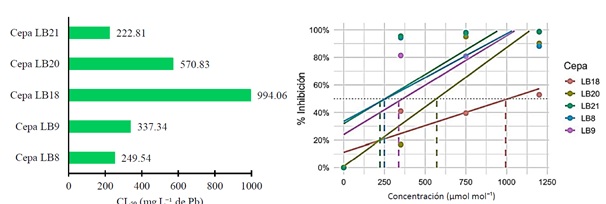
The presence of lead (Pb) in agricultural soils of banana-growing areas poses risks to the environment, health, and economy of Ecuador; therefore, the use of native soil microorganisms for the immobilization of this metal is essential. The potential of native bacteria as agents capable of reducing Pb concentrations in a plantation in the Valencia canton was evaluated. Twenty-seven samples were collected, and Pb-resistant bacteria were isolated and characterized using biochemical and morphological tests, as well as by evaluating their antibiotic resistance and growth at Pb concentrations of 350, 750, and 1200 mg L–¹. Bacterial consortia with high tolerance to the metal were formed and inoculated into soils in the study area. The physiology of banana seedlings was monitored for 90 days as an indicator of soil health, and physicochemical analyses were performed to determine the apparent reduction in Pb. The soil showed Pb levels exceeding the agricultural limit (119.33 and 106.08 mg kg-1) with a pH of 5.78–5.96. Pseudomonas spp. and Bacillus spp. exhibited lead tolerance, with LB18 and LB20 showing the best growth
and CL₅₀ de 994.06 y 570.83 mg L-1, respectively. The mixed consortium promoted
the greatest plant growth (23.73 cm; ≈7 leaves) and reduced the negative response to the metal, achieving the highest apparent reduction in Pb (88.58%), demonstrating the ef fectiveness of these microbial communities as a sustainable biotechnological strategy for soil restoration and the preservation of banana productivity.
Downloads
References
Abbas, S. Z., Rafatullah, M., Ismail, N., Lalung, J., & Hashim, R. (2018). Bioremediation of heavy metals using consortia of Pseudomonas spp. and Bacillus spp. in contaminated soils. Environmental Technology & Innovation, 10(3), 1–12. https://doi.org/10.1016/j.eti.2018.01.004
Alvarado-Campo, K. L., Quintero, M., Cuadrado-Cano, B., Montoya-Giraldo, M., Otero-Tejada, E. L., Blandón, L., Sánchez, O., Zuleta-Correa, A., & Gómez-León, J. (2023). Heavy metal tolerance of microorganisms isolated from coastal marine sediments and their lead removal potential. Microorganisms, 11(11), 2708. https://doi.org/10.3390/microorganisms11112708
Azubuike, C. C., Chikere, C. B., & Okpokwasili, G. C. (2016). Técnicas de biorremediación: clasificación según el lugar de aplicación: principios, ventajas, limitaciones y perspectivas. World Journal of Microbiology and Biotechnology, 32(11), 180. https://doi.org/10.1007/s11274-016-2137-x
Balasubramanian, V., Vashisht, A., Sharma, P., & Choudhary, M. (2020). Assessment of physiological and morphological responses of plants under metal toxicity stress. Scientific Reports, 10(1), 13987. https://doi.org/10.1038/s41598-020-70747-8
Breidenstein, E. B. M., de la Fuente-Núñez, C., & Hancock, R. E. W. (2011). Pseudomonas aeruginosa: all roads lead to resistance. Trends in Microbiology, 19(8), 419–426.
Cabezas, G. (2024, March 7). Top exporters lead stable global banana market in 2023. Tridge. https://www.tridge.com/stories/top-exporters-lead-stable-global-banana-market-in-2023
Cedeño, A. V., & Canchignia, H. F. (2022). Empleo de bacterias como alternativa de biorremediación en suelos contaminados con mercurio (Hg), zinc (Zn), aluminio (Al) y cobre (Cu). Universidad Técnica Estatal de Quevedo. https://repositorio.uteq.edu.ec/server/api/core/bitstreams/9e6fcbd3-980b-4af9-a192-306979d84fb1/content
Coleman, N. V., & Gillieatt, B. F. (2024). Unravelling the mechanisms of antibiotic and heavy metal resistance co-selection in environmental bacteria. FEMS Microbiology Reviews, 48(4), fuaa017. https://doi.org/10.1093/femsre/fuaa017
Cruz Cárdenas, C. I., Zelaya Molina, L. X., Sandoval Cancino, G., de los Santos Villalobos, S., Rojas Anaya, E., Chávez Díaz, I. F., & Ruiz Ramírez, S. (2021). Utilización de microorganismos para una agricultura sostenible en México: consideraciones y retos. Revista Mexicana de Ciencias Agrícolas, 12(5), 899–913. https://doi.org/10.29312/remexca.v12i5.2905
Cui, J., Li, H., Shi, Y., Zhang, F., Hong, Z., Fang, D., Jiang, J., Wang, Y., & Xu, R. (2024). Influence of soil pH and organic carbon content on the bioaccessibility of lead and copper in four spiked soils. Environmental Pollution, 360, 124686. https://doi.org/10.1016/j.envpol.2024.124686
Dar, M. A., & Kaushik, G. (2023). Biodegradation of malathion in amended soil by indigenous novel bacterial consortia and analysis of degradation pathway. Soil Systems, 7(4), 81. https://doi.org/10.3390/soilsystems7040081
FAO, ITPS, GSBI, CDB, & CE. (2021). Estado del conocimiento sobre la biodiversidad del suelo: Situación, desafíos y potencialidades. Resumen para los formuladores de políticas. Roma, FAO. https://openknowledge.fao.org/server/api/core/bitstreams/475c4c8a-3bb0-4e6d-b52a-fb0758bdcc61/content https://doi.org/10.4060/cb1929es
González-Henao, S., & Ghneim-Herrera, T. (2021). Heavy metals in soils and the remediation potential of bacteria associated with the plant microbiome. Frontiers in Environmental Science, 9, 604216. https://doi.org/10.3389/fenvs.2021.604216
Gram, C. (1884). Ueber die isolirte Färbung der Schizomyceten in Schnitt- und Trockenpräparaten. Fortschritte der Medicin, 2, 185–189.
Gul, I., Adil, M., Lv, F., Li, T., Chen, Y., Lu, H., Ahamad, M. I., Lu, S., & Feng, W. (2024). Microbial strategies for lead remediation in agricultural soils and wastewater: mechanisms, applications, and future directions. Frontiers in Microbiology, 15. https://doi.org/10.3389/fmicb.2024.1434921
Haruna, F. A., Yusuf, M. R., Usman, S., Shehu, D., Babagana, K., Sufyanu, A. J., … Yakasai, H. M. (2023). Bioremediation of lead contaminated environment by Bacillus cereus strain BUK_BCH_BTE2: Isolation and characterization of the bacterium. Case Studies in Chemical and Environmental Engineering, 8, 100540. https://doi.org/10.1016/j.cscee.2023.100540
Islam, M. N., Ganguli, S., Saha, N., Huda, M. M., Hoque, M. A., Peng, C., & Ng, J. C. (2024). Uncovering the impact of mega-scale shipbreaking yards on soil and crop quality in Bangladesh: A spatiotemporal dynamics and associated health risks of metal/loid contamination. Journal of Hazardous Materials, 464, 132931. https://doi.org/10.1016/j.jhazmat.2023.132931
Instituto Espacial Ecuatoriano (IEE). (2013). Memoria técnica: Cantón Valencia — Geopedología [PDF]. Geoportal IGM. https://www.geoportaligm.gob.ec/geodescargas/valencia/mt_valencia_geopedologia.pdf
Instituto Nacional de Estadística y Censos (INEC). (2024). Encuesta de Superficie y Producción Agropecuaria Continua (ESPAC) — Presentación de resultados [PowerPoint]. ESPAC. https://www.ecuadorencifras.gob.ec/documentos/web-inec/Estadisticas_agropecuarias/espac/2024/Presentacion_de_resultados_ESPAC_2024.pdf
Jimoh, F. A., Ajao, A. T., Aborisade, W. T., & Abdulsalam, Z. B. (2025). Co-selection of antibiotic resistance and heavy metal tolerance in bacterial species isolated from automobile scrapyard soils. World Journal of Microbiology and Biotechnology, 41(5), 1-12.
Kaur, H., Sharma, R., & Singh, P. (2021). Mechanisms of heavy metal resistance in soil bacteria: Implications for bioremediation. Frontiers in Microbiology, 12, 678910. https://doi.org/10.3389/fmicb.2021.678910
Khalid, A., Maqbool, H., Khan, I., Khan, B., Naz, I., Qayyum, S. A., ... & Chaudhary, H. J. (2025). Assessment of microbial remediation potential of indigenous bacterial and fungal communities for toxic heavy metal sequestration. Environmental Geochemistry and Health, 47(11), 1-48.
King, E. O., Ward, M. K., & Raney, D. E. (1954). Two simple media for the demonstration of pyocyanin and fluorescin. The Journal of Laboratory and Clinical Medicine, 44(2), 301–307.
Kumar, A., Kumar, A., Cabral-Pinto, M. M. S., Chaturvedi, A. K., Shabnam, A. A., Gangavarapu, S., … Yadav, K. K. (2020). Toxicidad del plomo: riesgos para la salud, influencia en la cadena alimentaria y estrategias de remediación sostenibles. International Journal of Environmental Research and Public Health, 17(7), 2179. https://doi.org/10.3390/ijerph17072179
León-Armijos, F. L., Espinoza-Aguilar, M. A., Carvajal-Romero, H. R., & Quezada-Campoverde, J. M. (2022). Análisis económico de la producción bananera orgánica y convencional de la parroquia La Iberia. Polo del Conocimiento, 7(1), 1404–1420. https://doi.org/10.23857/pc.v7i1.3552
Lin, D., Ouyang, Y., Huang, C. H., & Huang, D. Y. (2010). Characterization of heavy metals from banana farming soils. CLEAN — Soil, Air, Water, 38(5–6), 430–436. https://doi.org/10.1002/clen.201000020
Lu, X., Yang, Q., Wang, H., & Zhu, Y. (2023). A global meta-analysis of the correlation between soil physicochemical properties and lead bioaccessibility. Journal of Hazardous Materials, 453, 131440. https://doi.org/10.1016/j.jhazmat.2023.131440
Mendoza, M., Lozano, J., Nieto, F., & Guamán, R. (2022). Génesis y dinámica climática de los ecosistemas tropicales de Los Ríos, Ecuador. Revista Climatología Latinoamericana, 23, 117–124. https://doi.org/10.59427/rcli/2023/v23.117-124
Ministerio del Ambiente del Ecuador. (2015). Norma de calidad ambiental del recurso suelo y criterios de remediación para suelos contaminados: Libro VI, Anexo 2 (TULSMA, apartado 4.2.2, tabla 3). https://faolex.fao.org/docs/pdf/ecu112181.pdf
Naik, M. M., & Dubey, S. K. (2013). Lead-resistant bacteria: Lead resistance mechanisms, their applications in bioremediation and biomonitoring. Ecotoxicology and Environmental Safety, 98, 1–7.
Organisation for Economic Co-operation and Development. (2006). OECD guideline for the testing of chemicals, section 227: Terrestrial plant test: Vegetative vigour test. OECD Publishing. https://doi.org/10.1787/9789264067295-en
Panigrahi, N., Thompson, A. J., Zubelzu, S., & Knox, J. W. (2021). Identifying opportunities to improve management of water stress in banana production. Scientia Horticulturae, 276, 109735. https://doi.org/10.1016/j.scienta.2020.109735
Pardo, R., Herguedas, M., Barrado, E., & Vega, M. (2003). Biosorption of cadmium, copper, lead and zinc by inactive biomass of Pseudomonas putida. Analytical and bioanalytical chemistry, 376(1), 26-32.
Pazmiño, J. (2016). Evaluación del potencial biorremediador de bacterias nativas en suelos contaminados [Tesis de pregrado, Universidad Técnica Estatal de Quevedo]. Repositorio UTEQ. https://repositorio.uteq.edu.ec/server/api/core/bitstreams/616d9e83-47e8-42eb-9806-bc46369742d5/content
Qiao, W., et al. (2019). Bioimmobilization of lead by Bacillus subtilis X3 biomass. Journal of Environmental Sciences, 80, 83–91.
Rashid, A., Schutte, B. J., Ulery, A., Deyholos, M. K., Sanogo, S., Lehnhoff, E. A., & Beck, L. (2023). Heavy metal contamination in agricultural soil: Environmental pollutants affecting crop health. Agronomy, 13(6), 1521. https://doi.org/10.3390/agronomy13061521
Rath, S., Sahu, M. C., Dubey, D., Debata, N. K., & Padhy, R. N. (2011). Which value should be used as the lethal concentration 50 (LC50) with bacteria?. Interdisciplinary Sciences: Computational Life Sciences, 3(2), 138-143.
Reiner, K. (2010). Catalase test protocol [Protocolo]. American Society for Microbiology. Recuperado de https://asm.org/protocols/catalase-test-protocol
Sharma, S., & Bhatt, R. (2023). Lead (Pb) toxicity in soils: Impacts on microbial communities and remediation strategies. Environmental Science and Pollution Research, 30(2), 1234–1250. https://doi.org/10.1007/s11356-022-23017-x
Science Buddies Staff. (2025). Measuring Plant Growth. Science Buddies. Recuperado de https://www.sciencebuddies.org/science-fair-projects/references/measuring-plant-growth
Soto, Z. G., Navarrete, A. M., Alarcón, A. V., Pelcastre, M. I., Torres, E. A., Méndez, J. P., & González, C. R. D. (2022). Aislamiento de consorcio bacteriano localmente adaptado a suelo con antecedentes de acetoclor: Isolation of bacterial consortium locally adapted to soil with a history of acetochlor. South Florida Journal of Development, 3(2), 2699–2707. https://doi.org/10.46932/sfjdv3n2-088
Vélez, J. M. B., et al. (2021). Bioremediation potential of Pseudomonas genus isolates: biosorption of lead by Pseudomonas spp. Biocatalysis and Agricultural Biotechnology, 35, 102049.
Vilela, J., & Abasolo, F. (2022). Bacterias biotransformadoras de hidrocarburos y metales pesados. Biotecnología Ambiental (92 pp.). Universidad Técnica Estatal de Quevedo, Ecuador.
Villacís, J., Zapata, M., León, F., Vásquez, L., Mullo, P., Zapata, G., & Gutiérrez, R. (2016). Compatibilidad y sobrevivencia de microorganismos beneficiosos en suelos agrícolas. Universidad Técnica Estatal de Quevedo. file:///C:/Users/Admin/Downloads/Dialnet-CompatibilidadYSobrevivenciaDeMicroorganismosBenef-7882145.pdf
Wang, Z., Li, Z., Gao, C., Jiang, Z., Huang, S., Li, X., & Yang, H. (2025). Bacillus subtilis as an excellent microbial treatment agent for environmental pollution: A review. Biotechnology Journal, 20(4), e70026.
Zakaria, A. T., Sakimin, S. Z., Ismail, M. R., Ahmad, K., & Kasim, S. (2024). Mejora del crecimiento y la resistencia de las plantas de banano a la enfermedad del marchitamiento por Fusarium según los compuestos de silicato y la frecuencia de aplicación. Plants, 13(4), 542. https://doi.org/10.3390/plants13040542
Zheng, L., Liu, J., Qian, X., & Chen, Y. (2021). Bioremediation of lead-contaminated soil using a bacterial consortium of Pseudomonas and Bacillus spp. Journal of Hazardous Materials, 409, 124959. https://doi.org/10.1016/j.jhazmat.2020.124959
Zuluaga, A. M., & Martínez, J. R. (2018). Diagnóstico de Helicobacter spp. en mucosa gástrica de equinos, mediante pruebas de actividad ureasa. Revista Científica Facultad de Ciencias Veterinarias, 28(1), 19–24. https://www.redalyc.org/journal/959/95955168003/html/