Comparación de Modelos Estadísticos para la Predicción del Nicho Ecológico de Fusarium oxysporum f. sp. cubense y su Implicaciónen la Fitosanidad de Suelos Agrícolas
DOI:
https://doi.org/10.28940/terralatinoamericana.v44i.2417Palabras clave:
aprendizaje automático, árboles de regresión aditivos bayesianos, enfermedad de Panamá, MaxEntResumen
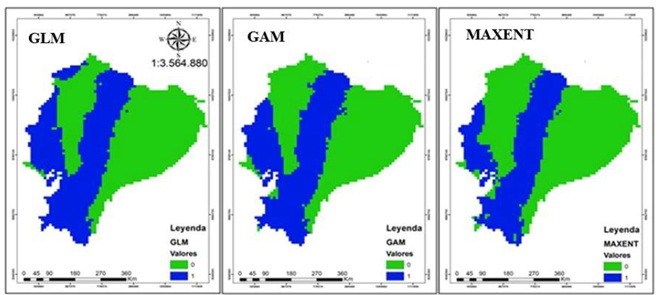
Es importante evaluar la eficacia de diferentes modelos de distribución de especies, ya que son instrumentos valiosos para predecir distribuciones futuras. Se evaluó la eficacia del modelo bayesiano, Bayesian Additive Regression Trees (BART), frente a modelos estadísticos: Generalized Linear Model (GLM), Generalized Additive Model (GAM) y algoritmos de aprendizaje automático: Random Forest (RF), Maximum Entropy Model (MaxEnt) y Boosted Regression Tree (GBM) para modelar la distribución potencial del patógeno Fusarium oxysporum f. sp. cubense en Ecuador continental, fitopatógeno de suelo que afecta significativamente la producción de banano. Se emplearon 92 registros de presencia de la especie y cuatro variables bioclimáticas (de WorldClim). Se obtuvieron los modelos a una resolución espacial de 10 × 10 km2, y fueron evaluados con diferentes métricas de rendimiento. Los mapas geográficos de probabilidad de presencia generados en R para cada modelo se exportaron a ArcGis, para elaborar mapas binarios y calcular el área de presencia y ausencia de la especie. La eficacia de los modelos varía significativamente según la métrica utilizada. A pesar de ello, el modelo Random Forest tuvo buen rendimiento en la mayoría de las métricas empleadas, principalmente en discriminación; sin embargo, el Modelo Lineal Generalizado presentó mejor precisión y confiabilidad, con una calibración excelente. Con MaxEnt se obtuvo la mayor área de presencia del fitopatógeno (106 800 km2). Todos los modelos mostraron consistentemente una favorabilidad ambiental > 0.90 en la región Sierra, asociado a las características geográficas, climáticas y ecológicas de la región, tales como la combinación de temperatura y humedad y la disponibilidad de hospederos. Los modelos demostraron su eficacia al predecir la distribución potencial de F. oxysporum; sin embargo, se sugiere continuar la investigación con un mayor número de registros de presencia. El estudio es relevante como línea base, especialmente al explorar modelos bayesianos (BART).
Descargas
Referencias
Ab Lah, N. Z., Yusop, Z., Hashim, M., & Mohd, J. 2021. Predicting the habitat suitability of Melaleuca cajuputi based on the MaxEnt species distribution model. Forests, 12(11), 1449. https://doi.org/10.3390/f12111449
Acurio, A., Rafael, V., & Dangles, O. 2010. Biological invasions in the Amazonian Tropical Rain Forest: the case of Drosophilidae (Insecta, Diptera) in Ecuador, South America. BIOTROPICA, 42(6), 717-723. https://www.jstor.org/stable/40891353
Ahmadi, M., Hemamii, M., Mahmoud, M., & Shabani, F. 2023. MaxEnt brings comparable results when the input data are MaxEnt brings comparable results when the input data are distribution models. Ecology and Evolution, 13(2), 1-13. https://doi.org/10.1002/ece3.9827
Araújo, M. B., & New, M. 2007. Ensemble forecasting of species distributions. Trends in Ecology & Evolution, 22(1), 42-47. https://doi.org/10.1016/j.tree.2006.09.010
Arellano, M. 2018. Detección de Fusarium oxysporum en cultivos de uvilla (Physalis peruviana L.) en la Sierra norte y centro del Ecuador. Tesis de Licenciatura. Pontificia Universidad Católica del Ecuador.
Burgess, L. W. 1981. General ecology of the Fusaria. In P. E. Nelson, T. A. Toussoun, & R. J. Cook (Eds.). Fusarium: diseases, biology, and taxonomy (pp. 225-235). Pennsylvania State University Press, University Park.
Carlson, C. J. 2020. embarcadero: Species distribution modelling with Bayesian additive regression trees in r. Methods in Ecology and Evolution, 11(7), 850-858. https://doi.org/10.1111/2041-210X.13389
Correll, J. C. 1991. The relationship between formae speciales, races, and vegetative compatibility groups in Fusarium oxysporum. Phytopathology, 81(9), 1061-1064.
Courtois, P., Figuieres, C., Mulier, C., & Weill, J. 2018. A Cost-benefit approach for prioritizing invasive species. Ecological Economics, 146, 607-620. https://doi.org/10.1016/j.ecolecon.2017.11.037
Elith, J., y Leathwick, J. 2017. Boosted Regression Trees for ecological modeling. R Documentation. Available online: https://cran. r-project. org/web/packages/dismo/vignettes/brt. pdf
Ferrer-Sánchez, Y., Jacho-Saa, W. R., Urdánigo Zambrano, J. P., Abasolo-Pacheco, F., Plasencia-Vázquez, A. H., Zambrano-Mero, G. J., Castillo-Macías, M. J., Muñoz Zambrano, K. T., Coveña-Rosado, A., & Estrella Bravo, G. V. 2022. Invasiones biológicas en agroecosistemas de Ecuador Continental: nicho ecológico de especies exóticas y cultivos agrícolas bajo riesgo. Acta Biológica Colombiana, 26(3), 352-364. https://doi.org/10.15446/abc.v26n3.81765
Fick, S. E., & Hijmans, R, J. 2017. WorldClim 2: new 1-km spatial resolution climate surfaces for global land areas. International Journal of Climatology, 37(12), 4302-4315. https://doi.org/10.1002/joc.5086
Guillera-Arroita, G., Lahoz-Monfort, J., Elith, J., Gordon, A., Kujala, H., Lentini, P., McCarthy, M., Tingley, R., & Wintle, B. 2015. Is my species distribution model fit forpurpose? Matching data and models to applications. Global Ecology and Biogeography, 24(3), 276-292. https://doi.org/10.1111/geb.12268
Hao, T., Elith, J., Lahoz, J., & Guillera, G. 2020. Testing whether ensemble modelling is advantageous for maximising predictive performance of species distribution models. Ecography, 43(4), 549-558. https://doi.org/10.1111/ecog.04890
Instituto Nacional de Estadística y Censos. 2021. Boletín Técnico: Encuesta de Superficie y Producción Agropecuaria Continua, 2020. Quito, Ecuador: Instituto Nacional de Estadística y Censos (INEC), Secretaria Nacional de Planificación y Desarrollo (SENPLADES), Dirección Producción de Estadística Agropecuarias y Ambientales (INEC) - InstQuito.
Kleemann, J., Koo, H., Hensen, I., Mendieta-Leiva, G., Kahnt, B., Kurze, C., Inclan, D. J., Cuenca, P., Noh, J. K., Hoffmann, M. H., Factos, A., Lehnert, M., Lozano, P., & Furst, C. 2022. Priorities of action and research for the protection of biodiversity and ecosystem services in continental Ecuador. Biological Conservation, 265, 109404. https://doi.org/10.1016/j.biocon.2021.109404
Konowalik, K., & Nosol, A. 2021. Evaluation metrics and validation of presence only species distribution models based on distributional maps with varying coverage. Scientific Reports, 11, 1482. https://doi.org/10.1038/s41598-020-80062-1
Kosicki, J. Z. 2020. Generalised Additive Models and Random Forest Approach as effective methods for predictive species density and functional species richness. Environmental and Ecological Statistics, 24, 273-292. https://doi.org/10.1007/s10651-020-00445-5
Linders, T., Schaffner, U., Eschen, R., Abebe, A., Simon, C., & Nigatu, L. 2019. Direct and indirect effects of invasive species: Biodiversity loss is a major mechanism by which an invasive tree affects ecosystem functioning. Journal of Ecology, 107(6), 2660-2672. https://doi.org/10.1111/1365-2745.13268
Norberg, A., Abrego, N., Blanchet, G., Adler, F., Anderson, B., Anttila, J., Araújo, M. B., Dallas, T., Dunson, D., Elith, J. et al. 2019. A comprehensive evaluation of predictive performance of 33 species distribution models at species and community levels. Ecological Monographs, 89(3), e01370.
Pearson, R. G., Thuiller, W., Araújo, M. B., Martinez-Meyer, E., Brotons, L., McClean, C., Miles, L., Segurado, P., Dawson, T. P., & Lees, D. C. 2006. Model-based uncertainty in species range prediction. Journal of Biogeography, 33, 1704–1711. https://doi.org/10.1111/j.1365-2699.2006.01460.x
Phillips, S. J., Anderson, R. P., Dudík, M., Schapire, R. E., & Blair, M. E. 2017. Opening the black box: an open-source release of Maxent. Ecography 40(7), 887-893.
Ron, S. R. R. 2005. Predicting the distribution of the amphibian pathogen Batrachochytrium dendrobatidis in the New World. BIOTROPICA, 37(2), 209-221.
RStudio Team. (2023). RStudio: Integrated Development for R. RStudio, PBC. https://www.rstudio.com/
Smith, S. N. 2007. An overview of ecological and habitat aspects in the genus Fusarium with special emphasis on the soil-borne pathogenic forms. Plant Pathology Bulletin, 16, 97-120.
Shabani, F., Kumar, L., & Ahmadi, M. 2016. A comparison of absolute performance of different correlative and mechanistic species distribution models in an independent area. Ecology and Evolution, 6(16), 5973-5986. https://doi.org/10.1002/ece3.2332
Sofaer, H., Jarnevich, C., Pearse, I., Smyth, R., & Auer, S. 2019. The development and delivery of species distribution models to inform decision-making. BioScience, 69(7), 544–557. https://doi.org/10.1093/biosci/biz045
Thakuri, S., Shrestha, P., Deuba, M., Shah, P., Bhandari, O., & Shrestha, S. 2019. Potential habitat modeling of water hyacinth in lakes of nepal using maxent algorithm. ISPRS Annals of the Photogrammetry, Remote Sensing and Spatial Information Science, 4(2), 103-110. https://doi.org/10.5194/isprs-annals-IV-5-W2-103-2019
Williams, J., Seo, Thorne, J., Nelson, J., & Erwin, S. 2009. Using species distribution models to predict new occurrences for rare plants. Diversity and Distributions, 15(4), 565-576. https://doi.org/10.1111/j.1472-4642.2009.00567.x
Wunderlich, R., Lin, Y. P., Anthony, J., & Petway, J. 2019. Two alternative evaluation metrics to replace the true skill statistic in the assessment of species distribution models. Nature Conservation, 35, 7-116. https://doi.org/10.3897/natureconservation.35.33918
Zurell, D., Franklin, J., König, C., Bouchet, P. J., Dormann, C. F., Elith, J., Fandos, G., & Feng, X. 2020. A standard protocol for reporting species distribution models. Ecography, 43(9), 1261-1277. https://doi.org/10.1111/ecog.04960