Relative Humidity and Nutrient Solution Concentration Af fect Cucumber (Cucumis sativus L.) Yield, Quality and Nutrient Status
DOI:
https://doi.org/10.28940/terra.v42i0.1968Keywords:
ionic balance, electrical conductivity, soilless crops, vapor pressure deficitAbstract
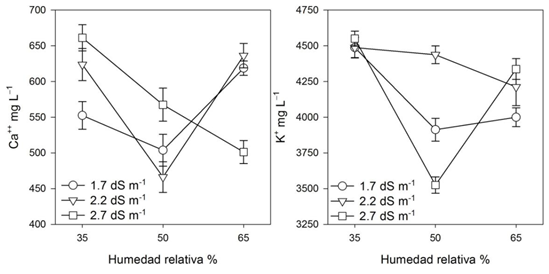
Most cucumber growers in low-tech greenhouse do not pay attention to air moisture ef fect on crops. Relative humidity (RH) af fects plant transpiration and nutrient translocation to the shoot, thereby, af fecting nutritional status. The present study determined whether the concentration of the nutrient solution af fects cucumbers plan´st growth in terms of electrical conductivity (CE) (1.7, 2.2 and 2.7 dS m-1) fruit yield and quality under dif ferent RH (35%, 50%, 65%). Compared to plants under RH 35%, yield increased by 14 and 17% when the humidity increased to 50 and 65%, respectively. However, this increase was more marked with nutrient solutions of low concentration (1.7 dS m-1). In high RH conditions (65%), NO3– (-21%), K+ (-16%), and Ca++ (-14%) concentration in the petiole extract decreased, while similar trends occurred in fruit with NO3– (-26%) and K+ (-13%). In contrast, Ca++ increased up to 24%. Relative humidity modified the balance among NO3–, K+ and Ca++, which is 19.3 optimal for K+/Ca++ in fruit and 8.7 for NO3–/Ca++ in the petiole. In conclusion cucumber produces higher fruit quality and yield when RH of the greenhouse is at 65% in combination with nutrient solutions of low concentration (1.7 dS m-1).
Downloads