Native Bacteria as a Sustainable Alternative for Serrano Pepper Yield

Authors

  • J. Guadalupe Luna-Ortega Universidad Politécnica de la Región Laguna
  • Tomás Juan Álvaro Cervantes-Vázquez Juarez University of the State of Durango image/svg+xml https://orcid.org/0000-0002-6968-4784
  • David Antonio Zúñiga-Gracia Universidad Politécnica de la Región Laguna
  • Pablo Preciado-Rangel Instituto Tecnológico de Torreón
  • J. Isabel Márquez-Mendoza Universidad Autónoma Agraria Antonio Narro image/svg+xml
  • Aaron David Lugo-Palacios Juarez University of the State of Durango image/svg+xml
  • Miguel Ángel Gallegos-Robles Juarez University of the State of Durango image/svg+xml

DOI:

https://doi.org/10.28940/terralatinoamericana.v43i.2156

Keywords:

Biofertilizers, capsaicin, fitohormones

Abstract

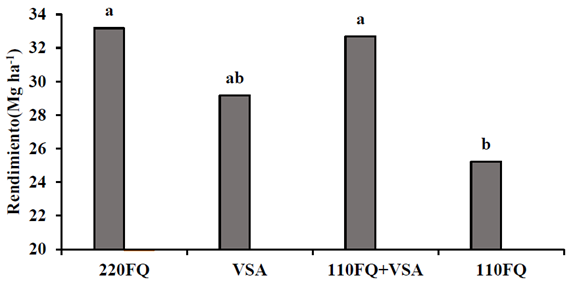
The chili fruit (Capsicum annuum L.) is widely consumed for its rich nutrient content and health benefits, making it an essential component of a healthy diet. Despite these benefits, conventional production systems can cause ecological issues, including greenhouse gas emissions and increased soil salinity. This highlights the need for sustainable farming practices. This research evaluated the impact of bioinoculation with native strains of Bacillus velezensis, Bacillus subtilis, and Azospirillum brasilensis, on the yield and bioactive compound content of serrano chili fruits in the Comarca Lagunera. Bioinoculation with native strains, combined with a 50% reduction in chemical fertilization, produced similar results to those obtained with full chemical fertilization in terms of fruit weight with 6.07 g and 6.15 g respectively, in terms of yield 33 Mg ha-1 and 32 Mg ha-1, amount of phenols 6.27 mg AG 100 g-1 BF and 6.56 mg AG 100 g-1, vitamin C 0.82 mg g-1 BF and 1.10 mg g-1 BF while for capsaicin 269.25 µg g-1 of BS and 274.75 µg g-1 of BS in the same order. The results demonstrate that this methodology can be a sustainable alternative, allowing for a decrease in chemical fertilizer use while promoting soil health through the bioinoculation of native bacteria, which are ef fective when adapted to abiotic stress factors.

Downloads
Download data is not yet available.

Author Biographies

  • J. Guadalupe Luna-Ortega, Universidad Politécnica de la Región Laguna

    Researcher.

  • Tomás Juan Álvaro Cervantes-Vázquez, Juarez University of the State of Durango

    Researcher.

  • David Antonio Zúñiga-Gracia, Universidad Politécnica de la Región Laguna

    Researcher.

  • Pablo Preciado-Rangel, Instituto Tecnológico de Torreón

    Researcher.

  • J. Isabel Márquez-Mendoza, Universidad Autónoma Agraria Antonio Narro

    Researcher.

  • Aaron David Lugo-Palacios, Juarez University of the State of Durango

    Researcher.

  • Miguel Ángel Gallegos-Robles, Juarez University of the State of Durango

    Researcher.

Downloads

Published

30-04-2025

Issue

Section

Scientific Papers

How to Cite

Native Bacteria as a Sustainable Alternative for Serrano Pepper Yield. (2025). TERRA LATINOAMERICANA, 43. https://doi.org/10.28940/terralatinoamericana.v43i.2156

Most read articles by the same author(s)

1 > >>