Ef fect of Protein Hydrolysates and Diatomaceous Soil as Biostimulants on Hydroponic Grape Tomato
DOI:
https://doi.org/10.28940/terralatinoamericana.v44i.2502Keywords:
biostimulation, silicon, soilless cultivation, Solanum lycopersicumAbstract
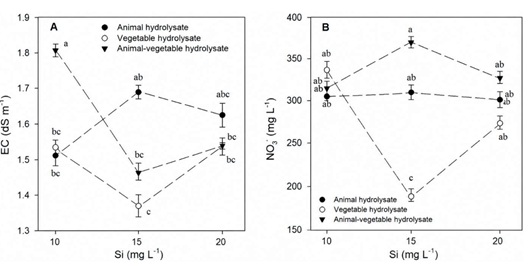
The search for non-microbial biostimulants to optimize sustainable hydroponic production is a rapidly expanding research area; however, the synergistic ef fect between protein hydrolysates and silicon (Si) in horticultural crops has not yet been fully elucidated. This study evaluated the biostimulant ef fect of the combined application of three protein hydrolysates (animal, plant, and mixed-origin) and three Si concentrations (10, 15, and 20 mg L-1) on growth, yield, and net CO₂ assimilation rate of grape tomato plants (Solanum lycopersicum L.) grown in a hydroponic system, as well as on the chemical characteristics of the substrate and leachate. A randomized complete block design with a 3 × 3 factorial arrangement was used, with four replications. Results showed that the plant-derived hydrolysate exhibited the greatest biostimulant potential by increasing biomass production, fruit size, weight, yield, and net photosynthetic rate, while reducing total soluble solids. Si increased net CO₂ assimilation at 20 mg L-1 without af fecting fruit size or yield. In the substrate, the plant-derived hydrolysate raised pH and decreased electrical conductivity and nitrate levels, suggesting greater nitrogen use ef ficiency. Potassium was not influenced by the hydrolysate but was af fected by Si doses, particularly at 10 and 20 mg L-1. No significant interactions between the two factors were detected for most evaluated variables. The application of plant-derived protein hydrolysate enhances grape tomato growth and yield, promoting a more stable root-zone environment and greater ef ficiency in nitrate assimilation.
Downloads
References
Aguilar-Luna, J. M., Hernández-Vargas, L., & Hernández-Ángel, R. (2025). Root bio-stimulation and solar radiation in Coffea arabica L. plants at the nursery stage. Mesoameric Agronomy, 36(1). doi.org/10.15517/am.2024.59975
Anchondo-Páez, J., Sánchez-Chávez, E., Abel Ramírez-Estrada, C., Salcido-Martínez, A., Humberto Ochoa-Chaparro, E., and Muñoz-Márquez, E. (2024). Effectiveness of Silicon Nanoparticles and Codasil® as Potential Biostimulants in Snap Bean. Terra Latinoamericana, 42. doi.org/10.28940/terra.v42i0.1885
Azad, M. O. K., Park, B. S., Adnan, M., Germ, M., Kreft, I., Woo, S. H., & Park, C. H. (2021). Silicon biostimulant enhances the growth characteristics and fortifies the bioactive compounds in common and Tartary buckwheat plant. Journal of Crop Science and Biotechnology, 24(1), 51-59. https://doi.org/10.1007/s12892-020-00058-1
Beckles, D. M. (2012). Factors affecting the postharvest soluble solids and sugar content of tomato (Solanum lycopersicum L.) fruit. Postharvest Biology and Technology, 63(1), 129-140. https://doi.org/10.1016/j.postharvbio.2011.05.016
Campos, H., Mancera, A. V., Trejo, C., Quintana, F. U., García, T. C., García-Díaz, S. E., ... & Parada, J. R. B. (2024). Gas exchange and its relationship with chlorophyll fluorescence in bell pepper plants (Capsicum annuum L.) under water stress. Agricultural and Livestock Record, 10(1), 1. https://doi.org/10.30973/aap/2024.10.0101001
Carillo, P., Pannico, A., Cirillo, C., Ciriello, M., Colla, G., Cardarelli, M., De Pascale, S., & Rouphael, Y. (2022). Protein Hydrolysates from Animal or Vegetal Sources Affect Morpho-Physiological Traits, Ornamental Quality, Mineral Composition, and Shelf-Life of Chrysanthemum in a Distinctive Manner. Plants, 11(17), 2321. https://doi.org/10.3390/plants11172321
Casadesús, A., Pérez-Llorca, M., Munné-Bosch, S., & Polo, J. (2020). An enzymatically hydrolyzed animal protein-based biostimulant (Pepton) increases salicylic acid and promotes growth of tomato roots under temperature and nutrient stress. Frontiers in Plant Science, 11, 953. https://doi.org/10.3389/fpls.2020.00953
Casbis, G. M., Torres, Ó. G. V., Rodríguez, M. A., & Nava, H. S. (2022). Physical and chemical properties of substrates according to their granulometry and organic-mineral component. Agricultural and Livestock Record https://doi.org/10.30973/aap/2022.8.0081007
Cerdán, M., Sánchez-Sánchez, A., Oliver, M., Juárez, M., & Sánchez-Andreu, J. J. (2009). Effect of foliar and root applications of amino acids on iron uptake by tomato plants. Acta Horticulturae, 830, 481-488. https://doi.org/10.17660/ActaHortic.2009.830.68
Chura-Chuquija, J., & Montero Ravelo, A. A. (2025). Fish hydrolysate with homolactic fermentation in purple corn (Zea mays L.) in La Molina. Applied Ecology, 24(1), 35-45. doi.org/10.21704/rea.v24i1.2275
Colla, G., Cardarelli, M., Bonini, P., & Rouphael, Y. (2017b). Foliar applications of protein hydrolysate, plant and seaweed extracts increase yield but differentially modulate fruit quality of greenhouse tomato. HortScience, 52(9), 1214-1220. https://doi.org/10.21273/HORTSCI12200-17
Consentino, B. B., Virga, G., La Placa, G. G., Sabatino, L., Rouphael, Y., Ntatsi, G., Iapichino, G., D’Anna, F., Consentino, S. L., & Sabatino, P. (2020). Celery (Apium graveolens L.) performances as subjected to different sources of protein hydrolysates. Plants, 9(12), 1633. https://doi.org/10.3390/plants9121633
Costan, A., Stamatakis, A., Chrysargyris, A., Petropoulos, S. A., & Tzortzakis, N. (2020). Interactive effects of salinity and silicon application on Solanum lycopersicum growth, physiology and shelf‐life of fruit produced hydroponically. Journal of the Science of Food and Agriculture, 100(2), 732-743. https://doi.org/10.1002/jsfa.10077
Cruz, J. C. C., & Martínez-Trinidad, T. (2025). Potential of the use of biostimulants in urban tree management. Mexican Journal of Forest Sciences, 16, 91. doi.org/10.29298/rmcf.v16i91.1575
Czelej, M., Garbacz, K., Czernecki, T., Wawrzykowski, J., & Waśko, A. (2022). Protein Hydrolysates Derived from Animals and Plants—A Review of Production Methods and Antioxidant Activity. Foods, 11 (13), 1953. https://doi.org/10.3390/foods11131953
Dehghanipoodeh, S., Ghobadi, C., Baninasab, B., Gheysari, M., & Bidabadi, S. S. (2016). Effects of potassium silicate and nanosilica on quantitative and qualitative characteristics of a commercial strawberry (Fragaria x ananassa cv. ‘Camarosa’). Journal of Plant Nutrition, 39(4), 502-507. https://doi.org/10.1080/01904167.2015.1086789
Dhanasekaran, P., Chittibabu, S., Mouzeyar, S., Boulaflous-Stevens, A., Delattre, C., & Roche, J. (2025). From waste to wonder: The potential of protein hydrolysates as plant biostimulants in agriculture. Bioresource Technology Reports, 32, 102333. https://doi.org/10.1016/j.biteb.2025.102333
du Jardin, P. (2015). Plant biostimulants: definition, concept, main categories and regulation. Scientia Horticulturae, 196, 3-14. https://doi.org/10.1016/j.scienta.2015.09.021
Galindo, J., González, N., Marrero, Y., Rodríguez, M., & Herrera, M. (2024). Saccharomyces cerevisiae hydrolyzate: its effect on the in vitro ruminal microbial population of star grass (cynodon nlemfuensis). Cuban Journal of Agricultural Science, 58, cu-id.
Hernández Valencia, R. D., Juárez Maldonado, A., Pérez Hernández, A., Lozano Cavazos, C. J., Zermeño González, A., & González Fuentes, J. A. (2022). Influence of organic fertilizers and silicon on the physiology, yield, and nutraceutical quality of strawberry crops. Nova Scientia, 14(28). doi.org/10.21640/ns.v14i28.3032
Hernández-Juárez, A., Ruiz-Aguilar, M. Y., Aguirre-Uribe, L. A., Ramírez-Barrón, S. N., Pérez-Luna, Y. del C., & Castro-del Ángel, E. (2024). El papel biológico del silicio en cultivos agrícolas: su contribución al control de plagas y enfermedades: Silicio: Defensa Biológica Agrícola. Revista Mexicana De Agroecosistemas, 11(1). https://doi.org/10.60158/rma.v11i1.421
Jarosz, Z. (2014). The effect of silicon application and type of medium on yielding and chemical composition of tomato. Acta Scientiarum Polonorum Hortorum Cultus, 13(4), 171-183.
Junior, L. A. Z., Fontes, R. L. F., Neves, J. C. L., Korndörfer, G. H., & Ávila, V. T. (2010). Rice grown in nutrient solution with doses of manganese and silicon. Revista Brasileira de Ciência do Solo, 34(5), 1629-1639. https://doi.org/10.1590/S0100-06832010000500015
Koukounaras, A. (2021). Advanced Greenhouse Horticulture: New Technologies and Cultivation Practices. Horticulturae, 7, 1. https://dx.doi.org/10.3390/horticulturae7010001
Liang, Y., Sun, W., Zhu, Y. G., & Christie, P. (2007). Mechanisms of silicon-mediated alleviation of abiotic stresses in higher plants: a review. Environmental Pollution, 147(2), 422-428. https://doi.org/10.1016/j.envpol.2006.06.008
Lozano, W. A. P., Almeida, L. E. H., Molina, J. A. A., Reyes, C. M. Z., & López, I. A. M. (2025). Impact of MicroRNAs on the Epigenetic Regulation of Abiotic Stress in Cultivated Plants: A Critical Review and Biotechnological Perspectives. Ibero-American Journal of Education, 9(3), 69-94. doi.org/10.31876/rie.v9i3.319
Lucini, L., Rouphael, Y., Cardarelli, M., Bonini, P., Baffi, C., & Colla, G. (2018). A Vegetal Biopolymer-Based Biostimulant Promoted Root Growth in Melon While Triggering Brassinosteroids and Stress-Related Compounds. Front. Plant Sci. 9, 472. doi: 10.3389/fpls.2018.00472
Marodin, J. C., Resende, J. T. V., Morales, R. G. F., Silva, M. D. L., Galvão, A. G., & Zanin, D. S. (2014). Yield of tomato fruits in relation to silicon sources and rates. Horticultura Brasileira, 32(2), 220-224. https://doi.org/10.1590/S0102-05362014000200018
Martínez-Gutiérrez, A., Zamudio-González, B., Galvão, J. C. C., Espinosa-Calderón, A., Tadeo-Robledo, M., Vázquez-Alarcón, A., & Villegas-Aparicio, Y. (2022). Effect of foliar amino acids on nutrient uptake and removal in maize. Mexican Journal of Agronomy, 45(2), 173-181. https://doi. org/10.35196/rfm
Matsumiya, Y., & Kubo, M. (2011). Soybean Peptide: Novel Plant Growth Promoting Peptide from
Soybean, Soybean and Nutrition, Prof. Hany El-Shemy (Ed.), ISBN: 978-953-307-536-5, InTech, Available
Meléndez, R. M., Ramírez, A. A., Montejo, N. C., López, A. M., & Pérez, M. C. L. (2024). Ascophyllum Nodosum and Calcium Nitrate as Biostimulants in the Development and Yield of Tomato Cultivation. Ciencia Latina: Multidisciplinary Journal, 8(1), 1574-1589. doi.org/10.37811/cl_rcm.v8i1.9553
Mishra, M., Arukha, A.P., Bashir, T., Yadav, D. & Prasad G.B.K.S. (2017) All New Faces of Diatoms: Potential Source of Nanomaterials and Beyond. Front. Microbiol. 8:1239. doi: 10.3389/fmicb.2017.01239
Pasković, I., Popović, L., Pongrac, P., Polić Pasković, M., Kos, T., Jovanov, P., & Franić, M. (2024). Protein hydrolysates—Production, effects on plant metabolism, and use in agriculture. Horticulturae, 10(10), 1041. https://doi.org/10.3390/horticulturae10101041
Perez, L. F. A., & Herrera, E. C. (2020). Effect of silicon on tomato production in semi-controlled conditions in the Colombian Caribbean. Journal of Applied Biotechnology & Bioengineering, 7(5), 191-194. DOI: 10.15406/jabb.2020.07.00233
Qi, Y., Wei, W., Chen, C., & Chen, L. (2019). Plant root-shoot biomass allocation over diverse biomes: A global synthesis. Global Ecology and Conservation, 18, e00606. https://doi.org/10.1016/j.gecco.2019.e00606
Ramos Abad, A. S., Campos Albornoz, M. E., Condor Pérez, A. E., Toribio Ayala, C. N., & Rueda Castro, H. D. (2025). Effect of biostimulants on pre-basic potato seeds obtained from in vitro seedlings. Alfa Journal of Research in Agronomic and Veterinary Sciences, 9(26), 398-410. doi.org/10.33996/revistaalfa.v9i26.354
Rouphael, Y., Colla, G., Giordano, M., El-Nakhel, C., Kyriacou, M. C., & De Pascale, S. (2017). Foliar applications of a legume-derived protein hydrolysate elicit dose-dependent increases of growth, leaf mineral composition, yield and fruit quality in two greenhouse tomato cultivars. Scientia Horticulturae, 226, 353-360. https://doi.org/10.1016/j.scienta.2017.09.002
Saltos, J. J. S., Troya, F. J. M., Aguilera, R. A. V., Sánchez, N. L. M., & Gómez, K. D. G. (2025). Evaluation of the impact of organic silicon on the vegetative development and productivity of soybean crops. Knowledge Hub, 10(6), 799-821. doi.org/10.23857/pc.v10i6.9676
Sánchez, S. P. A. (2024). Characterization of bioactive peptides derived from plant proteins and their antioxidant effect in functional foods in Ecuador. Ibero-American Journal of Health Science Research, 4(2), 270-277. doi.org/10.56183/iberojhr.v4i2.683
Suarez, L. M., Salcedo, J. G., & Zapata, J. E. (2022). Biological activity of Venezuelan cassava leaf hydrolysates obtained with different microbial enzymes. Techological information, 33(2), 77-88. doi.org/10.4067/S0718-07642022000200077
Sun, W., Shahrajabian, M. H., Kuang, Y., & Wang, N. (2024). Amino acids biostimulants and protein hydrolysates in agricultural sciences. Plants, 13(2), 210. https://doi.org/10.3390/plants13020210
Tejada Vizcarra, J. C., Tirado Rebaza, L. U. M., Mamani Huarcusi, J. M., Apaza Atencio, J. A., Muñante Carrillo, K. A., & Gomez Aguilar, Y. D. (2025). Effect of fish waste hydrolysate on the cultivation of curly lettuce (Lactuca sativa) in Tacna, Peru. Journal of Agricultural and Natural Resources Research and Innovation, 12(1), 13-22. https://doi.org/10.53287/ozyq5541hg24i.
Ugolini, L., Cinti, S., Righetti, L., Stefan, A., Matteo, R., D’Avino, L., & Lazzeri, L. (2015). Production of an enzymatic protein hydrolyzate from defatted sunflower seed meal for potential application as a plant biostimulant. Industrial Crops and Products, 75, 15-23. https://doi.org/10.1016/j.indcrop.2015.04.007
Wang, L., & Ruan, Y. L. (2016). Shoot–root carbon allocation, sugar signalling and their coupling with nitrogen uptake and assimilation. Functional Plant Biology, 43(2), 105-113. https://doi.org/10.1071/FP15249
Xu, L., & Geelen, D. (2018). Developing biostimulants from agro-food and industrial by-products. Front. Plant Sci. 9:1567. https://doi.org/10.3389/fpls.2018.01567
Yakhin, O. I., Lubyanov, A. A., Yakhin, I. A., & Brown, P. H. (2017). Biostimulants in plant science: a global perspective. Frontiers in Plant Science, 7, 2049. https://doi.org/10.3389/fpls.2016.02049
Zhu, Y., & Gong, H. (2014). Beneficial effects of silicon on salt and drought tolerance in plants. Agronomy for Sustainable Development, 34(2), 455-472. https://doi.org/10.1007/s13593-013-0194-1