Glomeromycotina Guild Spore Abundance Correlates with Soil Organic Carbon in Homegardens and Seasonal Forests in Yucatan, Mexico

Authors

  • Sergio Manrique-Caamal Autonomous University of Yucatán image/svg+xml
  • Héctor Estrada-Medina Autonomous University of Yucatán image/svg+xml
  • Juan J. Jiménez-Osornio Autonomous University of Yucatán image/svg+xml
  • Michael F. Allen University of California Riverside
  • Edith B. Allen University of California Riverside
  • Roberto C. Barrientos-Medina Autonomous University of Yucatán image/svg+xml
  • Oscar O. Álvarez-Rivera Centro de Investigación Científica de Yucatán.

DOI:

https://doi.org/10.28940/terra.v42i0.1812

Keywords:

arbuscular mycorrhizal fungi, edaphophilic fungi, rhizophilic fungi

Abstract

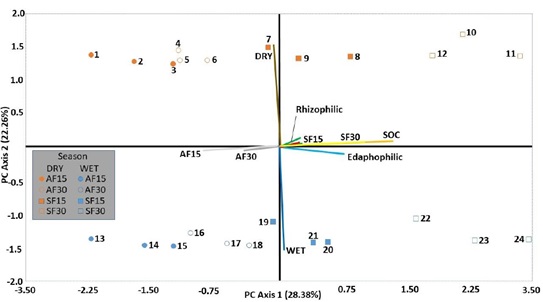
Soil organic carbon (SOC) is a key indicator of soil health. Arbuscular mycorrhizal fungi (AMF) have been shown to increase SOC and respond to SOC content, which in turn, is directly related to land use. We investigated the relationships between land use and Glomeromycotina AMF spore abundance of two AMF functional guilds, rhizophilic (having high root internal AMF hyphal length) and edaphophilic (with high external soil hyphal length) to SOC content in agroforestry systems (AS) and seasonal forest (SF) of Tzucacab, Yucatan, Mexico. Our results indicate greater SOC values in SF than AS of the same age with a trend of increasing SOC with system age. Rhizophilic spore abundance correlated with SOC content, showing dif ferences among land uses and system ages but not between seasons. No relationship was observed between edaphophilic spore abundance to SOC. Thus, we suggest that Glomeromicotyna spore abundance (measured at any time of the year) of rhizophilic fungi could be a good indicator of SOC and, a tool to monitor soil health due to land use changes.

Downloads
Download data is not yet available.

Author Biographies

  • Sergio Manrique-Caamal, Autonomous University of Yucatán

    Departamento de Manejo y Conservación e Recursos Naturales Tropicales. Campus de Ciencias Biológicas y Agropecuarias, Universidad Autónoma de Yucatán, Carretera Mérida-Xmatkuil Km. 15.5, 97315 Mérida, Yucatán, México.

    Bachelor´s student

  • Héctor Estrada-Medina, Autonomous University of Yucatán

    Departamento de Manejo y Conservación e Recursos Naturales Tropicales. Campus de Ciencias Biológicas y Agropecuarias, Universidad Autónoma de Yucatán, Carretera Mérida-Xmatkuil Km. 15.5, 97315 Mérida, Yucatán, México.

    Proffesor-Researcher

  • Juan J. Jiménez-Osornio, Autonomous University of Yucatán

    Departamento de Manejo y Conservación e Recursos Naturales Tropicales. Campus de Ciencias Biológicas y Agropecuarias, Universidad Autónoma de Yucatán, Carretera Mérida-Xmatkuil Km. 15.5, 97315 Mérida, Yucatán, México.

    Proffesor-Researcher

  • Michael F. Allen, University of California Riverside

    Department of Microbiology and Plant Pathology, University of California Riverside, 900 University Ave. Riverside, CA 92521.

    Proffesor

  • Edith B. Allen, University of California Riverside

    Department of Botany and Plant Sciences, University of California Riverside, 900 University Ave. Riverside, CA 92521.

    Proffessor

  • Roberto C. Barrientos-Medina, Autonomous University of Yucatán

    Departamento de Ecología. Campus de Ciencias Biológicas y Agropecuarias, Universidad Autónoma de Yucatán, Carretera Mérida-Xmatkuil Km. 15.5, 97315 Mérida, Yucatán, México.

    Profesor

  • Oscar O. Álvarez-Rivera, Centro de Investigación Científica de Yucatán.

    Unidad de Biotecnología. Centro de Investigación Científica de Yucatán. Calle 43 No. 130 Chuburná de Hidalgo, 97200 Mérida, Yucatán.

    PhD student

Downloads

Published

29-03-2024

Issue

Section

Scientific Papers

How to Cite

Glomeromycotina Guild Spore Abundance Correlates with Soil Organic Carbon in Homegardens and Seasonal Forests in Yucatan, Mexico. (2024). TERRA LATINOAMERICANA, 42. https://doi.org/10.28940/terra.v42i0.1812