Comparison of Statistical Models for the Prediction of the Ecological Niche of Fusarium oxysporum f. sp. cubense and its Implication in the Phytosanitation of Agricultural soils
DOI:
https://doi.org/10.28940/terralatinoamericana.v44i.2417Keywords:
machine learning, Bayesian additive regression trees, Panama disease, MaxEntAbstract
It is important to evaluate the ef fectiveness of dif ferent species distribution models, as they are valuable tools for predicting future distributions. The ef ficiency of the Bayesian model Bayesian Additive Regression Trees (BART) was evaluated against statistical models, including the Generalized Linear Model (GLM) and Generalized
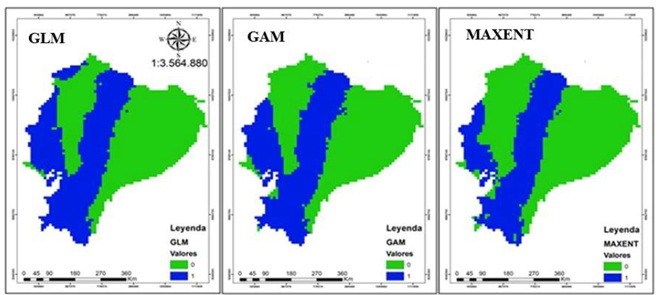
Additive Model (GAM), and machine learning algorithms, including Random Forest (RF), Maximum Entropy (MaxEnt), and Boosted Regression Tree (GBM), to model the potential distribution of the pathogen Fusarium oxysporum f. sp. cubense in mainland Ecuador, a soil phytopathogen that significantly af fects banana production. Ninety-two presence records and four bioclimatic variables (WorldClim) were used. The models were generated at a spatial resolution of 10 × 10 km² and evaluated using dif ferent performance metrics. Probability-of-presence maps generated in R for each model were exported to ArcGIS to produce binary maps and calculate the area of presence and absence of the species. Model performance varied depending on the evaluation metric. Despite this, the Random Forest model performed well across most metrics, particularly in discrimination; however, the Generalized Linear Model showed higher accuracy and reliability, with excellent calibration. MaxEnt produced the largest predicted area of presence of the phytopathogen (106 800 km²). All models consistently showed environmental favorability > 0.90 in the Sierra region, associated with its geographical, climatic, and ecological characteristics, such as the combination of temperature and humidity and host availability. The models demonstrated ef ficiency in predicting the potential distribution of F. oxysporum; however, further research with a greater number of presence records is recommended. The study is relevant as a baseline, particularly for the application of Bayesian models such as BART.
Downloads
References
Ab Lah, N. Z., Yusop, Z., Hashim, M., & Mohd, J. 2021. Predicting the habitat suitability of Melaleuca cajuputi based on the MaxEnt species distribution model. Forests, 12(11), 1449. https://doi.org/10.3390/f12111449
Acurio, A., Rafael, V., & Dangles, O. 2010. Biological invasions in the Amazonian Tropical Rain Forest: the case of Drosophilidae (Insecta, Diptera) in Ecuador, South America. BIOTROPICA, 42(6), 717-723. https://www.jstor.org/stable/40891353
Ahmadi, M., Hemamii, M., Mahmoud, M., & Shabani, F. 2023. MaxEnt brings comparable results when the input data are MaxEnt brings comparable results when the input data are distribution models. Ecology and Evolution, 13(2), 1-13. https://doi.org/10.1002/ece3.9827
Araújo, M. B., & New, M. 2007. Ensemble forecasting of species distributions. Trends in Ecology & Evolution, 22(1), 42-47. https://doi.org/10.1016/j.tree.2006.09.010
Arellano, M. 2018. Detección de Fusarium oxysporum en cultivos de uvilla (Physalis peruviana L.) en la Sierra norte y centro del Ecuador. Tesis de Licenciatura. Pontificia Universidad Católica del Ecuador.
Burgess, L. W. 1981. General ecology of the Fusaria. In P. E. Nelson, T. A. Toussoun, & R. J. Cook (Eds.). Fusarium: diseases, biology, and taxonomy (pp. 225-235). Pennsylvania State University Press, University Park.
Carlson, C. J. 2020. embarcadero: Species distribution modelling with Bayesian additive regression trees in r. Methods in Ecology and Evolution, 11(7), 850-858. https://doi.org/10.1111/2041-210X.13389
Correll, J. C. 1991. The relationship between formae speciales, races, and vegetative compatibility groups in Fusarium oxysporum. Phytopathology, 81(9), 1061-1064.
Courtois, P., Figuieres, C., Mulier, C., & Weill, J. 2018. A Cost-benefit approach for prioritizing invasive species. Ecological Economics, 146, 607-620. https://doi.org/10.1016/j.ecolecon.2017.11.037
Elith, J., y Leathwick, J. 2017. Boosted Regression Trees for ecological modeling. R Documentation. Available online: https://cran. r-project. org/web/packages/dismo/vignettes/brt. pdf
Ferrer-Sánchez, Y., Jacho-Saa, W. R., Urdánigo Zambrano, J. P., Abasolo-Pacheco, F., Plasencia-Vázquez, A. H., Zambrano-Mero, G. J., Castillo-Macías, M. J., Muñoz Zambrano, K. T., Coveña-Rosado, A., & Estrella Bravo, G. V. 2022. Invasiones biológicas en agroecosistemas de Ecuador Continental: nicho ecológico de especies exóticas y cultivos agrícolas bajo riesgo. Acta Biológica Colombiana, 26(3), 352-364. https://doi.org/10.15446/abc.v26n3.81765
Fick, S. E., & Hijmans, R, J. 2017. WorldClim 2: new 1-km spatial resolution climate surfaces for global land areas. International Journal of Climatology, 37(12), 4302-4315. https://doi.org/10.1002/joc.5086
Guillera-Arroita, G., Lahoz-Monfort, J., Elith, J., Gordon, A., Kujala, H., Lentini, P., McCarthy, M., Tingley, R., & Wintle, B. 2015. Is my species distribution model fit forpurpose? Matching data and models to applications. Global Ecology and Biogeography, 24(3), 276-292. https://doi.org/10.1111/geb.12268
Hao, T., Elith, J., Lahoz, J., & Guillera, G. 2020. Testing whether ensemble modelling is advantageous for maximising predictive performance of species distribution models. Ecography, 43(4), 549-558. https://doi.org/10.1111/ecog.04890
Instituto Nacional de Estadística y Censos. 2021. Boletín Técnico: Encuesta de Superficie y Producción Agropecuaria Continua, 2020. Quito, Ecuador: Instituto Nacional de Estadística y Censos (INEC), Secretaria Nacional de Planificación y Desarrollo (SENPLADES), Dirección Producción de Estadística Agropecuarias y Ambientales (INEC) - InstQuito.
Kleemann, J., Koo, H., Hensen, I., Mendieta-Leiva, G., Kahnt, B., Kurze, C., Inclan, D. J., Cuenca, P., Noh, J. K., Hoffmann, M. H., Factos, A., Lehnert, M., Lozano, P., & Furst, C. 2022. Priorities of action and research for the protection of biodiversity and ecosystem services in continental Ecuador. Biological Conservation, 265, 109404. https://doi.org/10.1016/j.biocon.2021.109404
Konowalik, K., & Nosol, A. 2021. Evaluation metrics and validation of presence only species distribution models based on distributional maps with varying coverage. Scientific Reports, 11, 1482. https://doi.org/10.1038/s41598-020-80062-1
Kosicki, J. Z. 2020. Generalised Additive Models and Random Forest Approach as effective methods for predictive species density and functional species richness. Environmental and Ecological Statistics, 24, 273-292. https://doi.org/10.1007/s10651-020-00445-5
Linders, T., Schaffner, U., Eschen, R., Abebe, A., Simon, C., & Nigatu, L. 2019. Direct and indirect effects of invasive species: Biodiversity loss is a major mechanism by which an invasive tree affects ecosystem functioning. Journal of Ecology, 107(6), 2660-2672. https://doi.org/10.1111/1365-2745.13268
Norberg, A., Abrego, N., Blanchet, G., Adler, F., Anderson, B., Anttila, J., Araújo, M. B., Dallas, T., Dunson, D., Elith, J. et al. 2019. A comprehensive evaluation of predictive performance of 33 species distribution models at species and community levels. Ecological Monographs, 89(3), e01370.
Pearson, R. G., Thuiller, W., Araújo, M. B., Martinez-Meyer, E., Brotons, L., McClean, C., Miles, L., Segurado, P., Dawson, T. P., & Lees, D. C. 2006. Model-based uncertainty in species range prediction. Journal of Biogeography, 33, 1704–1711. https://doi.org/10.1111/j.1365-2699.2006.01460.x
Phillips, S. J., Anderson, R. P., Dudík, M., Schapire, R. E., & Blair, M. E. 2017. Opening the black box: an open-source release of Maxent. Ecography 40(7), 887-893.
Ron, S. R. R. 2005. Predicting the distribution of the amphibian pathogen Batrachochytrium dendrobatidis in the New World. BIOTROPICA, 37(2), 209-221.
RStudio Team. (2023). RStudio: Integrated Development for R. RStudio, PBC. https://www.rstudio.com/
Smith, S. N. 2007. An overview of ecological and habitat aspects in the genus Fusarium with special emphasis on the soil-borne pathogenic forms. Plant Pathology Bulletin, 16, 97-120.
Shabani, F., Kumar, L., & Ahmadi, M. 2016. A comparison of absolute performance of different correlative and mechanistic species distribution models in an independent area. Ecology and Evolution, 6(16), 5973-5986. https://doi.org/10.1002/ece3.2332
Sofaer, H., Jarnevich, C., Pearse, I., Smyth, R., & Auer, S. 2019. The development and delivery of species distribution models to inform decision-making. BioScience, 69(7), 544–557. https://doi.org/10.1093/biosci/biz045
Thakuri, S., Shrestha, P., Deuba, M., Shah, P., Bhandari, O., & Shrestha, S. 2019. Potential habitat modeling of water hyacinth in lakes of nepal using maxent algorithm. ISPRS Annals of the Photogrammetry, Remote Sensing and Spatial Information Science, 4(2), 103-110. https://doi.org/10.5194/isprs-annals-IV-5-W2-103-2019
Williams, J., Seo, Thorne, J., Nelson, J., & Erwin, S. 2009. Using species distribution models to predict new occurrences for rare plants. Diversity and Distributions, 15(4), 565-576. https://doi.org/10.1111/j.1472-4642.2009.00567.x
Wunderlich, R., Lin, Y. P., Anthony, J., & Petway, J. 2019. Two alternative evaluation metrics to replace the true skill statistic in the assessment of species distribution models. Nature Conservation, 35, 7-116. https://doi.org/10.3897/natureconservation.35.33918
Zurell, D., Franklin, J., König, C., Bouchet, P. J., Dormann, C. F., Elith, J., Fandos, G., & Feng, X. 2020. A standard protocol for reporting species distribution models. Ecography, 43(9), 1261-1277. https://doi.org/10.1111/ecog.04960