Phytophthora-Responsive Proteins in Cacao: Comparative Bioinformatic Analysis for Biological Control
DOI:
https://doi.org/10.28940/terra.latinam..v44i.2472Keywords:
comparative bioinformatics, orthologous proteins, resistance to oomycetes, transcription factors, virulence factorsAbstract
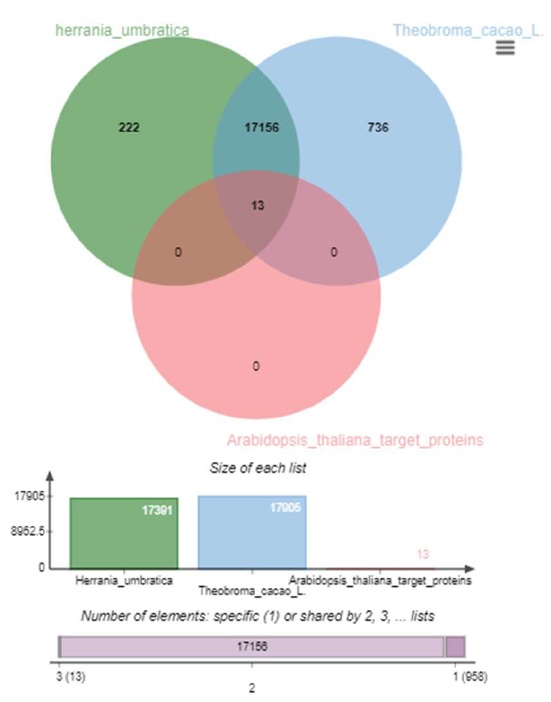
Phytophthora spp. is one of the most important phytosanitary threat to cacao agroforestry systems, causing yield losses exceeding 40%. This study conducted a comparative bioinformatic analysis to identify proteins associated with resistance mechanisms in Arabidopsis thaliana, Theobroma cacao L., and Herrania umbratica. From an initial dataset of 91 Arabidopsis sequences, 20 genes were identified as potentially involved in plant defense. Protein sequences were analyzed using BLASTX, selecting those with E-values ≤ 1e-10, adequate query coverage, and identity values above 65%. These proteins were then compared against T. cacao and H. umbratica genomes using BLASTP, enabling detection of functionally relevant homologs. Ortholog analysis with OrthoVenn3 revealed 13 conserved proteins shared among the three species, including lectin-like receptors, transcription factors (bZIP60, NAC089), stress-related proteins (PHOS32), and key immune signaling components such as FLS2, RBK1, and RPH1. Phylogenetic analyses highlighted strong evolutionary proximity between Theobroma cacao L. and Herrania umbratica, while Arabidopsis showed expected divergence but retained conserved immune-associated pathways. These conserved proteins represent promising candidates for functional validation and potential application in cacao breeding programs aimed at enhancing resistance to Phytophthora spp. Overall, this study demonstrates the value of in silico comparative approaches to accelerate the discovery of defense-related genes and support the development of more resilient and sustainable cacao production systems.
Downloads