Predictive Modelling of the Potential Distribution of Spodoptera frugiperda (J.E. Smith) in Ecuador Under Changing Climatic Conditions: A Basis for Management Strategies
DOI:
https://doi.org/10.28940/terra.latinam..v44i.2498Keywords:
global warming, phytosanitary management, fall armyworm, ecological niche, pestAbstract
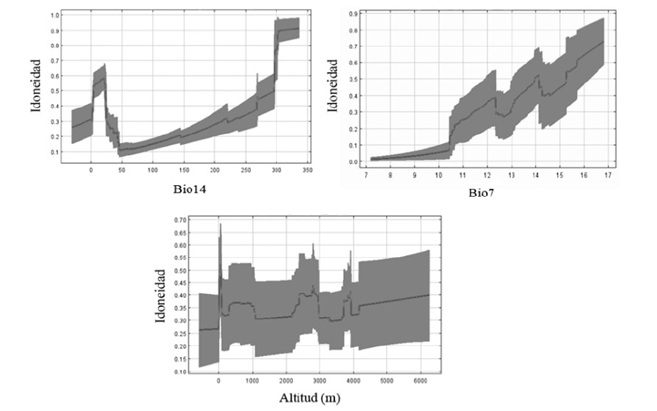
Among the most significant agricultural pests, Spodoptera frugiperda stands out for the significant economic impact it causes. In Ecuador, this species represents a persistent threat, and monitoring and management strategies within its distribution area need to be strengthened. This study evaluated changes in the potential geographic distribution of S. frugiperda using ecological niche models, considering alterations associated with climate change. Based on 211 records of presence in mainland Ecuador a species distribution model based on climatic suitability was developed to characterize the current and potential distribution of the species in two future climate scenarios. The optimal niche is defined by rainfall in the driest month between 0-20 mm, annual temperature ranges of 10.5-13 °C, and elevations < 500 m of altitude. Excessive rainfall is associated with areas of low favorability. Approximately 78 151 km² of territory contain favorable climatic conditions for S. frugiperda. The coast is home to 62.5% of the favorable area in the provinces of Los Ríos, Guayas, Manabí, Santa Elena, and El Oro. The highlands contain 36.5% of the favorable area, and the Amazon is the least vulnerable due to its excessive rainfall. Projections under the conservative scenario indicate relative stability. In contrast, the extreme scenario projects a progressive expansion to 89 482 km² by 2100. The alarming change will be in the Amazon region, which would experience a potential expansion from the current 527 km² to 9680 km² in 2100. This complex dynamic of spatial redistribution implies that some areas that are currently hotspots for infestation will become less favorable, while regions historically free of the pest will become high-risk areas. This change requires a fundamental reconfiguration of monitoring and control strategies. This information will enable a consolidated diagnosis and the implementation of ef fective management measures.
Downloads
References
Adan, M., Tonnang, H. E., Greve, K., Borgemeister, C., & Goergen, G. (2025). Modelling the environmental and terrestrial drivers of the spread of the invasive fall armyworm Spodoptera frugiperda in Africa. Crop Protection, 192, 107133. https://doi.org/10.1016/j.cropro.2025.107133
Anderson, R. P., & Raza, A. (2010). The effect of the extent of the study region on GIS models of species geographic distributions and estimates of niche evolution: preliminary tests with montane rodents (genus Nephelomys) in Venezuela. Journal of Biogeography, 37(7), 1378-1393. https://doi.org/10.1111/j.1365-2699.2010.02290.x
Aiello‐Lammens, M. E., Boria, R. A., Radosavljevic, A., Vilela, B., & Anderson, R. P. (2015). spThin: an R package for spatial thinning of species occurrence records for use in ecological niche models. Ecography, 38(5), 541-545. https://doi.org/10.1111/ecog.01132
Alkishe, A. A., Peterson, A. T., & Samy, A. M. (2017). Climate change influences on the potential geographic distribution of the disease vector tick Ixodes ricinus. PloS One, 12(12), e0189092. https://doi.org/10.1371/journal.pone.0189092
Armenta, G. E., Sofiea, C., Gordillo, F., Guerrero, A., & Villa, J. L. (2020). Análisis de las amenazas climáticas futuras en las cuencas hidrográficas: Santiago, Mayo, Puyango y Catamayo. AXIOMA, (21), 5-21. Recuperado a partir de https://axioma.pucesi.edu.ec/index.php/axioma/article/view/578
Baloch, M. N., Fan, J., Haseeb, M., & Zhang, R. (2020). Mapping potential distribution of Spodoptera frugiperda (Lepidoptera: Noctuidae) in central Asia. Insects, 11(3), 172. https://doi.org/10.3390/insects11030172
Barve, N., Barve, V., Jiménez-Valverde, A., Lira-Noriega, A., Maher, S. P., Peterson, A. T., ... & Villalobos, F. (2011). The crucial role of the accessible area in ecological niche modeling and species distribution modeling. Ecological Modelling, 222(11), 1810-1819. https://doi.org/10.1016/j.ecolmodel.2011.02.011
Booth, T. H. (2022). Checking bioclimatic variables that combine temperature and precipitation data before their use in species distribution models. Austral Ecology, 47(7), 1506-1514. https://doi.org/10.1111/aec.13234
Boria, R. A., Olson, L. E., Goodman, S. M., & Anderson, R. P. (2014). Spatial filtering to reduce sampling bias can improve the performance of ecological niche models. Ecological Modelling, 275, 73-77. https://doi.org/10.1016/j.ecolmodel.2013.12.012
Cáceres, L., & Nuñez, A. M. (2011). Segunda Comunicación Nacional sobre Cambio Climático, Convención Marco de las Naciones Unidas sobre Cambio Climático (en línea). Ecuador, Ministerio del Ambiente. Disponible en https://unfccc.int/resource/docs/natc/ecunc2.pdf.
Chamberlain, S. (2020). scrubr: Clean biological occurrence records. R package version 0.3. 2.
CMC. (2017). IPSL-CM6A-LR. Consultado 6 may 2023. Disponible en https://cmc.ipsl.fr/ipsl-climate-models/ipsl-cm6/
Cobos, M. E., Peterson, A. T., Barve, N., & Osorio-Olvera, L. (2019). kuenm: an R package for detailed development of ecological niche models using Maxent. PeerJ, 7, e6281. https://doi.org/10.7717/peerj.6281
Cokola, M. C., Mugumaarhahama, Y., Noël, G., Bisimwa, E. B., Bugeme, D. M., Chuma, G. B., ... & Francis, F. (2020). Bioclimatic zonation and potential distribution of Spodoptera frugiperda (Lepidoptera: Noctuidae) in south Kivu Province, DR Congo. BMC Ecology, 20(1), 66. https://doi.org/10.1186/s12898-020-00335-1
Datta, A., Schweiger, O., & Kühn, I. (2020). Origin of climatic data can determine the transferability of species distribution models. NeoBiota, 59, 61-76. https://doi.org/10.3897/neobiota.59.36299
Early, R., González-Moreno, P., Murphy, S. T., & Day, R. (2018). Forecasting the global extent of invasion of the cereal pest Spodoptera frugiperda, the fall armyworm. BioRxiv, 391847. https://doi.org/10.3897/neobiota.40.28165
Fan, J., Wu, P., Tian, T., Ren, Q., Haseeb, M., & Zhang, R. (2020). Potential distribution and niche differentiation of Spodoptera frugiperda in Africa. Insects, 11(6), 383. https://doi.org/10.3390/insects11060383
FAO. (2012). Herramientas para la adaptación y mitigación del cambio climático en el sector agropecuario. Roma, Organización de las Naciones Unidas para la Alimentación y la Agricultura. Disponible en https://www.biopasos.com/documentos/2/022.pdf.
Fernandez, M. A., Bucaram, S. J., & Renteria, W. (2015). Assessing local vulnerability to climate change in Ecuador. SpringerPlus, 4, 1-20. https://doi.org/10.1186/s40064-015-1536-z
Fick, S. E., & Hijmans, R. J. (2017). WorldClim 2: new 1‐km spatial resolution climate surfaces for global land areas. International Journal of Climatology, 37(12), 4302-4315. https://doi.org/10.1002/joc.5086
Fourcade, Y., Engler, J. O., Rödder, D., & Secondi, J. (2014). Mapping species distributions with MAXENT using a geographically biased sample of presence data: a performance assessment of methods for correcting sampling bias. PloS One, 9(5), e97122. https://doi.org/10.1371/journal.pone.0097122
Hastenrath, S. (1981). The Glaciation of the Ecuadorian Andes. Balkema, 173 pp.
INEC. (2021). Estadísticas Agropecuarias. Consultado 15 dic. 2022. Disponible en https://www.ecuadorencifras.gob.ec/estadisticas-agropecuarias-2/
INIAP. (2016). Estimación de la incidencia de plagas y enfermedades en el cultivo de maíz en las provincias de Los Ríos, Guayas y Manabí. Portoviejo, Ecuador, Instituto Nacional de Investigaciones Agropecuarias. Consultado 5 mayo 2023. Disponible en http://repositorio.iniap.gob.ec/handle/41000/5388
Jiang, C., Zhang, X., Xie, W., Wang, R., Feng, C., Ma, L., ... & Wang, H. (2022). Predicting the potential distribution of the fall armyworm Spodoptera frugiperda (JE Smith) under climate change in China. Global Ecology and Conservation, 33, e01994. https://doi.org/10.1016/j.gecco.2021.e01994
Jiménez Salazar, M. Á., & Méndez González, J. (2021). Distribución actual y potencial de Pinus engelmannii Carriére bajo escenarios de cambio climático. Madera y bosques, 27(3). https://doi.org/10.21829/myb.2021.2732117
Laroche, F. (2024). Efficient sampling designs to assess biodiversity spatial autocorrelation: should we go fractal? Peer Community Journal, 4. https://doi.org/10.24072/pcjournal.454
Legendre, P., & Legendre, L. (2012). Numerical ecology (Vol. 24). Elsevier.
Li, C., Liao, J., Ya, Y., Liu, J., Li, J., & Yu, G. (2022). Analysis of potential distribution of Spodoptera frugiperda in western China. Journal of Asia-Pacific Entomology, 25(4), 101985. https://doi.org/10.1016/j.aspen.2022.101985
Lipper, L., Thornton, P., Campbell, B. M., Baedeker, T., Braimoh, A., Bwalya, M., Caron, P., Cattaneo, A., Garrity, D., Henry, K., Hottle, R., Jackson, L., Jarvis, A., Kossam, F., Mann, W., McCarthy, N., Meybeck, A., Neufeldt, H., Remington, T., Sen, P. T., Sessa, R., Shula, R., Tibu, A., & Torquebiau, E. F. (2014). Climate-smart agriculture for food security. Nature Climate Change, 4(12),1068-1072. https://doi.org/10.1038/nclimate2437
Liu, C., Berry, P. M., Dawson, T. P., & Pearson, R. G. (2005). Selecting thresholds of occurrence in the prediction of species distributions. Ecography, 28(3), 385-393. https://doi.org/10.1111/j.0906-7590.2005.03957.x
Liu, C., White, M., & Newell, G. (2013). Selecting thresholds for the prediction of species occurrence with presence-only data. Journal of Biogeography, 40(4), 778-789. https://doi.org/10.1111/jbi.12058
Liu, T., Wang, J., Hu, X., & Feng, J. (2020). Land-use change drives present and future distributions of Fall armyworm, Spodoptera frugiperda (J.E. Smith) (Lepidoptera: Noctuidae). Science of The Total Environment, 706, 135872. https://doi.org/10.1016/j.scitotenv.2019.135872
Lozano-Povis, A., Alvarez-Montalván, C. E., & Moggiano, N. (2021). El cambio climático en los andes y su impacto en la agricultura: una revisión sistemática. Scientia Agropecuaria, 12(1), 101-108. http://dx.doi.org/10.17268/sci.agropecu.2021.012
Monteros, A. (2014). Rendimientos de maíz duro seco en el Ecuador invierno 2014 (Enero - Mayo). Quito, Ecuador, Ministerio de Agricultura, Ganadería, Acuacultura y Pesca.
Montezano, D. G., Sosa-Gómez, D. R., Specht, A., Roque-Specht, V. F., Sousa-Silva, J. C., Paula-Moraes, S. D., ... & Hunt, T. E. (2018). Host plants of Spodoptera frugiperda (Lepidoptera: Noctuidae) in the Americas. African Entomology, 26(2), 286-300. https://doi.org/10.4001/003.026.0286
Nagoshi, R. N., Nagoshi, B. Y., Cañarte, E., Navarrete, B., Solórzano, R., & Garcés-Carrera, S. (2019). Genetic characterization of fall armyworm (Spodoptera frugiperda) in Ecuador and comparisons with regional populations identify likely migratory relationships. PloS One, 14(9), e0222332. https://doi.org/10.1371/journal.pone.0222332
Owens, H. L., Campbell, L. P., Dornak, L. L., Saupe, E. E., Barve, N., Soberón, J., ... & Peterson, A. T. (2013). Constraints on interpretation of ecological niche models by limited environmental ranges on calibration areas. Ecological Modelling, 263, 10-18. https://doi.org/10.1016/j.ecolmodel.2013.04.011
Paudel Timilsena, B., Niassy, S., Kimathi, E., Abdel-Rahman, E. M., Seidl-Adams, I., Wamalwa, M., ... & Subramanian, S. (2022). Potential distribution of fall armyworm in Africa and beyond, considering climate change and irrigation patterns. Scientific Reports, 12(1), 539. https://doi.org/10.1038/s41598-021-04369-3
Pereira, L. M., Davies, K. K., den Belder, E., Ferrier, S., Karlsson‐Vinkhuyzen, S., Kim, H., ... & Lundquist, C. J. (2020). Developing multiscale and integrative nature–people scenarios using the Nature Futures Framework. People and Nature, 2(4), 1172-1195. https://doi.org/10.1002/pan3.10146
Peterson, A. T., Soberón, J., Pearson, R. G., Anderson, R. P., Martínez-Meyer, E., Nakamura, M., & Araújo, M. B. (2011). Ecological niches and geographic distributions. In Ecological niches and geographic distributions. USA: Princeton University Press.
Phillips, S. J., Anderson, R. P., & Schapire, R. E. (2006). Maximum entropy modeling of species geographic distributions. Ecological Modelling, 190(3-4), 231-259. https://doi.org/10.1016/j.ecolmodel.2005.03.026
Prasad, T. V., Rao, M. S., Rao, K. V., Bal, S. K., Muttapa, Y., Choudhary, J. S., & Singh, V. K. (2022). Temperature-based phenology model for predicting the present and future establishment and distribution of recently invasive Spodoptera frugiperda (JE Smith) in India. Bulletin of Entomological Research, 112(2), 271-285. https://doi.org/10.1017/S0007485321000882
Radosavljevic, A., & Anderson, R. P. (2014). Making better Maxent models of species distributions: complexity, overfitting and evaluation. Journal of Biogeography, 41(4), 629-643. https://doi.org/10.1111/jbi.12227
Soberón, J., & Townsend Peterson, A. (2005). Interpretation of Models of Fundamental Ecological Niches and Species’ Distributional Areas. Biodiversity Informatics, 2.0. http://dx.doi.org/10.17161/bi.v2i0.4
Steinke, D., Gemeinholzer, B., Martínez-Meyer, E., Noesgaard, D., Young, A., & Schigel, D. (2025). Globally aggregated biodiversity data impact predictive and descriptive research. Proceedings of the National Academy of Sciences, 122(50), e2519119122. https://doi.org/10.1073/pnas.2519119122
Syfert, M. M., Smith, M. J., & Coomes, D. A. (2013). The effects of sampling bias and model complexity on the predictive performance of MaxEnt species distribution models. PloS One, 8(2), e55158. https://doi.org/10.1371/journal.pone.0055158
Tepa-Yotto, G., Tonnang, H., Goergen, G., Subramanian, S., Kimathi, E., Abdel-Rahman, E., Flo, D., Thunes, K., Fiaboe, K., Niassy, S., Bruce, A., Mohamed, S., Tamó, M., Ekesi, S., & Sæthre, M-G. (2021). Global Habitat Suitability of Spodoptera furipterid (JE Smith) (Lepidoptera, Noctuidae): Key Parasitoids Considered for Its Biological Control. Insects, 12(4), 273. https://doi.org/10.3390/insects12040273
Toulkeridis, T., Tamayo, E., Simón-Baile, D., Merizalde-Mora, M. J., Reyes–Yunga, D. F., Viera-Torres, M., & Heredia, M. (2020). Climate Change according to Ecuadorian academics–Perceptions versus facts. LA GRANJA. Revista de Ciencias de la Vida, 31(1), 21-46. https://doi.org/10.17163/lgr.n31.2020.02.
Vuille, M., Bradley, R. S., & Keimig, F. (2000). Climate variability in the Andes of Ecuador and its relation to tropical Pacific and Atlantic sea surface temperature anomalies. Journal of Climate, 13(14), 2520-2535.
Wang, R., Jiang, C., Guo, X., Chen, D., You, C., Zhang, Y., ... & Li, Q. (2020). Potential distribution of Spodoptera frugiperda (JE Smith) in China and the major factors influencing distribution. Global Ecology and Conservation, 21, e00865. https://doi.org/10.1016/j.gecco.2019.e00865
Wyckhuys, K. A., & O’Neil, R. J. (2006). Population dynamics of Spodoptera frugiperda Smith (Lepidoptera: Noctuidae) and associated arthropod natural enemies in Honduran subsistence maize. Crop Protection, 25(11), 1180-1190. https://doi.org/10.1016/j.cropro.2006.03.003
Zacarias, D. (2020). Global bioclimatic suitability for the fall armyworm, Spodoptera frugiperda (Lepidoptera: Noctuidae), and potential co-occurrence with major host crops under climate change scenarios. Climatic Change, 161(4), 555-566. https://doi.org/10.1007/s10584-020-02722-5