Los Parámetros Fisicoquímicos del Suelo Determinan la Estructura de la Comunidad Bacteriana en Agroecosistemas de Cacao (Theobroma cacao L.): Evidencia a partir de Metabarcoding
DOI:
https://doi.org/10.28940/terralatinoamericana.v44i.2466Palabras clave:
sostenibilidad agrícola, bioinformática, secuenciación de alto rendimiento, diversidad microbianaResumen
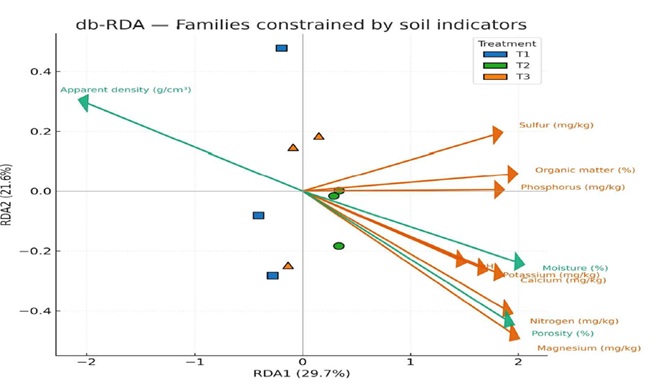
Este estudio evaluó el efecto de tres sistemas de producción de cacao (Theobroma cacao L.) monocultivo (T1), diversificado (T2) y agroforestal (T3) sobre las propiedades fisicoquímicas del suelo y la estructura de la comunidad bacteriana. Las muestras de suelo se recolectaron mediante un diseño sistemático y se analizaron indicadores físicos y químicos. La comunidad bacteriana se caracterizó mediante secuenciación de alto rendimiento del gen 16S rRNA (región V3–V4), seguida de análisis bioinformático y estadístico multivariante. El sistema diversificado (T2) presentó condiciones edáficas significativamente mejores, incluyendo mayor pH, contenido de materia orgánica y disponibilidad de nutrientes (N, P, K, Ca y Mg), en comparación con el monocultivo (T1), mientras que el sistema agroforestal (T3) mostró valores intermedios. Estas diferencias se asociaron con cambios en la diversidad y composición microbiana. Los índices de diversidad alfa (Observed, Chao1, Shannon y Simpson) fueron significativamente mayores en T2 y menores en T1 (p < 0.05). Los análisis de diversidad beta (PCoA con distancias de Aitchison y Bray–Curtis) evidenciaron una clara separación entre tratamientos. A nivel taxonómico, se observaron diferencias tanto a nivel de familia como de género. El monocultivo presentó mayor abundancia relativa de géneros asociados a Acidobacteria y Bradyrhizobium, mientras que el sistema diversificado mostró mayor representación de géneros como Rhizobium, Burkholderia y Streptomyces, comúnmente vinculados con procesos de ciclado de nutrientes. El sistema agroforestal presentó una composición intermedia, incluyendo géneros como Sphingomonas y Pseudomonas. El análisis multivariante (db-RDA) indicó que el pH, la materia orgánica y la disponibilidad de nutrientes fueron factores determinantes en la estructuración de la comunidad bacteriana. En conjunto, los resultados evidencian que los sistemas de manejo del cacao están asociados con cambios en las propiedades del suelo y en el microbioma, y sugieren que la diversificación puede contribuir a mejorar las condiciones edáficas y la diversidad microbiana en agroecosistemas tropicales.
Descargas
Referencias
Achat, D. L., Fortin, M., Landmann, G., Ringeval, B., & Augusto, L. (2015). Forest soil carbon is threatened by intensive biomass harvesting. Scientific Reports, 5(1), 15991. https://doi.org/10.1038/srep15991
Allen, S. L., Robayo, L. A., Martin, C. D., & Ganem, J. L. (2024). Productivity, Soil Health, and Tree Diversity in Dynamic Cacao Agroforestry Systems in Ecuador. Land, 13(7), 959. https://doi.org/10.3390/land13070959
Algora, C., Vasileiadis, S., Wasmund, K., Trevisan, M., Krüger, M., Puglisi, E., & Adrian, L. (2015). Manganese and iron as structuring parameters of microbial communities in Arctic marine sediments from the Baffin Bay. FEMS Microbiology Ecology, 91(6), fiv056. https://doi.org/10.1093/femsec/fiv056
Beckers, B. (2015). Modified lignin biosynthesis in field-grown Populus tremula x alba: Host genotype effects on the plant-associated bacterial microbiome. https://documentserver.uhasselt.be//handle/1942/20725
Blume, H.-P., Brümmer, G. W., Fleige, H., Horn, R., Kandeler, E., Kögel-Knabner, I., Kretzschmar, R., Stahr, K., & Wilke, B.-M. (2016). Inorganic Soil Components—Minerals and Rocks. En H.-P. Blume, G. W. Brümmer, H. Fleige, R. Horn, E. Kandeler, I. Kögel-Knabner, R. Kretzschmar, K. Stahr, & B.-M. Wilke (Eds.), Scheffer/SchachtschabelSoil Science (pp. 7-53). Springer. https://doi.org/10.1007/978-3-642-30942-7_2
Bertola, M., Ferrarini, A., & Visioli, G. (2021). Improvement of Soil Microbial Diversity through Sustainable Agricultural Practices and Its Evaluation by -Omics Approaches: A Perspective for the Environment, Food Quality and Human Safety. Microorganisms, 9(7), 1400. https://doi.org/10.3390/microorganisms9071400
Cao, Y., Zhang, K., Liu, S., & Wang, Y. (2024). A review of advancements in the theory and characterization of soil macropore structure. PeerJ, 12, e18442. https://doi.org/10.7717/peerj.18442
Caro-Quintero, A., & Konstantinidis, K. T. (2015). Inter-phylum HGT has shaped the metabolism of many mesophilic and anaerobic bacteria. The ISME Journal, 9(4), 958-967. https://doi.org/10.1038/ismej.2014.193
Cline, L. C., & Zak, D. R. (2015). Soil microbial communities are shaped by plant-driven changes in resource availability during secondary succession. Ecology, 96(12), 3374-3385. https://doi.org/10.1890/15-0184.1
Dai, Z., Ding, Y., Xu, C., Chen, Y., & Liu, L. (2022). Evaluation of the impact of crop residue on fractional vegetation cover estimation by vegetation indices over conservation tillage cropland: A simulation study. International Journal of Remote Sensing, 43(17), 6463-6482. https://doi.org/10.1080/01431161.2022.2139649
Dalmaso, G. Z. L., Ferreira, D., & Vermelho, A. B. (2015). Marine Extremophiles: A Source of Hydrolases for Biotechnological Applications. Marine Drugs, 13(4), 1925-1965. https://doi.org/10.3390/md13041925
Deguine, J.-P., Atiama-Nurbel, T., Aubertot, J.-N., Augusseau, X., Atiama, M., Jacquot, M., & Reynaud, B. (2015). Agroecological management of cucurbit-infesting fruit fly: A review. Agronomy for Sustainable Development, 35(3), 937-965. https://doi.org/10.1007/s13593-015-0290-5
Dobrowski, S. Z., Swanson, A. K., Abatzoglou, J. T., Holden, Z. A., Safford, H. D., Schwartz, M. K., & Gavin, D. G. (2015). Forest structure and species traits mediate projected recruitment declines in western US tree species. Global Ecology and Biogeography, 24(8), 917-927. https://doi.org/10.1111/geb.12302
Edelstein, C. P., Isaac, M. E., Orozco-Aguilar, L., Peguero, F., Delgado-Rodríguez, D., & Cerda, R. H. (2025). Effects of functional diversity on ecosystem services in cocoa agroforestry systems in Costa Rica. Frontiers in Sustainable Food Systems, 8. https://doi.org/10.3389/fsufs.2024.1507555
Fahad, S., Chavan, S. B., Chichaghare, A. R., Uthappa, A. R., Kumar, M., Kakade, V., Pradhan, A., Jinger, D., Rawale, G., Yadav, D. K., Kumar, V., Farooq, T. H., Ali, B., Sawant, A. V., Saud, S., Chen, S., & Poczai, P. (2022). Agroforestry Systems for Soil Health Improvement and Maintenance. Sustainability, 14(22), 14877. https://doi.org/10.3390/su142214877
Faure, D., Bonin, P., Duran, R., & the Microbial Ecology EC2CO consortium. (2015). Environmental microbiology as a mosaic of explored ecosystems and issues. Environmental Science and Pollution Research, 22(18), 13577-13598. https://doi.org/10.1007/s11356-015-5164-5
Gianfreda, L. (2015). Enzymes of importance to rhizosphere processes. Journal of soil science and plant nutrition, 15(2), 283-306. https://doi.org/10.4067/S0718-95162015005000022
Gong, L., Wang, H., Xiang, X., Qiu, X., Liu, Q., Wang, R., Zhao, R., & Wang, C. (2015). pH Shaping the Composition of sqhC-Containing Bacterial Communities. Geomicrobiology Journal, 32(5), 433-444. https://doi.org/10.1080/01490451.2014.950363
Lehman, R. M., Cambardella, C. A., Stott, D. E., Acosta-Martinez, V., Manter, D. K., Buyer, J. S., Maul, J. E., Smith, J. L., Collins, H. P., Halvorson, J. J., Kremer, R. J., Lundgren, J. G., Ducey, T. F., Jin, V. L., & Karlen, D. L. (2015). Understanding and Enhancing Soil Biological Health: The Solution for Reversing Soil Degradation. Sustainability, 7(1), 988-1027. https://doi.org/10.3390/su7010988
Li, L., Zhao, J., Liu, C., Deng, Y., Du, Y., Liu, Y., Wu, Y., Wu, W., & Pan, X. (2025). Spatial Differentiation of Heavy Metals/Metalloids, Microbial Risk Genes and Soil Microbiota in a Sulfur-Contaminated Landscape. Microorganisms, 13(9), 2010. https://doi.org/10.3390/microorganisms13092010
Lynch, M. D. J., & Neufeld, J. D. (2015). Ecology and exploration of the rare biosphere. Nature Reviews Microbiology, 13(4), 217-229. https://doi.org/10.1038/nrmicro3400
Manono, B. O., & Gichana, Z. (2025). Agriculture-Livestock-Forestry Nexus: Pathways to Enhanced Incomes, Soil Health, Food Security and Climate Change Mitigation in Sub-Saharan Africa. Earth, 6(3), 74. https://doi.org/10.3390/earth6030074
Massaccesi, L., Bardgett, R. D., Agnelli, A., Ostle, N., Wilby, A., & Orwin, K. H. (2015). Impact of plant species evenness, dominant species identity and spatial arrangement on the structure and functioning of soil microbial communities in a model grassland. Oecologia, 177(3), 747-759. https://doi.org/10.1007/s00442-014-3135-z
Matthews, T. J., & Whittaker, R. J. (2015). REVIEW: On the species abundance distribution in applied ecology and biodiversity management. Journal of Applied Ecology, 52(2), 443-454. https://doi.org/10.1111/1365-2664.12380
Moeslund, J. E., Arge, L., Bøcher, P. K., Dalgaard, T., Odgaard, M. V., Nygaard, B., & Svenning, J.-C. (2013). Topographically controlled soil moisture is the primary driver of local vegetation patterns across a lowland region. Ecosphere, 4(7), art91. https://doi.org/10.1890/ES13-00134.1
Munroe, J. W., Soto, G., de M. Virginio Filho, E., Fulthorpe, R., & Isaac, M. E. (2015). Soil microbial and nutrient properties in the rhizosphere of coffee under agroforestry management. Applied Soil Ecology, 93, 40-46. https://doi.org/10.1016/j.apsoil.2015.04.003
Nahon, S. M. R., Trindade, F. C., Yoshiura, C. A., Martins, G. C., da Costa, I. R. C., Costa, P. H. de O., Herrera, H., Balestrin, D., Godinho, T. de O., Marchiori, B. M., & Valadares, R. B. da S. (2024). Impact of Agroforestry Practices on Soil Microbial Diversity and Nutrient Cycling in Atlantic Rainforest Cocoa Systems. International Journal of Molecular Sciences, 25(21), 11345. https://doi.org/10.3390/ijms252111345
Negi, M., Sharma, S., & Singh, M. (2025). Plant-Driven Soil Dynamics: Exploring the Role of Roots, Fungi and Soil Traffic in Shaping the Soil Structure. Communications in Soil Science and Plant Analysis, 56(18), 2727-2746. https://doi.org/10.1080/00103624.2025.2524075
Omer, E., Szlatenyi, D., Csenki, S., Alrwashdeh, J., Czako, I., & Láng, V. (2024). Farming Practice Variability and Its Implications for Soil Health in Agriculture: A Review. Agriculture, 14(12), 2114. https://doi.org/10.3390/agriculture14122114
Ortego, J., Noguerales, V., Gugger, P. F., & Sork, V. L. (2015). Evolutionary and demographic history of the Californian scrub white oak species complex: An integrative approach. Molecular Ecology, 24(24), 6188-6208. https://doi.org/10.1111/mec.13457
Penny, C., Gruffaz, C., Nadalig, T., Cauchie, H.-M., Vuilleumier, S., & Bringel, F. (2015). Tetrachloromethane-Degrading Bacterial Enrichment Cultures and Isolates from a Contaminated Aquifer. Microorganisms, 3(3), 327-343. https://doi.org/10.3390/microorganisms3030327
Qiu, L., Zhang, Q., Zhu, H., Reich, P. B., Banerjee, S., van der Heijden, M. G. A., Sadowsky, M. J., Ishii, S., Jia, X., Shao, M., Liu, B., Jiao, H., Li, H., & Wei, X. (2021). Erosion reduces soil microbial diversity, network complexity and multifunctionality. The ISME Journal, 15(8), 2474-2489. https://doi.org/10.1038/s41396-021-00913-1
Sobrinho, T. G., Paolucci, L. N., Muscardi, D. C., Maradini, A. C., Silva, E. A., Schoereder, R. R. C. S. and J. H., Sobrinho, T. G., Paolucci, L. N., Muscardi, D. C., Maradini, A. C., Silva, E. A., & Schoereder, R. R. C. S. and J. H. (2015). Biodiversity and Ecosystem Functioning in Tropical Habitats—Case Studies and Future Perspectives in Atlantic Rainforest and Cerrado Landscapes. En Biodiversity in Ecosystems—Linking Structure and Function. IntechOpen. https://doi.org/10.5772/59042
Santoyo, G., Urtis-Flores, C. A., Loeza-Lara, P. D., Orozco-Mosqueda, Ma. del C., & Glick, B. R. (2021). Rhizosphere Colonization Determinants by Plant Growth-Promoting Rhizobacteria (PGPR). Biology, 10(6), 475. https://doi.org/10.3390/biology10060475
Satam, H., Joshi, K., Mangrolia, U., Waghoo, S., Zaidi, G., Rawool, S., Thakare, R. P., Banday, S., Mishra, A. K., Das, G., & Malonia, S. K. (2023). Next-Generation Sequencing Technology: Current Trends and Advancements. Biology, 12(7), 997. https://doi.org/10.3390/biology12070997
Sousa, R. do S. dos R. de, Lima, G. V. S., Garcias, J. T., Gomes, G. de O., Mateus, J. R., Madeira, L. D. P. dos S., Seldin, L., Rogez, H. L. G., & Marques, J. M. (2024). The Microbial Community Structure in the Rhizosphere of Theobroma cacao L. and Euterpe oleracea Mart. Is Influenced by Agriculture System in the Brazilian Amazon. Microorganisms, 12(2), 398. https://doi.org/10.3390/microorganisms12020398
Souza, R. de, Ambrosini, A., & Passaglia, L. M. P. (2015). Plant growth-promoting bacteria as inoculants in agricultural soils. Genetics and Molecular Biology, 38, 401-419. https://doi.org/10.1590/S1415-475738420150053
Stefan, L., Hartmann, M., Engbersen, N., Six, J., & Schöb, C. (2021). Positive Effects of Crop Diversity on Productivity Driven by Changes in Soil Microbial Composition. Frontiers in Microbiology, 12. https://doi.org/10.3389/fmicb.2021.660749
Stenuit, B., & Agathos, S. N. (2015). Deciphering microbial community robustness through synthetic ecology and molecular systems synecology. Current Opinion in Biotechnology, 33, 305-317. https://doi.org/10.1016/j.copbio.2015.03.012
Sawant, S. S., Park, H.-Y., Sim, E.-Y., Kim, H.-S., & Choi, H.-S. (2025). Microbial Fermentation in Food: Impact on Functional Properties and Nutritional Enhancement—A Review of Recent Developments. Fermentation, 11(1), 15. https://doi.org/10.3390/fermentation11010015
Țopa, D.-C., Căpșună, S., Calistru, A.-E., & Ailincăi, C. (2025). Sustainable Practices for Enhancing Soil Health and Crop Quality in Modern Agriculture: A Review. Agriculture, 15(9), 998. https://doi.org/10.3390/agriculture15090998
Tzilivakis, J., Warner, D., Green, A., & Lewis, K. (2015). Guidance and tool to support farmers in taking aware decisions on Ecological Focus Areas: Final report for Project JRC/IPR/2014/H.4/0022/NC [Report]. Joint Research Centre (JRC), European Commission. https://uhra.herts.ac.uk/id/eprint/12386/
Vaudour, E., Costantini, E., Jones, G. V., & Mocali, S. (2015). An overview of the recent approaches to terroir functional modelling, footprinting and zoning. SOIL, 1(1), 287-312. https://doi.org/10.5194/soil-1-287-2015
Wang, X., Han, C., Zhang, J., Huang, Q., Deng, H., Deng, Y., & Zhong, W. (2015). Long-term fertilization effects on active ammonia oxidizers in an acidic upland soil in China. Soil Biology and Biochemistry, 84, 28-37. https://doi.org/10.1016/j.soilbio.2015.02.013
Wemheuer, F., Berkelmann, D., Wemheuer, B., Daniel, R., Vidal, S., & Bisseleua Daghela, H. B. (2020). Agroforestry Management Systems Drive the Composition, Diversity, and Function of Fungal and Bacterial Endophyte Communities in Theobroma Cacao Leaves. Microorganisms, 8(3), 405. https://doi.org/10.3390/microorganisms8030405
Wu, H., Lei, X., Chen, X., Shen, J., Wang, X., & Ma, T. (2024). Study on Effect of Particle Size Distribution on Water-Retention Capacity of Coral Sand from Macro and Micro Perspective. Journal of Marine Science and Engineering, 12(2), 341. https://doi.org/10.3390/jmse12020341
Zeng, Q., Wang, Z., Shen, Z., Li, W., Luo, K., Qin, Q., Li, S., & Gu, Q. (2025). Microbiome Diversity and Dynamics in Lotus–Fish Co-Culture Versus Intensive Pond Systems: Implications for Sustainable Aquaculture. Biology, 14(8), 1092. https://doi.org/10.3390/biology14081092