InfiltR: a Tool to Model Soil Water Infiltration
DOI:
https://doi.org/10.28940/terralatinoamericana.v44i.2269Keywords:
automation, interactivity, mathematical models, optimizationAbstract
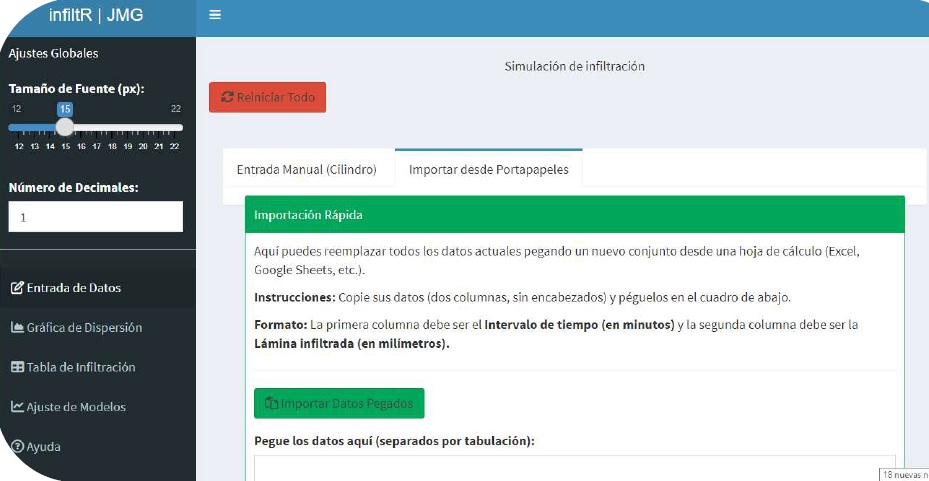
Water infiltration into the soil is a fundamental process in the hydrological cycle, directly influencing plant water availability, aquifer recharge, and human access to water. This study aimed to develop an interactive application using Shiny to automate the simulation, computation, and prediction of infiltration dynamics based on the cylinder method. The application was developed in R, integrating multiple essential libraries to ensure robust functionality. The theoretical framework and computational procedures were based on peer-reviewed scientific literature documenting standardized infiltration estimation methodologies. The resulting application, infiltR, not only simulates and quantifies infiltration but also allows users to customize parameters, thereby optimizing and improving the understanding of soil infiltration processes. Moreover, the application enables real-time infiltration forecasting based on two mathematical models. This open-source tool is freely accessible, with its complete source code available on GitHub for modification and improvement. Furthermore, a comprehensive instructional video on its use will be published
on YouTube. For advanced users, the code can also be implemented directly from R or
accessed through a simple link without the need to install R. This application has significant potential for both real-time field applications and educational settings, providing deeper insight into the mechanisms governing soil water infiltration.
Downloads
Publication Facts
Reviewer profiles N/A
Author statements
- Editor & editorial board
- profiles
- Academic society
- Terra Latinoamericana
- Publisher
- Mexican Society of Soil Science, C.A.

To learn about these publication facts, click 
PF is maintained by the Public Knowledge Project
References
Baty F., Delignette-Muller M.L., Charles S., Flandrois J. P., Ritz C., & Siberchicot A. (2015). nlstools: Tools for Nonlinear Regression Diagnostics (Version 1.0-2). https://doi.org/10.32614/CRAN.package.nlstools
Beltrán, L. M. A. (2021). Irrigación y drenaje agrícola ( creado en rstudio Página de rpubs, Ed.; p. 20). Rpubs. https://rpubs.com/Leugimxw9/Irrigacion1
Chang, W., Cheng, J., Allaire, J. J., Xie, Y., & McPherson, J. (2023). shiny: Web Application Framework for R. (Version 1.7.5). [Software]. https://doi.org/10.32614/CRAN.package.shiny
Chang, W., & Ribeiro, B. B. (2023). shinydashboard: Create Dashboards with “Shiny” (Version 0.7.2). [Software]. https://doi.org/10.32614/CRAN.package.shinydashboard
Cunha, J. L. X. L., Coelho, M. E. H., de Albuquerque, A. W., Silva, C. A., da Silva Júnior, A. B., & de Carvalho, I. D. E. (2015). Water infiltration rate in yellow latosol under different soil management systems. Revista Brasileira de Engenharia Agricola e Ambiental, 19(11), 1021–1027. https://doi.org/10.1590/1807-1929/agriambi.v19n11p1021-1027
Elzhov, T. V., Mullen, K. M., Spiess, A. N., & Bolker, B. (2022). minpack.lm: R Interface to the Levenberg-Marquardt Nonlinear Least-Squares Algorithm (Version 1.2-2). [Software]. https://doi.org/10.32614/CRAN.package.minpack.lm
Farid, H. U., Mahmood-Khan, Z., Ahmad, I., Shakoor, A., Anjum, M. N., Iqbal, M. M., Mubeen, M., & Asghar, M. (2019). Estimation of infiltration models parameters and their comparison to simulate the onsite soil infiltration characteristics. International Journal of Agricultural and Biological Engineering, 12(3), 84–91. https://doi.org/10.25165/j.ijabe.20191203.4015
Harisuseno, D., & Cahya, E. N. (2020). Determination of soil infiltration rate equation based on soil properties using multiple linear regression. Journal of Water and Land Development, 47(1), 77–88. https://doi.org/10.24425/jwld.2020.135034
Hidayat, M., & Razali, M. (2018). The influence of vegetation types on the infiltration capacity of Ie Suum geothermal area in Mount Seulawah Agam. Journal of Physics: Conference Series, 1116(5). https://doi.org/10.1088/1742-6596/1116/5/052029
Kabacoff I. Robert. (2011). R in acction: Data analysis and graphics with R (Manning Publication Co., Ed.).
Posit Software, PBC. (2024). RStudio integrated development for R. Posit Software. https://posit.co/downloads/
Rahardjo, A. P. (2020). Effect of Slope on Infiltration Capacity and Erosion of Mount Merapi Slope Materials. Journal of the Civil Engineering Forum, 1000(1000). https://doi.org/10.22146/jcef.58350
R Core Team. (2024). A language and environment for statistical computing. R Foundation for Statistical Computing. https://www.r-project.org/
Sievert, C., Parmer C., Hocking T., Chamberlain S., & Ram K. (2020). plotly: Create Interactive Web Graphics via “plotly.js” (Version 4.10.1). [Software]. https://doi.org/10.32614/CRAN.package.plotly
Weber, J. F. (2015). Estimación de los parámetros del modelo de infiltración de Philip en áreas permeables del ejido urbano de la ciudad de córdoba, Argentina. Aqua-LAC, 7(1), 39–48.
Xie Y., Cheng J., Tan X., Allaire JJ., Girlich M., Ellis G. F., & Rauh J. (2023). DT: A Wrapper of the JavaScript Library “DataTables” (Version 0.28). [Software]. https://doi.org/10.32614/CRAN.package.DT