Influence of Sargassum Extract and Mineral Fertilizer on the Yield of Pinto Bean (Phaseolus vulgaris L.) cv. San Rafael

Authors

  • Ana Rosa Sánchez-Camarillo Instituto Politécnico Nacional, Centro de Investigación en Biotecnología Aplicada
  • Maria Myrna Solís-Oba Instituto Politécnico Nacional, Centro de Investigación en Biotecnología Aplicada
  • Aida Solís-Oba Universidad Autónoma Metropolitana Unidad Xochimilco
  • Rubria Marlen Martínez-Casares Universidad Autónoma Metropolitana Unidad Xochimilco
  • Rigoberto Castro-Rivera Instituto Politécnico Nacional, Centro de Investigación en Biotecnología Aplicada

DOI:

https://doi.org/10.28940/terralatinoamericana.v43i.2155

Keywords:

antioxidants, vegetal growth, DPPH, seeds

Abstract

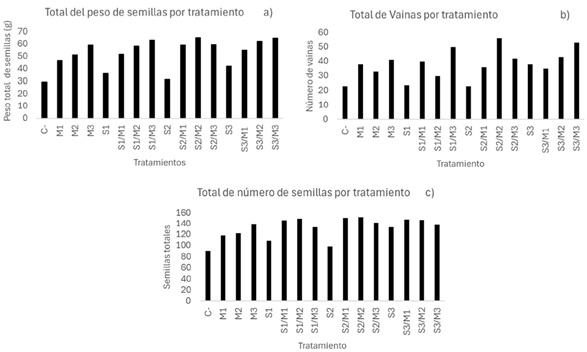
Bean seeds are of significant global importance due to their high nutritional value. Mineral fertilizers are commonly used to enhance crop productivity; however, their excessive application can be detrimental to the environment. An alternative is the use of sargassum extracts, which both reduce the demand for mineral fertilizers and help mitigate the environmental and economic problems caused by massive sargassum accumulations on coastal areas. This study evaluated the ef ficacy of combining organic fertilization based on sargassum extract (S) with mineral fertilizer (M) at dif ferent doses in pinto bean cultivation. The experiment was conducted over two cropping cycles using three concentration levels of Sargassum (S1, S2, S3), three of mineral fertilizer (M1, M2, M3), their combinations (S/M), and an unfertilized control (C-), in a randomized experimental design. Application of either M or S fertilizers increased yield compared with the control. The S2/M2 and S3/M2 combinations increased seed weight by 5% and 10%, respectively, relative to M3 alone, while S1/M2 and S2/M1 produced seed weights comparable to M3. In contrast, S3/M1 resulted in a 7% reduction in seed weight compared with M3. Neither the DPPH radical scavenging activity nor the anthocyanin content of the seeds was af fected by fertilizer treatments. These findings indicate that the combined use of sargassum extract and mineral fertilizer is a promising strategy to reduce mineral fertilizer inputs without compromising yield, while also valorizing sargassum—a low-cost material that poses environmental challenges but contains beneficial compounds for plants.

Downloads
Download data is not yet available.

Author Biographies

  • Ana Rosa Sánchez-Camarillo, Instituto Politécnico Nacional, Centro de Investigación en Biotecnología Aplicada

    Ingeniero químico, maestría en ambiental y actualmente es alumna del doctorado en Ciencias en Biotecnología del Instituto Politécnico Nacional

  • Aida Solís-Oba, Universidad Autónoma Metropolitana Unidad Xochimilco

    Recibió su doctorado en Ciencias Biológicas en 1999 de la Universidad Autónoma Metropolitana. De 1999 a 2000 fue investigadora postdoctoral en la Universidad de Florida. Es profesora del Departamento de Sistemas Biológicos de la Universidad Autónoma Metropolitana. Forma parte del equipo de biotransformaciones. Sus intereses actuales de investigación incluyen biotransformaciones utilizando plantas como fuente de enzimas y química analítica de metabolitos vegetales.

  • Rubria Marlen Martínez-Casares, Universidad Autónoma Metropolitana Unidad Xochimilco

    Tiene el grado de doctora, actualmente labora como docente en la Universidad Autónoma Metropolitana Unidad Xochimilco

  • Rigoberto Castro-Rivera, Instituto Politécnico Nacional, Centro de Investigación en Biotecnología Aplicada

    Ingeniero Agrónomo especialista en Zootecnia, Maestría en Ciencias de la Productividad Ganadera, Doctor en Ciencias en Recursos Genéticos y Productividad en Ganadería. Profesor titular C del Instituto Politécnico Nacional

Downloads

Published

30-09-2025

Issue

Section

Scientific Papers

How to Cite

Influence of Sargassum Extract and Mineral Fertilizer on the Yield of Pinto Bean (Phaseolus vulgaris L.) cv. San Rafael. (2025). TERRA LATINOAMERICANA, 43. https://doi.org/10.28940/terralatinoamericana.v43i.2155

Most read articles by the same author(s)