Isolation and in vitro Characterization of Actinobacteria from Coastal Soils Against Pathogenic Vibrios for Use as Probiotics in Aquaculture
DOI:
https://doi.org/10.28940/terralatinoamericana.v43i.2310Keywords:
marine actinomycetes, antibacterial activity, bioprotective agentsAbstract
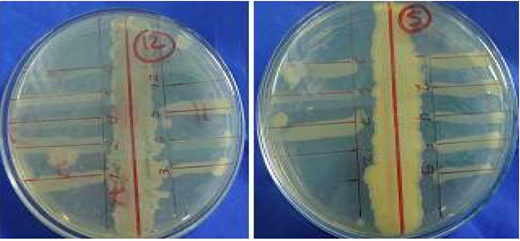
The use of probiotic bacteria has global importance in aquaculture and aquaponics because they improve growth rates and enhance the organisms resistance to disease, thus increasing production. This study aimed to isolate and characterize actinomycete strains from marine–coastal soils on both coasts of Mexico and to evaluate them in vitro against marine pathogens to determine their probiotic potential and applicability in aquaculture and aquaponics. Fif ty-four actinomycete strains were isolated, and 14 of them exhibited antibacterial activity against the evaluated Vibrio spp. species [V. alginolyticus (CIAD-CAIM 57), V. parahaemolyticus (ATCC-17802), V. harveyi (CIAD-CAIM 1793), and V. vulnificus (CIAD-CAIM 157)]. Based on the results, strain M4 was selected and characterized according to its morphological and biochemical traits. This strain showed enzymatic activity in vitro, confirming its probiotic potential and applicability in aquaculture; it also exhibited increased activity against the pathogenic vibrios tested. These results suggest that strain M4, isolated from coastal marine soil, has probiotic potential and could serve as an alternative to antibiotics to mitigate pathogen attacks in agroaquaculture production systems.
Downloads
References
Abirami, M., Khanna, V.G. & Kannabiran, K. (2013). Antibacterial activity of marine Streptomyces sp. isolated from Andaman & Nicobar Islands, India. International Journal of Pharma and Bio Sciences, 4, 280-286.
Ameen, F., AlNadhari, S. & Al-Homaidan, A.A. (2021). Marine microorganisms as an untapped source of bioactive compounds. Saudi Journal of Biological Sciences, 28, 224-231. https://doi.org/10.1016/j.sjbs.2020.09.052
Bermudez-Brito, M., Plaza-Diaz, J., Muñoz-Quezada, S., Gómez-Llorente, C. & Gil, A. (2012). Probiotic mechanisms of action. Annals of Nutrition and Metabolism, 61, 160-174. https://doi.org/10.1159/000342079
Boughachiche, F., Reghioua, S., Zerizer, H. & Boulahrouf, A. (2012). Activité antibactérienne d’espèces rares de Streptomyces contre des isolats cliniques multirésistants. Annales de Biologie Clinique (Paris), 70, 169-174. https://doi:10.1684/abc.2012.0661
Bukhari, S.I., Hamed, M M., Al-Agamy, M.H., Gazwi, H.S., Radwan, H.H. & Youssif, A.M. (2021). Biosynthesis of copper oxide nanoparticles using Streptomyces MHM38 and its biological applications. Journal of Nanomaterials, 2021, 1-16. https://doi.org/10.1155/2021/6693302
Chater, K.F., Biro, S., Lee, K.J., Palmer, T. & Schrempf, H. (2010). The complex extracellular biology of Streptomyces. FEMS Microbiology Reviews, 34, 171-198. https://doi.org/10.1111/j.1574-6976.2009.00206.x
Das, R., Romi, W., Das, R., Sharma, H.K. & Thakur, D. (2018). Antimicrobial potentiality of Actinobacteria isolated from two microbiologically unexplored forest ecosystems of Northeast India. BMC Microbiology, 18, 1-16. https://doi.org/10.1186/s12866-018-1215-7
Das, S., Ward, L.R. & Burke, C. (2008). Prospects of using marine actinobacteria as probiotics in aquaculture. Applied Microbiology Biotechnology, 81, 419-429. https://doi.org/10.1007/s00253-008-1731-8
Das, S., Ward, L.R. & Burke, C. (2010). Screening of marine Streptomyces spp. for potential use as probiotics in aquaculture. Aquaculture, 305, 32-41. https://doi.org/10.1016/j.aquaculture.2010.04.001
Dharmaraj, S. (2011). Antagonistic potential of marine Actinobacteria against fish and shellfish pathogens. Turkish Journal of Biology, 35, 303-311. https://doi.org/10.3906/biy-1001-30
Eccleston, G.P., Brooks, P.R. & Kurtböke, D.I. (2008). The occurrence of bioactive micromonosporae in aquatic habitats of the sunshine coast in Australia. Marine Drugs, 6, 243-261. https://doi.org/10.3390/md20080012
Elsayed, T. R., Galil, D. F., Sedik, M. Z., Hassan, H. M. & Sadik, M.W. Antimicrobial and anticancer activities of actinomycetes isolated from Egyptian soils. International Journal of Current Microbiology and Applied Sciences, 9, 1689-1700. https://doi.org/10.20546/ijcmas.2020.909.209
Ganesan, P., Reegan, A.D., David, R.H.A., Gandhi, M.R., Paulraj, M.G., Al-Dhabi, N.A. & Ignacimuthu, S. (2017). Antimicrobial activity of some actinomycetes from Western Ghats of Tamil Nadu, India. Alexandria Journal of Medicine, 53(2), 101-110. https://doi.org/10.1016/j.ajme.2016.03.004
García-Bernal M., Medina Marrero R., Abasolo-Pacheco F., Ojeda-Silvera C.M., Arcos-Ortega G.F. & Mazón-Suástegui J.M. 2022. Efecto antifúngico de la cepa de Streptomyces sp. RL8 y su acción promotora en la germinación y crecimiento inicial del frijol tepari (Phaseolus acutifolius Gray). Terra Latinoamericana, 40, 1-12. e1067. https://doi.org/10.28940/terra.v40i0.1067
García-Bernal M., Medina-Marrero R., Cuevas-Hernández L., Álvarez-Hernández U., Ojeda-Silvera C.M., Batista-Sánchez D. & Mazón-Suástegui J.M. 2025. Actinomicetos promueven crecimiento en plántulas de Nicotiana tabacum L. Terra Latinoamericana, 43, 1-11. e1981. https://doi.org/10.28940/terra.v43i.1981
García-Bernal, M., Campa-Córdova, A.I., Saucedo, P.E., Casanova-González, M., Medina-Marrero, R. & Mazón-Suástegui, J.M. (2015). Isolation and in vitro selection of actinomycetes strains as potential probiotics for aquaculture. Veterinary World, 8(2), 170-176. https://doi.org/10.14202/vetworld.2015.170-176
García-Bernal, M., Medina-Marrero, R., Campa-Córdova, Á.I. & Mazón-Suástegui, J.M. (2017). Probiotic effect of Streptomyces strains alone or in combination with Bacillus and Lactobacillus in juveniles of the white shrimp Litopenaeus vannamei. Aquaculture International, 25(2), 927-939. https://doi.org/10.1007/s10499-016-0085-y
García-Bernal, M., Medina-Marrero, R., Rodríguez-Jaramillo, C., Marrero-Chang, O., Campa-Córdova, Á.I., Medina García, R. & Mazón-Suástegui, J.M. (2018). Probiotic effect of Streptomyces spp. on shrimp (Litopenaeus vannamei) postlarvae challenged with Vibrio parahaemolyticus. Aquaculture Nutrition, 24(2), 865-71. https://doi.org/10.1111/anu.1262224
Gebreyohannes, G., Feleke, M., Sahile, S. & Raja, N. (2013). Isolation and characterization of potential antibiotic producing actinomycetes from water and sediments of Lake Tana, Ethiopia. Asian Pacific Journal of Tropical Biomedicine, 3(6), 426-435. https://doi.org/10.1016/S2221-1691(13)60092-1
Gil, V.G., Pastor, S. & March, G.J. (2009). Quantitative isolation of biocontrol agents Trichoderma spp., Gliocladium spp. and actinomycetes from soil with culture media. Microbiological Research, 164(2), 196-205. https://doi.org/10.1016/j.micres.2006.11.022
Gonzalez, I., Ayuso-Sacido, A., Anderson, A. & Genilloud, O. (2005). Actinomycetes isolated from lichens: Evaluation of their diversity and detection of biosynthetic gene sequences. FEMS Microbiology Ecology, 54(3), 401-415. https://doi.org/10.1016/j.femsec.2005.05.004
Harley, J.P. & Prescott, L.M. (2005). Laboratory Exercises in Microbiology. 5th ed.The McGraw Hill Companies. Boston, MA, USA.
Imada, C., Koseki, N., Kamata, M., Kobayashi, T. & Hamada-Sato, N. (2007). Isolation and characterization of antibacterial substances produced by marine actinomycetes in the presence of seawater. Actinomycetologica, 21(1), 27-31. https://doi.org/10.3209/saj.SAJ210104
Irianto, A. & Austin, B. (2002). Probiotics in aquaculture. Journal of Fish Diseases, 25(11), 633-642. https://doi.org/10.1046/j.1365-2761.2002.00422.x
Jose, P.A., Maharshi, A. & Jha, B. (2021). Actinobacteria in natural products research: Progress and prospects. Microbiological Research, 246(3), 126708. https://doi.org/10.1016/j.micres.2021.126708
León, J., Aponte, J.J., Cuadra, D., Galindo, N., Jaramillo, L., Vallejo, M. & Marguet, E. (2016). Actinomicetos aislados de Argopecten purpuratus productores de enzimas extracelulares y con actividad inhibitoria de patógenos marinos. Revista de Biología Marina y Oceanografía. 51:69-80. https://doi.org/10.4067/S0718-19572016000100007
León, J., Pellón, F., Unda, V., David, J., Anaya, C. & Mendoza, V. (2000). Producción de enzimas extracelulares por bacterias aisladas de invertebrados marinos. Revista Peruana de Biología, 7(2), 202-210. https://doi.org/10.15381/rpb.v7i2.6828
Nonomura, H. (1974). Key for classification and identification of 458 species of the Streptomycetes included in ISP. Journal of Fermentation Technology, 52(2), 78-92.
Pisano, M., Sommer, M. & Lopez, M. (1986). Application of pretreatments for the isolation of bioactive actinomycetes from marine sediments. Applied Microbiology and Biotechnology, 25, 285-288. https://doi.org/10.1007/BF00253664
Prakash, D., Nawani, N., Prakash, M., Bodas, M., Mandal, A., Khetmalas, M. & Kapadnis, B. (2013). Actinomycetes: a repertory of green catalysts with a potential revenue resource. BioMed Research International, 2013(21), 264020. https://doi.org/10.1155/2013/264020
Rammali, S., Hilali, L., Dari, K., Bencharki, B., Rahim, A., Timinouni, M. & Khattabi, A. (2022). Antimicrobial and antioxidant activities of Streptomyces species from soils of three different cold sites in the Fez-Meknes region Morocco. Scientific Reports. 12(1), 17233. https://doi.org/10.1038/s41598-022-21644-z
Ridell, M., Wallerström, G. & Williams, S.T. (1986). Immunodiffusion analysis of phenetically defined strains of Streptomyces, Streptoverticillum and Nocardiopsis. Systematic and Applied Microbiology, 8, 24-27. https://doi.org/10.1016/S0723-2020(86)80143-6
Stavropoulou, E. & Bezirtzoglou, E. (2020). Probiotics in medicine: a long debate. Frontiers in Immunology, 11, 2192. https://doi.org/10.3389/fimmu.2020.02192
Taddei, A., Rodríguez, M. J., Márquez-Vilchez, E. & Castelli, C. (2006). Isolation and identification of Streptomyces spp. from Venezuelan soils: morphological and biochemical studies. I. Microbiological Research, 161(3), 222-231. https://doi.org/10.1016/j.micres.2005.08.004
Tresner, H.D., Hayes, J.A. & Backus, E.J. (1968). Differential tolerance of Streptomycetes to sodium chloride as a taxonomic aid. Applied Microbiology, 16(8), 1134-1136. https://doi.org/10.1128/am.16.8.1134-1136.1968
Tuong, N.T.C., Nguyen Xuan, H., Le Thi Nam, T., Masaru, M. & Ikuo, M. (2011). Identification and characterization of actinomycetes antagonistic to pathogenic Vibrio spp. isolated from shrimp culture pond sediments in Thua Thien Hue–Viet Nam. Journal of the Faculty of Agriculture Kyushu University, 56(1), 15-20. https://doi.org/10.5109/19532
Valdés, M., Pérez, N. O., Estrada-de Los Santos, P., Caballero-Mellado, J., Peña-Cabriales, J. J., Normand, P. & Hirsch, A. M. (2005). Non-Frankia actinomycetes isolated from surface-sterilized roots of Casuarina equisetifolia fix nitrogen. Applied and Environmental Microbiology, 71(1), 460-466. https://doi.org/10.1128/AEM.71.1.460-466.2005
Vélez, P.E. & Rodríguez, J.R. (2012). Evaluación de etapas del proceso productivo de un bioinsumo dirigido a la degradación de materiales orgánicos y regulación sanitaria de cultivos. Revista de Investigaciones. No. 17. Centro Editorial Universidad Católica de Manizales. Disponible en: https://repositorio.ucm.edu.co/handle/10839/210
You, J., Cao, L., Liu, G., Zhou, S., Tan, H., Lin, Y. (2005). Isolation and characterization of actinomycetes antagonistic to pathogenic Vibrio spp. from nearshore marine sediments. World Journal of Microbiology and Biotechnology. 21 679-682. https://doi.org/10.1007/s11274-004-3851-3
Zhou, X., Wang, Y., Li, W. (2009). Effect of probiotic on larvae shrimp (Penaeus vannamei) based on water quality, survival rate and digestive enzyme activities. Aquaculture, 287(3), 349-353. https://doi.org/10.1016/j.aquaculture.2008.10.046