Biological Performance of Eisenia foetida and Quality of Vermicompost Generated from Dif ferent Organic Sources
DOI:
https://doi.org/10.28940/terralatinoamericana.v43i.2367Keywords:
bio-factory, vermicompost, soil recovery, vermicompostingAbstract
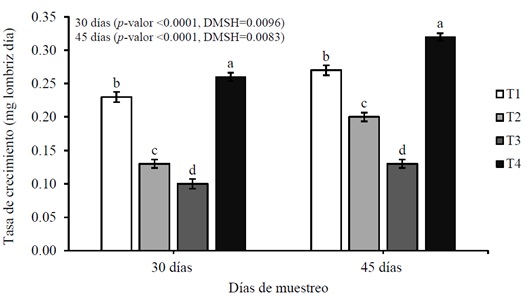
The degradation of agricultural soils decreases their fertility and nutrient retention capacity, making the application of organic amendments, such as vermicompost, essential for their restoration and functional improvement. The objective of this study was to evaluate the biological performance of the Californian red worm (Eisenia foetida Sav.) and the quality of the vermicompost generated from four organic substrate mixtures: cattle manure + banana rachis (T1), cattle manure + palm rachis (T2), cattle manure + coconut rachis (T3), and cattle manure + market plant waste (T4), with 50:50 ratios (% by volume). The experimental design used was a randomized block with eight replications. The length, population, growth, and reproduction rates of the red worm were evaluated 30 and 45 days af ter the start of the treatments, in addition to the yield and bromatological quality of the vermicompost produced. The best results were obtained af ter 45 days of evaluation. Treatments T1, T4, and T2 showed the highest average worm lengths, with values of 5.58 ± 0.09, 5.53 ± 0.16, and 5.40 ± 0.25 cm, respectively. Treatment T4 recorded the highest population density, with 4319.75 ± 64.71 worms m³, as well as the highest growth rate (0.32 ± 0.01 mg worm⁻¹ day⁻¹) and the highest reproduction index (14.56 ± 0.23%). Treatment T1 had the highest vermicompost yield, with 40.38±0.58 kg m³, an alkaline pH of 8.77 ± 0.15, and a K content of 1.57 ± 0.01%. However, treatment T3 showed the highest organic matter content (50.97 ± 0.21%), total carbon
(22.23 ± 0.99%), and a C/N ratio of 22.61 ±0.70. These results demonstrate the potential of vermicomposting as an ef ficient biotechnological strategy for the reproduction of the Californian red worm and the utilization of agro-industrial organic waste, enabling the production of high-quality organic amendments for the recovery and improvement of agricultural soils.
Downloads
Publication Facts
Reviewer profiles N/A
Author statements
- Editor & editorial board
- profiles
- Academic society
- Terra Latinoamericana
- Publisher
- Mexican Society of Soil Science, C.A.

To learn about these publication facts, click 
PF is maintained by the Public Knowledge Project
References
Alonso J, García MA, Pérez-López M, & Melgar MJ (2024). Acumulacion de metales pesados en macromicetos comestibles y factores que influyen en su captación. Rev.Toxicol., 21 (1): 11-15.
Ashok KK, Subalakshmi R, Jayanthi M, Abirami G, Vijayan DS, Venkatesa PS, & Baskaran L (2023). Production and characterization of enriched vermicompost from banana leaf biomass waste activated by biochar integration. Environ Res, 219: 115090. https://doi.org/10.1016/j.envres.2022.115090
Benavides BJ, Espitia MA, Bracho LL, & Benítez PN (2006). Manejo de la lombriz roja californiana (Eisenia foetida) para producir lombricompusto en la costa atlantica. Corpoica, 1 (1): 1-14.
Berrospe-Ochoa EA, Ordaz-Chaparro VM, Rodríguez-Mendoza MdlN, & Quintero-Lizaola R (2012). Cachaza como sustrato para la producción de plántulas de tomate. Revista Chapingo Serir Horticultura 18 (1): 141-156.
Biruntha M, Karmegam N, Archana J, Karunai Selvi B, John Paul JA, Balamuralikrishnan B. . . Ravindran B (2020). Vermiconversion of biowastes with low-to-high C/N ratio into value added vermicompost. Bioresour Technol, 297 (1): 122398. https://doi.org/10.1016/j.biortech.2019.122398
Bugarín-Montoya R, Virgen-Ponce M, Galvís-Spinola A, García-Paredes D, Hernández-Mendoza T, Bojorquez-Serrano I, & Madueño-Molina A (2011). Extracción de nitrógeno en seís especies olerícolas durantes su ciclo de crecimiento. Biagro, 23 (2): 93-98.
Campoverde SDK, Velasco Matveev LA, & Acurio Martínez WD (2020). Aplicación de sustratos orgánicos en la cría de la lombriz roja californiana (Eisenia foetidae) para la producción de alimento animal. ConcienciaDigital, 3 (3.1): 22-35. https://doi.org/10.33262/concienciadigital.v3i3.1.1354
Canales GA, Solís RBJ, Panca CRJ, & Quispe C, Bessy Laleska (2020). Crianza de Eisenia foetida (lombriz roja) en diferentes sustratos de desarrollo biológico. Ecología Aplicada, 19 (2). https://doi.org/10.21704/rea.v19i2.1559
Carvajal MJS, & Mera BAC (2010). Fertilización biológica: técnicas de vanguardia para el desarrollo agrícola sostenible. Producción + Limpia, 5 (2): 77-96.
Colín NV, Avilés NF, Domínguez VIA, Olivares PJ, & R SC. (2014). Efecto de la dieta sobre la tasa de crecimiento y reproducción de Eisenia fetida L. en el sur del Estado de México. In G. R. Basurto, E. A. M. Anaya, E. R. Santos, & M. L. Reyes (Eds.), Reunión Nacional de Investigación Pecuaria, Memoria (pp. 783-785).
Das D, & Deka H (2021). Vermicomposting of harvested waste biomass of potato crop employing Eisenia fetida: changes in nutrient profile and assessment of the maturity of the end products. Environ Sci Pollut Res Int, 28 (27): 35717-35727. https://doi.org/10.1007/s11356-021-13214-z
de Gante CVH (2013). La lombricultura: alternativa a la disposición final de residuos domicilarios. Elemento, 89 (1): 43-46.
De la Cruz CMV (2023). Humus de lombriz roja californiana (Eisenia fetida) a partir de la combinación de residuos orgánicos. Erevna: Research Reports, 1 (1). https://doi.org/10.70171/qe9dvn74
Flores-Pacheco JA, Romero O, Vivas E, Lacayo J, & Cassell´s R (2018). Evaluación de la viabilidad de distintas dietas para la producción de Lombrihumus con las especies Eisenia foetida y Eudrillus sp. Nexo Revista Científica, 31 (01): 28-46. https://doi.org/10.5377/nexo.v31i01.6452
González-Márquez LC, Félix-Gastélum R, Sandoval-Romero JA, Escobedo-Urías DC, & Longoria-Espinoza RM (2021). Caracterización de biofertilizantes utilizados en el valle agrícola de Guasave, Sinaloa, México. Revista Terra Latinoamericana, 39. https://doi.org/10.28940/terra.v39i0.859
Guamán-Rivera SA, & Flores-Mancheno CI (2023). Seguridad Alimentaria y Producción Agrícola Sostenible en Ecuador. Revista Científica Zambos, 2 (1): 1-20. https://doi.org/10.69484/rcz/v2/n1/35
Hussain N, & Abbasi S (2018). Efficacy of the vermicomposts of different organic wastes as “clean” fertilizers: State-of-the-art. Sustainability, 10 (4). https://doi.org/10.3390/su10041205
Mancera-Rodríguez NJ, & Álvarez LR (2006). Estado del conocimiento de las concentraciones de mercurio y otros metales pesados en peces dulceacuícolas de colombia. Acta Biológica Colombiana 11 (1): 3-23.
Manqueira RD, Pérez DM, Díaz LMS, Ravelo A, & Izquierdo DR (2022). Comportamiento productivo, reproductivo y morfometrpia de la lombriz roja californiana en sistemas de vermicompostaje de residuos orgánicos. Ecovida, 12 (3): 257-266.
Martínez AAM, & Cayón S (2021). Dinámica del crecimiento y desarrollo del banano (Musa AAA Simmonds cvs. gran Enano y Valery). Rev. Fac. Nal. Agr. Medellín, 64 (2): 6055-6064.
Oviedo-Ocaña ER, Marmolejo RLF, & Torres LP (2014). Influencia de la frecuencia de volteo para el control de la humedad de los sustratos en el compostaje de biorresiduos de origen municipal. Rev. Int. Contam. Ambie., 30 (1): 91-100.
Pérez A, Céspedes C, & Núñez P (2008). Caracterización física-química y biológica de enmiendas orgánicas aplicadas en la producción de cultivos en República Dominicana. J. Soil Sc. Plant Nutri., 8 (4): 10-29.
Pupiro LA, Vilches E, Núñez E, Gómez J, Báez M, & León P (2004). Efecto del humus de lombriz en el rendimiento y las principales plagas insectiles en el cultivo del frijol (Phaseolus vulgaris L.). Cultivos Tropicales, 25 (1): 89-95.
Rahman A, Hashem MA, Kabir AKMA, Bhuiyan MKJ, & Rahman MM (2020). Influence of amount of red worm (Eisenia foetida) on the organic matter degradation during vermicomposting of cattle manure. Bangladesh Journal of Animal Science, 49 (1): 45-54.
Räty M, & Huhta V (2004). Earthworm communities in birch stands with different origin in central Finland. Pedobiologia, 48 (3): 283-291. https://doi.org/10.1016/j.pedobi.2004.02.002
Ravelo PK, Pérez DM, Toledo PLE, Martínez RM, & Maqueira RD (2023). Efecto de la utilización de estiércol porcino y caprino como sustrato en la producción de humus de lombriz Eisenia foetida (Lombriz roja californiana). Ecovida, 13 (2): 58-67.
Rodríguez DN, Cano RP, Figueroa VU, Palomo GA, Favela CE, Álvarez RVdP. . . Moreno RA (2008). Producción de tomate en invernadero con humus de lombriz como sustrato. Rev. Fitotec. Mex., 31 (3): 265-272.
Sharma K, & Garg VK (2019). Recycling of lignocellulosic waste as vermicompost using earthworm Eisenia fetida. Environ Sci Pollut Res Int, 26 (14): 14024-14035. https://doi.org/10.1007/s11356-019-04639-8
Singh AK, AK T, Singh SRK, & Raj KY (2021). Significance of substrate straw on nutritive quality of vermicompost and growth of vermiworm species Eisenia fetida. The Pharma Innovation Journal, 10 (2): 590-596.
Soares JC, Santos CS, Carvalho SMP, Pintado MM, & Vasconcelos MW (2019). Preserving the nutritional quality of crop plants under a changing climate: importance and strategies. Plant and Soil, 443 (1-2): 1-26. https://doi.org/10.1007/s11104-019-04229-0
Soto-Valenzuela JO, Álvarez-Vera MS, Vázquez Vásquez JE, & Ricardo Ricardo GB (2024). Evaluación físico, químico y microbiológico del suelo en cultivos de Musa paradisiaca Cavendish y Elaeis guineensis Jac. Provincia de los Ríos. Revista Alfa, 8 (22): 110-125. https://doi.org/10.33996/revistaalfa.v8i22.252
Swarnam TP, Velmurugan A, Pandey SK, & Dam Roy S (2016). Enhancing nutrient recovery and compost maturity of coconut husk by vermicomposting technology. Bioresour Technol, 207: 76-84. https://doi.org/10.1016/j.biortech.2016.01.046
Torrendel M, Useta G, & Pelerino F (2008). La yerba no es basura lombricultura y producción de vermicompost a partir de residuos de yerba mate en Uruguay. Inn Tec, 3 (2): 35-39.