Weed Communities in Ecuadorian Cacao: Diversity, Abundance and Ecological Functions for Bioremediation Strategies and Sustainable Management of Tropical Agricultural Soils
DOI:
https://doi.org/10.28940/terra.latinam..v44i.2499Keywords:
Jaccard coef ficient, reproductive dynamics, importance value index (IVI), morphotypes, Bray-Curtis similarityAbstract
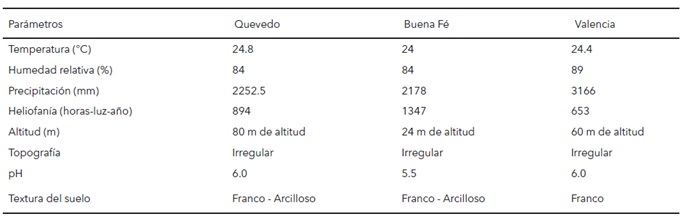
Ecuador ranks fourth worldwide in cocoa production and first as the leading producer of fine-flavor cocoa. In this context, weeds—plants without economic value in agronomic systems—af fect crop productivity and development, making them one of the most important constraints in agricultural production. The objective of this research was to identify the weed community associated with cocoa (Theobroma cacao L.) cultivation by evaluating the diversity and abundance of weed species in three localities of the Ecuadorian tropics: Quevedo, Buena Fe, and Valencia. Analysis of weed biological diversity at the family and locality levels showed that the families Caryophyllaceae, Fabaceae, and Cucurbitaceae exhibited high values across dif ferent diversity indices. At the locality level, Buena Fe showed greater diversity according to the Individual Index, whereas Valencia stood out according to the Simpson (1–D), Shannon (H′), and Equitability (J) indices. Similarities among localities, evaluated using Jaccard and Bray–Curtis coef ficients, revealed patterns of resemblance and dif ferentiation in weed species composition. According to the Importance Value Index (IVI), Geophila macropoda (Ruiz & Pav.) DC. was the most important species overall. At the locality level, Buena Fe was characterized by the predominance of Drymaria cordata (L.) Willd. ex Schult., whereas Psychotria nervosa Sw. was the most prominent species in Valencia. Functional analysis of reproductive traits and interference within the weed community revealed a diversity of morphotypes and reproductive strategies, highlighting the presence of both annual and perennial life cycles, as well as various propagation mechanisms. The families Poaceae, Asteraceae, and Urticaceae were consistently represented and particularly relevant in this context. These findings underscore the importance of considering the diversity and specific characteristics of weed communities when making decisions related to sustainable agricultural management.
Downloads
References
Arias, A. (2021). Manejo integrado de cacao (Theobroma cacao L.): Enmiendas edáficas, efecto en la floración y cuajado de fruto [Tesis de grado]. Universidad Técnica de Machala.
Armengot, L., & Marconi, L. (2020). Complex agroforestry systems against biotic homogenization: the case of plants in the herbaceous stratum of cocoa production systems. Agriculture, Ecosystems & Environment, 287, 106664.
Armengot, L., Barbieri, P., Andres, C., Milz, J., & Schneider, M. (2016). Cacao agroforestry systems have higher return on labor compared to full-sun monocultures. Agronomy for Sustainable Development, 36, 70.
Armengot, L., Ferrari, L., Milz, J., Velásquez, F., Hohmann, P., & Schneider, M. (2020). Cacao agroforestry systems do not increase pest and disease incidence compared with monocultures under good cultural management practices. Crop Protection, 130, 105047.
Armengot, L., Picucci, M., Milz, J., Hansen, J. K., & Schneider, M. (2023). Locally-selected cacao clones for improved yield: a case study in different production systems in a long-term trial. Frontiers in Sustainable Food Systems, 7, 1253063.
Arroyo, D., Garay, J., Demaría, M., & Rauber, R. (2019). Malezas del semiárido central argentino. INTA.
Blanco-Valdés, Y. (2016). The role of weeds as a component of biodiversity in agroecosystems. Cultivos Tropicales, 37(4), 34–56.
Carias, W., Lewis, T., & Moreno, M. (2010). Efecto del manejo de malezas en la fenología y rendimiento de dos variedades de maíz Zea mays, en la biodiversidad, abundancia de malezas e insectos, durante el período de marzo a junio del 2010 [Tesis doctoral]. Centro Nacional de Referencia de Agroplasticultura (CNRA), UNAN-León.
Castro, V., Alvarado, L., Borjas, R., & Julca, A. (2019). Comunidad de malezas asociadas al cultivo de café (Coffea arabica, Rubiaceae) en la selva central del Perú. Arnaldoa, 26(3), 977–990. https://doi.org/10.22497/arnaldoa.263.26308
Cerda, R., Deheuvels, O., Calvache, D., Niehaus, L., Saenz, Y., Kent, J., Vilchez, S., Villota, A., Martinez, C., & Somarriba, E. (2014). Contribution of cocoa agroforestry systems to family income and domestic consumption: looking toward intensification. Agroforestry Systems, 88, 957–981.
Clough, Y., Faust, H., & Tscharntke, T. (2009). Cacao boom and bust: sustainability of agroforests and opportunities for biodiversity conservation. Conservation Letters, 2(5), 197–205.
Curtis, J., & McIntosh, R. (1951). An upland forest continuum in the prairie-forest border region of Wisconsin. Ecology, 32(3), 476–496. https://doi.org/10.2307/1931725
Dorado Orea, M. D., Romero-Cortes, T., López-Pérez, P. A., Pérez Espana, V. H., Ramírez-Lepe, M., & Cuervo-Parra, J. A. (2017). Current status of cocoa frosty pod rot caused by Moniliophthora roreri and a phylogenetic analysis. Plant Pathology Journal, 16(1), 41–53.
Esche, L., Schneider, M., Milz, J., & Armengot, L. (2023). The role of shade tree pruning in cocoa agroforestry systems: agronomic and economic benefits. Agroforestry Systems, 97(1), 175–185.
Galeazzi, M. (2015). Relevamiento de malezas en cultivos de soja en la zona de Colonia Las Ensenadas, Dpto. Río Cuarto (Córdoba, Argentina). Universidad Nacional de Río Cuarto.
Jacobi, J., Andres, C., Schneider, M., Pillco, M., Calizaya, P., & Rist, S. (2014). Carbon stocks, tree diversity, and the role of organic certification in different cocoa production systems in Alto Beni, Bolivia. Agroforestry Systems, 88(6), 1117–1132.
Jacobi, J., Schneider, M., Bottazzi, P., Pillco, M., Calizaya, P., & Rist, S. (2013). Agroecosystem resilience and farmers’ perceptions of climate change impacts on cocoa farms in Alto Beni, Bolivia. Renewable Agriculture and Food Systems, 30(2), 170–183.
Krauss, U., & Soberanis, W. (2002). Effect of fertilization and biocontrol application frequency on cocoa pod diseases. Biological Control, 24(1), 82–89.
Läderach, P., Martinez-Valle, A., Schroth, G., & Castro, N. (2013). Predicting the future climatic suitability for cocoa farming of the world’s leading producer countries, Ghana and Côte d’Ivoire. Climatic Change, 119(3-4), 841–854.
Marconi, L., & Armengot, L. (2020). Complex agroforestry systems against biotic homogenization: the case of plants in the herbaceous stratum of cocoa production systems. Agriculture, Ecosystems & Environment, 287, 106664.
Mueller, D., & Ellenberg, H. (1974). Aims and methods of vegetation ecology. Vegetation Analysis in the Field (Vol. 23).
Niether, W., Armengot, L., Andres, C., Schneider, M., & Gerold, G. (2018). Shade trees and tree pruning alter throughfall and microclimate in cocoa (Theobroma cacao L.) production systems. Annals of Forest Science, 75(2), 38.
Niether, W., Jacobi, J., Blaser, W. J., Andres, C., & Armengot, L. (2020). Cocoa agroforestry systems versus monocultures: a multi-dimensional meta-analysis. Environmental Research Letters, 15(10), 104085.
Pérez-Neira, D., Schneider, M., & Armengot, L. (2020). Crop-diversification and organic management increase the energy efficiency of cacao plantations. Agricultural Systems, 177, 102711.
Phillips-Mora, W., & Wilkinson, M. J. (2007). Frosty pod of cacao: a disease with a limited geographic range but unlimited potential for damage. Phytopathology, 97(12), 1644–1647.
Pognante, S. (2013). Relevamiento de malezas en cultivos de soja en la zona de Monte Maiz, Dpto. Unión, Córdoba–Argentina. Universidad Nacional de Río Cuarto.
Quintero-Pertúz, I., Carbonó-Delahoz, E., Hoyos, V., Jarma-Orozco, A., & Plaza, G. (2021). Fitosociología de malezas en plantaciones bananeras en el departamento del Magdalena, Colombia. Caldasia, 43(1), 80–93. https://doi.org/10.15446/caldasia.v43n1.83554
Ramírez, J., Hoyos, V., & Plaza, G. (2015). Fitosociología de malezas asociadas al cultivo de arroz en el departamento del Tolima, Colombia. Agronomía Colombiana, 33(1), 64–73.
Ramírez-Argueta, O., Orozco-Aguilar, L., Dubón, A. D., Díaz, F. J., Sánchez, J., & Casanoves, F. (2022). Timber growth, cacao yields, and financial revenues in a long-term experiment of cacao agroforestry systems in northern Honduras. Frontiers in Sustainable Food Systems, 6, 941743.
Schneider, M., Andres, C., Trujillo, G., Alcon, F., Amurrio, P., Perez, E., Weibel, F., & Milz, J. (2017). Cocoa and total system yields of organic and conventional agroforestry vs. monoculture systems in a long-term field trial in Bolivia. Experimental Agriculture, 53(3), 351–374.
Ten Hoopen, G. M., Deberdt, P., Mbenoun, M., & Cilas, C. (2012). Modelling cacao pod growth: implications for disease control. Annals of Applied Biology, 160(3), 260–272.
Tscharntke, T., Clough, Y., Bhagwat, S. A., Buchori, D., Faust, H., Hertel, D., Hölscher, D., Juhrbandt, J., Kessler, M., Perfecto, I., Scherber, C., Schroth, G., Veldkamp, E., & Wanger, T. C. (2011). Multifunctional shade-tree management in tropical agroforestry landscapes—a review. Journal of Applied Ecology, 48(3), 619–629.
Willer, H., & Lernoud, J. (2018). The World of Organic Agriculture. Statistics and Emerging Trends 2018. Research Institute of Organic Agriculture (FiBL) and IFOAM - Organics International.
Worm, A., Santos, M., Morán, I., Vargas, P., Comboza, W., & Lara, E. (2018). Malezas presentes en cultivos del cantón Naranjal, Provincia Guayas, Ecuador. Investigatio, 11, 1–16.