Caracterización de Cepas Nativas de Beauveria bassiana Aisladas de Suelos y su Potencial para el Control Biológico de Cosmopolites sordidus en Ecuador
DOI:
https://doi.org/10.28940/terralatinoamericana.v44i.2446Palabras clave:
banano, biotecnología, entomopatógeno, picudo, rizosferaResumen
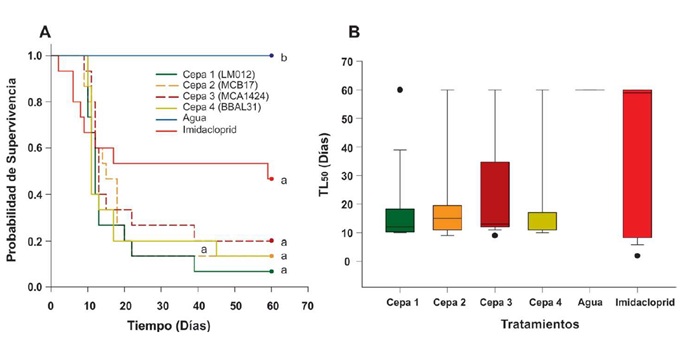
El hongo entomopatógeno Beauveria bassiana es ampliamente reconocido por su eficacia en el control biológico de Cosmopolites sordidus (picudo negro del banano); sin embargo, se desconoce sobre el potencial entomopatógeno que existen entre cepas nativas del Ecuador. Esta falta de información limita la selección de aislamientos con mayor virulencia, adaptación local o capacidad de persistencia en campo. El objetivo de este estudio fue caracterizar molecular, microscópica y macroscópicamente cuatro cepas nativas de B. bassiana aisladas de la rizosfera del banano y evaluar su efectividad en el control de C. sordidus bajo condiciones controladas. Los aislados codificados como LM012, MCB17, MCA1424 y BBAL31 fueron identificados como B. bassiana y exhibiendo una alta similitud con secuencias de cepas de referencia conocidas. Los aislados de B. bassiana presentaron diferencias en la morfología colonial principalmente en el patrón de crecimiento, color, textura y elevación, estas variaciones morfológicas reflejan la diversidad fenotípica entre los aislados. La exposición de suspenciones de cuatro cepas de B. bassiana en concentración de 1×10⁹ conidios mL-1 causaron el 100% de la mortalidad de adultos de C. sordidus, con el insecticida imidacloprid se alcanzó el 50% de mortalidad. Los valores de TL₅₀ fueron de 12, 15, 13 y 11 días para las cepas LM012, MCB17, MCA1424 y BBAL31, respectivamente, mientras que con imidacloprid fue de 59 días. Adicionalmente, no se observaron diferencias en el porcentaje de colonización de B. bassiana en el cuerpo de adultos de C. sordidus (p > 0.001). Los resultados obtenidos aportan evidencia relevante sobre la eficacia y versatilidad de B. bassiana como herramienta biotecnológica para el control de plagas, contribuyendo al fortalecimiento del enfoque ecológico en la protección vegetal y al diseño de estrategias de manejo integrado más sostenibles y seguras para el ambiente.
Descargas
Referencias
Abdelaziz, O., Senoussi, M. M., Oufroukh, A., Birgücü, A. K., Karaca, İ., Kouadri, F., Naima, B., & Bensegueni, A. (2018). Pathogenicity of three entomopathogenic fungi, to the aphid species, Metopolophium dirhodum (Walker) (Hemiptera: Aphididae), and their alkaline protease activities. Egyptian Journal of Biological Pest Control, 28(1), 1–5. https://doi.org/10.1186/s41938-018-0030-7
Abdel-Raheem, M. (2019). Isolation, mass production and application of entomopathogenic fungi for insect pests control. In Cottage Industry of Biocontrol Agents and Their Applications: Practical Aspects to Deal Biologically with Pests and Stresses Facing Strategic Crops. https://doi.org/10.1007/978-3-030-33161-0_7
Akello, J., Dubois, T., Coyne, D., & Kyamanywa, S. (2008). Effect of endophytic Beauveria bassiana on populations of the banana weevil, Cosmopolites sordidus, and their damage in tissue-cultured banana plants. Entomologia Experimentalis et Applicata, 129(2), 157–165. https://doi.org/10.1111/j.1570-7458.2008.00759.x
Akello, J., Dubois, T., Coyne, D., & Hillnhutter, C. (2009). Beauveria bassiana as an endophyte in tissue-cultured banana plants: A novel way to combat the banana weevil Cosmopolites sordidus. Acta Horticulturae, 828, 129–138. https://doi.org/10.17660/ActaHortic.2009.828.12
Alali, S., Mereghetti, V., Faoro, F., Bocchi, S., Azmeh, F. A., & Montagna, M. (2019). Thermotolerant isolates of Beauveria bassiana as potential control agent of insect pest in subtropical climates. PLoS ONE, 14(2). https://doi.org/10.1371/journal.pone.0211457
Alpizar, D., Fallas, M., Oehlschlager, A. C., & Gonzalez, L. M. (2012). Management of Cosmopolites sordidus and Metamasius hemipterus in Banana by Pheromone-Based Mass Trapping. Journal of Chemical Ecology, 38(3), 245–252. https://doi.org/10.1007/s10886-012-0091-0
Augustyniuk-Kram, A. (2018). Relationships between host insect, enzymatic activity and virulence of isolates of the entomopathogenic fungus Beauveria bassiana (Bals.-Criv.) Vuill. (Hypocreales). Acta Zoologica Bulgarica, 70, 3–10. https://www.scopus.com/inward/record.uri?eid=2-s2.0-85052389223&partnerID=40&md5=efd9be00fb864fc56c99fe7704b030a5
Baek, S., Noh, M. Y., Mun, S., Lee, S. J., Arakane, Y., & Kim, J. S. (2022). Ultrastructural analysis of beetle larva cuticles during infection with the entomopathogenic fungus, Beauveria bassiana. Pest Management Science, 78(8), 3356–3364. https://doi.org/10.1002/ps.6962
Bakaze, E., Beloved, |, Dzomeku, M., & Wünsche, J.-N. (2020). Banana defence responses to Cosmopolites sordidus feeding and methyl jasmonate application. https://doi.org/10.1111/aab.12638
Boucher, O., Simard, M.-N., Muckle, G., Rouget, F., Kadhel, P., Bataille, H., Chajès, V., Dallaire, R., Monfort, C., Thomé, J.-P., Multigner, L., & Cordier, S. (2013). Exposure to an organochlorine pesticide (chlordecone) and development of 18-month-old infants. NeuroToxicology, 35(1), 162–168. https://doi.org/10.1016/j.neuro.2013.01.007
Chaithra, M., Prameeladevi, T., Bhagyasree, S. N., Prasad, L., Subramanian, S., & Kamil, D. (2022). “Multilocus sequence analysis for population diversity of indigenous entomopathogenic fungus Beauveria bassiana and its bio-efficacy against the cassava mite, Tetranychus truncatus Ehara (Acari: Tetranychidae).” Frontiers in Microbiology, 13. https://doi.org/10.3389/fmicb.2022.1007017
Cito, A., Barzanti, G. P., Strangi, A., Francardi, V., Zanfini, A., & Dreassi, E. (2016). Cuticle-degrading proteases and toxins as virulence markers of Beauveria bassiana (Balsamo) Vuillemin. Journal of Basic Microbiology, 56(9), 941–948. https://doi.org/10.1002/jobm.201600022
De Graaf, J., Govender, P., Schoeman, A. S., & Viljoen, A. (2008). Efficacy of cultural control measures against the banana weevil, Cosmopolites sordidus (Germar), in South Africa. Journal of Applied Entomology, 132(1), 36–44. https://doi.org/10.1111/j.1439-0418.2007.01252.x
Dhar, S., Jindal, V., & Gupta, V. K. (2016). Optimization of growth conditions and medium composition for improved conidiation of newly isolated Beauveria bassiana strains. Indian Journal of Experimental Biology, 54(10), 634–643. https://www.scopus.com/inward/record.uri?eid=2-s2.0-84992090915&partnerID=40&md5=3829861b513767a05d6a027c47db1c91
Dhawan, M., Joshi, N., Kaur, S., & Sandhu, S. (2020). Deciphering the relationships among enzymatic systems and virulence of beauveria bassiana: A review. Journal of Experimental Biology and Agricultural Sciences, 8(6), 730–742. https://doi.org/10.18006/2020.8(6).730.742
Fancelli, M., Dias, A. B., Delalibera Júnior, I., Jesus, S. C. De, Nascimento, A. S. Do, Silva, S. D. O. E., Caldas, R. C., & Ledo, C. A. D. S. (2013). Beauveria bassiana strains for biological control of Cosmopolites sordidus (Germ.) (Coleoptera: Curculionidae) in plantain. BioMed Research International, 2013. https://doi.org/10.1155/2013/184756
Figueroa, L. B. P., Ferreira, J. M., Mamani, R. C. C., & de Freitas Soares, F. E. (2024). Biochemistry, Pathogenesis, and Parasitism of Beauveria. In Entomopathogenic Fungi: Prospects and Challenges (pp. 227–245). https://doi.org/10.1007/978-981-97-5991-0_10
Gold, C. S., Ragama, P. E., Coe, R., & Rukazambuga, N. D. T. M. (2005). Selection of assessment methods for evaluating banana weevil Cosmopolites sordidus (Coleoptera: Curculionidae) damage on highland cooking banana (Musa spp., genome group AAA-EA). Bulletin of Entomological Research, 95(2), 115–123. https://doi.org/10.1079/BER2004341
Gutiérrez, Y., Alarcón, K. A., Ortiz, C., Santos-Holguín, J. M., García-Riaño, J. L., Mejía, C., Amaya, C. V, & Uribe-Gutiérrez, L. (2024). Isolation and characterization of a native strain of the entomopathogenic fungus Beauveria bassiana for the control of the palm weevil Dynamis borassi (Coleoptera: Curculionidae) in the neotropics. World Journal of Microbiology and Biotechnology, 40(9). https://doi.org/10.1007/s11274-024-04044-5
Halim, N. A., Ahmad, R. H. I. R., Zakaria, A., Rafie, M. B. S. A., Syarif, M. N. Y., Khudri, N. A. F. R. S., Othman, N. W., & Azmi, W. A. (2024). Pathogenicity of native entomopathogenic fungus, Beauveria bassiana (Bals.-Criv.) Vuill. on the red palm weevil, Rhynchophorus ferrugineus Olivier Adults;]. Serangga, 29(3), 130 – 144. https://doi.org/10.17576/serangga-2024-2903-10
Hapsoh, Salbiah, D., & Dini, I. R. (2020). Isolation Beauveria bassiana Vuill. Entomopathogen Local from Plant Agriculture Rhizosphere in Riau Province, Indonesia with Insect Bait Tenebrio molitor Larvae. Journal of Physics: Conference Series, 1655(1). https://doi.org/10.1088/1742-6596/1655/1/012024
He, L.-M., Hu, X.-L., Chen, X., Zhang, S.-L., Luan, F.-G., & Li, Z.-Z. (2012). Genetic diversity and population genetic structure of Beauveria bassiana in northern China. Chinese Journal of Applied Ecology, 23(11), 3087–3095. https://www.scopus.com/inward/record.uri?eid=2-s2.0-84870749740&partnerID=40&md5=bb956ae86f8da4da9671be99728e0b1c
Indriyanti, D. R., Alfien, M. Y., Bintari, S. H., Setiati, N., Sumantri, G., & Prarastyani, H. (2022). Beauveria bassiana Growth and Development in Various Liquid Media. Biosaintifika, 14(3), 428–434. https://doi.org/10.15294/biosaintifika.v14i3.39705
Kary, N. E., Alizadeh, Z., & Dunphy, G. (2022). Evolutionary distinction between the geographical isolates of Beauveria bassiana from Iran and their efficacy against Helicoverpa armigera. International Journal of Tropical Insect Science, 42(3), 2083 – 2092. https://doi.org/10.1007/s42690-022-00729-2
Kisaakye, J., Fourie, H., Coyne, D., Cortada, L., Masinde, S., Subramanian, S., & Haukeland, S. (2021). Evaluation of the entomopathogenic potential of Beauveria bassiana, Metarhizium anisopliae and Isaria fumosorosea for management of Cosmopolites sordidus Germar (Coleoptera: Curculionidae). Agriculture (Switzerland), 11(12). https://doi.org/10.3390/agriculture11121290
Lopes, R. B., Michereff-Filho, M., Tigano, M. S., Neves, P. M. O. J., López, E. L., Fancelli, M., & da Silva, J. P. (2011). Virulence and horizontal transmission of selected Brazilian strains of Beauveria bassiana against cosmopolites sordidus under laboratory conditions. Bulletin of Insectology, 64(2), 201–208. https://www.scopus.com/inward/record.uri?eid=2-s2.0-82355181788&partnerID=40&md5=45a7cb137a7dd6b2881ea9a989f888f8
Mamy, L., Pesce, S., Sanchez, W., Aviron, S., Bedos, C., Berny, P., Bertrand, C., Betoulle, S., Charles, S., Chaumot, A., Coeurdassier, M., Coutellec, M.-A., Crouzet, O., Faburé, J., Fritsch, C., Gonzalez, P., Hedde, M., Leboulanger, C., Margoum, C., … Leenhardt, S. (2025). Impacts of neonicotinoids on biodiversity: a critical review. Environmental Science and Pollution Research, 32(6), 2794–2829. https://doi.org/10.1007/s11356-023-31032-3
Mantzoukas, S., Kitsiou, F., Natsiopoulos, D., & Eliopoulos, P. A. (2022). Entomopathogenic Fungi: Interactions and Applications. Encyclopedia, 2(2), 646–656. https://doi.org/10.3390/encyclopedia2020044
Membang, G., Ambang, Z., Mahot, H. C., Kuate, A. F., Fiaboe, K. K. M., & Hanna, R. (2020). Cosmopolites sordidus (Germar) susceptibility to indigenous Cameroonian Beauveria bassiana (Bals.) Vuill. and Metarhizium anisopliae (Metsch.) isolates. Journal of Applied Entomology, 144(6), 468–480. https://doi.org/10.1111/jen.12757
Meyling, N. V., & Eilenberg, J. (2007). Ecology of the entomopathogenic fungi Beauveria bassiana and Metarhizium anisopliae in temperate agroecosystems: Potential for conservation biological control. Biological Control, 43(2), 145–155. https://doi.org/10.1016/J.BIOCONTROL.2007.07.007
Mishra, S., Pang, S., Zhang, W., Lin, Z., Bhatt, P., & Chen, S. (2021). Insights into the microbial degradation and biochemical mechanisms of carbamates. Chemosphere, 279. https://doi.org/10.1016/j.chemosphere.2021.130500
Mitina, G. V, Tokarev, Y. S., Movila, A. A., & Yli-Mattila, T. (2011). Polymorphism of Beauveria bassiana (Deuteromycota: Hyphomycetes) strains isolated from Ixodes ricinus (Acari: Ixodidae) in Moldova. Ticks and Tick-Borne Diseases, 2(1), 50–54. https://doi.org/10.1016/j.ttbdis.2010.10.005
Mongyeh E. T., Ndamukong K. J. N., & Okolle J. N. (2015). Effects of insecticides with different modes of action in the control of banana weevils (Cosmopolites sordidus) in Cameroon. https://www.researchgate.net/publication/309204203
Negrete González, D., Ávalos Chávez, M. A., Lezama Gutiérrez, R., Chan Cupul, W., Molina Ochoa, J., & Galindo Velasco, E. (2018). Suitability of Cordyceps bassiana and Metarhizium anisopliae for biological control of Cosmopolites sordidus (Germar) (Coleoptera: Curculionidae) in an organic Mexican banana plantation: laboratory and field trials. Journal of Plant Diseases and Protection, 125(1), 73–81. https://doi.org/10.1007/s41348-017-0126-4
Padmavathi, J., Uma Devi, K., & Uma Maheswara Rao, C. (2003). The optimum and tolerance pH range is correlated to colonial morphology in isolates of the entomopathogenic fungus Beauveria bassiana - A potential biopesticide. World Journal of Microbiology and Biotechnology, 19(5), 469–477. https://doi.org/10.1023/A:1025151000398
Pauli, G. I., Rogério Biaggioni Lopes III Sérgio Batista Alves, I. I., & Rafael Damatto Junior Gabriel Moura Mascarin V, E. I. (2011). Falsa broca aumenta disseminação de Beauveria bassiana em populações de campo da broca-do-rizoma da bananeira West Indian Sugarcane Weevil enhances dissemination of Beauveria bassiana on field populations of the banana weevil. 11, 1867–1870.
Pérez, J. S. G., Paredes-Espinosa, R., Jump, G. E., & Gil, O. J. A. (2021). Selecting native entomopathogenic fungi against Cosmopolites sordidus (Germar) in the laboratory; [Selecąõ de fungos entomopatogênicos nativos contra Cosmopolites sordidus (Germar) em laboratório]. Revista de Ciencias Agroveterinarias, 20(1), 93 – 97. https://doi.org/10.5965/223811712012021093
Potenza, L., Cafiero, M. A., Camarda, A., Salandra, G., Cucchiarini, L., & Dachà, M. (2009). Characterization of Dermanyssus gallinae (Acarina: Dermanissydae) by sequence analysis of the ribosomal internal transcribed spacer regions. Veterinary Research Communications, 33(7), 611–618. https://doi.org/10.1007/s11259-009-9210-y
Rivera, D. R. V., Asang, S. E. F., Morán, W. C. E., Piguave, F. F. V., Leoro, H. P. V., Moran, E. S. H., & Espinoza, L. H. (2025). Biocontrol of Cosmopolites sordidus using entomopathogenic fungi under laboratory conditions, Ecuador. Revista de La Facultad de Agronomia, 42(2). https://doi.org/10.47280/RevFacAgron(LUZ).v42.2.I
Rocha, J. P. L., Nunes, T. V, Rodrigues, J. N., Lima, N. M. P., Rocha, P. A. L., Pinto, I. D. O., Sarmento, M. I., Araújo, W. L., de Moraes, C. B., & Sarmento, R. A. (2023). Morphophysiological Responses in Eucalyptus Demonstrate the Potential of the Entomopathogenic Fungus Beauveria bassiana to Promote Resistance against the Galling Wasp Leptocybe invasa. Forests, 14(7). https://doi.org/10.3390/f14071349
Safavi, S. (2010). Isolation, identification and pathogenicity assessment of a new isolate of entomopathogenic fungus, Beauveria bassiana in Iran. Journal of Plant Protection Research, 50(2), 158–163. https://doi.org/10.2478/v10045-010-0027-z
Sanjaya, Y., Ocampo, V. R., & Caoili, B. L. (2014). Entomopathogenic characterization of Beauveria bassiana fungi against Tetranychus kanzawai (Kishida) (Tetranychidae: Acarina) spider mite by its region. Thai Journal of Agricultural Science, 47(1), 13–21. https://www.scopus.com/inward/record.uri?eid=2-s2.0-84938561857&partnerID=40&md5=a5d101943bb2e964650cd8a2d1fa3892
Saragih, M. (2019). Endophytic Colonization and Plant Growth Promoting Effect by Entomopathogenic fungus, Beauveria bassiana to Red Chili (Capsicum annuum L.) with Different Inoculation Methods. IOP Conference Series: Earth and Environmental Science, 305(1). https://doi.org/10.1088/1755-1315/305/1/012070
Sayed, S. M., Ali, E. F., El-Arnaouty, S. A., Mahmoud, S. F., & Amer, S. A. (2018). Isolation, identification, and molecular diversity of indigenous isolates of Beauveria bassiana from Taif region, Saudi Arabia. Egyptian Journal of Biological Pest Control, 28(1), 1–6. https://doi.org/10.1186/s41938-018-0054-z
Srivani, M. V. K., & Jalaja, N. (2022). Efficacy of Entomopathogenic Fungi Beauveria bassiana in Pest Management. Current Trends in Biotechnology and Pharmacy, 16(4), 553–561. https://doi.org/10.5530/ctbp.2022.4.88
Tandon, V., Rana, A., Kapoor, P., & Katoch, A. (2024). Biocontrol Potential and Specificity of Entomopathogenic Fungi. In Entomopathogenic Fungi: Prospects and Challenges (pp. 127–140). https://doi.org/10.1007/978-981-97-5991-0_6
Tresson, P., Tixier, P., Puech, W., & Carval, D. (2021). The challenge of biological control of Cosmopolites sordidus Germar (Col. Curculionidae): A review. Journal of Applied Entomology, 145(3), 171–181. https://doi.org/10.1111/jen.12868
Trissi, A. N., El Bouhsini, M., Alsalti, M. N., von Korff, M., Hamwieh, A., Skinner, M., Parker, B. L., & Baum, M. (2013). Genetic diversity among summer and winter Beauveria bassiana populations as revealed by AFLP analysis. Journal of Asia-Pacific Entomology, 16(3), 269–273. https://doi.org/10.1016/j.aspen.2013.03.006
Vidaurre, D., Rodríguez, A., & Uribe, L. (2020). Factores edáficos y nemátodos entomopatógenos en un agroecosistema neotropical de banano. In Rev. Biol. Trop. (Int. J. Trop. Biol. ISSN (Vol. 68, Issue 1).
Wilson, W. M., Ibarra, J. E., Oropeza, A., Hernández, M. A., Toledo-Hernández, R. A., & Toledo, J. (2017). Infection of Anastrepha ludens (Diptera: Tephritidae) Adults during Emergence from Soil Treated with Beauveria bassiana under Various Texture, Humidity, and Temperature Conditions. Florida Entomologist, 100(3), 503–508. https://doi.org/10.1653/024.100.0302
Yao, J., Zhang, L., Chen, X., & Li, Z. (2012). A population survey of Beauveria bassiana in the microhabitat of the red turpentine beetle, Dendroctonus valens, in Chinese pine forests. Biocontrol Science and Technology, 22(11), 1254–1267. https://doi.org/10.1080/09583157.2012.724382
Zhang, R., Feng, S., Xie, X., Huang, Z., Wan, Q., Wang, S., & Zhang, Z. (2021). Dysbacteriosis of the Intestinal Flora Is an Important Reason for the Death of Adult House Flies Caused by Beauveria bassiana. Frontiers in Immunology, 11. https://doi.org/10.3389/fimmu.2020.589338