Black Carbon in Soils of the Monarch Butterfly Biosphere Reserve
DOI:
https://doi.org/10.28940/terralatinoamericana.v43i.2109Keywords:
incomplete combustion, edaphology, wilfire, recalcitrant, climatic variabilityAbstract
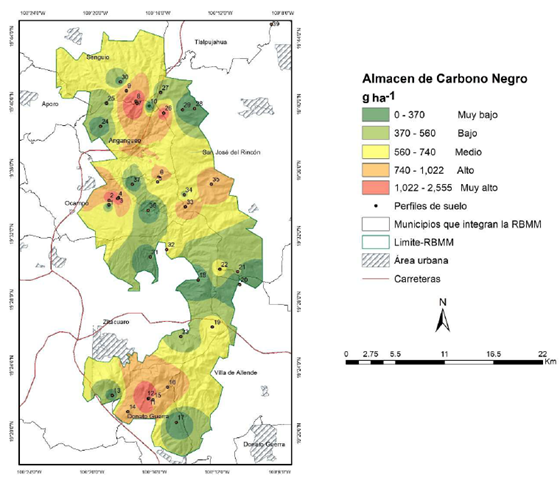
Black Carbon (BC) in soils, also called pyrogenic carbon (C), is a material produced by the incomplete biomass combustion. In forests, fires are frequent events and part of their natural dynamics. These events incorporate BC into soil over time, and the ef fect is to retain nutrients on its porous surface, generating microbial activity that promotes high soil fertility for centuries; additionally, physical and chemical properties improve and increases water infiltration into the soil. The capacity of BC to be stored depends on the type of vegetation, topography and climate. The objective of the present research is to estimate Black Carbon in the soils of the Monarch Butterfly Biosphere Reserve (MBBR), making and georeferencing 37 soil profiles. The amount of BC in soil per hectare was determined from potassium permanganate (KMnO4). The spatial interpolation method was the inverse distance weighting (IDW: inverse distance weighted). The results obtained show that the total CN found in 37 profiles was 13 000 g ha-1. Profile 7 stored more CN with 2555 g ha-1, which indicates the forest fires that occurred in the RBMM, and in addition, the C that was not emitted to the atmosphere. The present research is the first in studies on Black Carbon in forest soils in Mexico, and the results corroborate that forest soils are carbon stores.
Downloads