Uso de Digestato y Fertilización Mineral en Rendimiento, Concentración de Carotenos, Compuestos Fenólicos y Ácidos Orgánicos en dos Variedades de Tomate (Solanum lycopersicum L.)
DOI:
https://doi.org/10.28940/terralatinoamericana.v44i.2461Palabras clave:
antioxidantes, calidad nutracéutica, órgano-mineral, pigmentos vegetales, producción hortícolaResumen
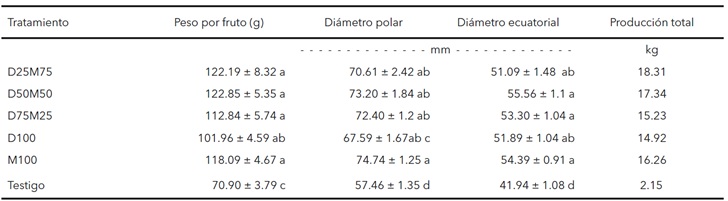
El tomate es una de las hortalizas más consumidas a nivel mundial, conocida por su contenido de compuestos fenólicos, carotenoides y ácidos orgánicos con beneficios para la salud. Aunque es común el uso de fertilizantes minerales en su cultivo, los excesos ocasionan problemas ambientales. En este estudio se evaluó el efecto de la fertilización orgánico-mineral en el rendimiento y la concentración de compuestos fenólicos y ácidos orgánicos en los frutos de dos variedades de tomate tipo saladette cultivadas en invernadero. Se diseñó un experimento con fertilización mixta utilizando fertilizante mineral (M) y digestato (D) proveniente de la digestión anaeróbica de estiércoles. Se aplicaron las siguientes proporciones: 25% D + 75% M (D25M75), 50% D + 50% M (D50M50), 75% D + 25% M (D75M25), además de tratamientos con 100% digestato (D100), 100% mineral (M100) y un testigo sin fertilización (T). Los resultados mostraron que es posible reducir en un 25% los requerimientos de fertilizante mineral mediante fertilización mixta con digestato. La combinación D25M75 generó mayores rendimientos de fruto de tomate que el tratamiento con solo fertilizante mineral. La aplicación de digestato en las diferentes concentraciones incrementó la cantidad de sólidos solubles y el índice de sabor del fruto respecto a los tratamientos sin digestato; asimismo, todos los tratamientos con digestato incrementaron las concentraciones de ácido gálico y ácido cafeico en los frutos, entre un 51.7 a 86.4% y ente un 34 al 54.2% respectivamente, en comparación con la fertilización mineral. Además, el efecto de la fertilización fue diferente según la variedad, el mayor contenido de carotenos en los frutos de la variedad Strongton fue en los fertilizados con D100; mientras que para la variedad King fue en los del tratamiento D25M75. Finalmente, los resultados sugieren que los digestatos subproducto de la digestión anaeróbica constituyen una alternativa eficiente para reducir el uso de fertilizantes minerales en cultivos de tomate, incrementando el rendimiento y las concentraciones de compuestos fenólicos y ácidos orgánicos, contribuyendo a prácticas agrícolas más sostenibles.
Descargas
Referencias
Contreras-Hinojosa, J. R., Volke-Haller, V., Oropeza-Mota, J. L., Rodríguez-Franco, C., Martínez-Saldaña, T., & Martínez-Garza, A. (2003). Encalado y fertilización fosfatada en el cultivo de papa en un Andosol de la Sierra Veracruzana, Terra, 21(3), 417-426.
Aguilar-Benítez, G., Solís-Oba, M. M., Castro-Rivera, R., López-Gayou, V., Lara-Ávila, J. P., & Esteves-Luna, M. A. (2020). Efecto de bacterias PGPB, composta y digestato en el rendimiento de materia seca de pasto ovillo. Revista Mexicana de Ciencias Agrícolas, (24), 117–127. https://doi.org/10.29312/remexca.v0i24.2363
Andelini, M., Major, N., Išic, N., Kovačević, T. K., Ban, D., Palčić, I., Radunic, M., & Goreta, S. (2023). Sugar and organic acid content is dependent on tomato (Solanum lycopersicum L.) peel color. Horticulturae, 9, 313. https://doi.org/10.3390/horticulturae9030313
Anton, D., Matt, D., Pedastsaar, P., Bender, I., Kazimierczak, R., Roasto, M., Kaart, T., Luik, A., & Püssa, T. (2014). Three-year comparative study of polyphenol contents and antioxidant capacities in fruits of tomato (Lycopersicon esculentum Mill.) cultivars grown under organic and conventional conditions. Journal of Agricultural and Food Chemistry, 62(22), 5173–5180. https://doi.org/10.1021/jf500792k
Barzee, T. J., Edalati, A., El-Mashad, H., Wang, D., Scow, K., & Zhang, R. (2019). Digestate biofertilizers support similar or higher tomato yields and quality than mineral fertilizer in a subsurface drip fertigation system. Frontiers in Sustainable Food Systems, 3, 58. https://doi.org/10.3389/fsufs.2019.00058
Bilalis, D., Krokida, M., Roussis, I., Papastylianou, P., Travlos, I., Cheimona, N., & Dede, A. (2018). Effects of organic and inorganic fertilization on yield and quality of processing tomato (Lycopersicon esculentum Mill.). Folia Horticulturae, 30, 321–332. https://doi.org/10.2478/fhort-2018-002
Brtnicky, M., Kintl, A., Holatko, J., Hammerschmiedt, T., Mustafa, A., Kucerik, J., & Elbl, J. (2022). Effect of digestates derived from the fermentation of maize legume intercropped culture and maize monoculture application on soil properties and plant biomass production. Chemical and Biological Technologies in Agriculture, 9(1), 1–24. https://doi.org/10.1186/s40538-022-00310-6
Castro-Ramos, J. J., Solís-Oba, A., Solís-Oba, M., Calderón-Vázquez, C. L., Higuera-Rubio, J. M., & Castro-Rivera, R. (2022). Effect of the initial pH on the anaerobic digestion process of dairy cattle manure. AMB Express, 12(1), 162. https://doi.org/10.1186/s13568-022-01486-8
Castro-Sierra, A., Espinosa-Solares, T., Houbron, E., Castro, R., Azcárraga-Salinas, B., Pacheco-Ortiz, J., & Solís-Oba, M.M. (2024). Production of phytoregulators during anaerobic digestion of bovine and porcine manures. Revista Mexicana de Ingeniería Química, 23, 1–17. https://doi.org/10.24275/rmiq/Bio24289
Chassy, A. W., Bui, L., Renaud, E. N., Van Horn, M., & Mitchell, A. E. (2006). Three-year comparison of the content of antioxidant microconstituents and several quality characteristics in organic and conventionally managed tomatoes and bell peppers. Journal of Agricultural and Food Chemistry, 54, 8244–8252. https://doi.org/10.1021/jf060950p
Coyago-Cruz, E., Meléndez-Martínez, A., Moriana, A., Girón, I., & Martín-Palomo, M., Galindo, A., Pérez-López, D., Torrecillas, A., Beltrán-Sinchiguano, E., & Corell, M. (2019). Yield response to regulated deficit irrigation of greenhouse cherry tomatoes. Agricultural Water Management, 213, 212–221. https://doi.org/10.1016/j.agwat.2018.10.020
Gautier, H., Lopez-Lauri, F., Massot, C., Murshed, R., Marty, I., Grasselly, D., Keller, C., Sallanon, H., & Génard, M. (2010). Impact of ripening and salinity on tomato fruit ascorbate content and enzymatic activities related to ascorbate recycling. Functional Plant Science and Biotechnology, 4(1), 66–75.
González-Coria, J., Lozano-Castellón, J., Jaime-Rodríguez, C., Olmo-Cunillera, A., Laveriano-Santos, E. P., Pérez, M., Lamuela-Raventós, R.M., Puig, J., Vallverdú-Queralt, A., & Romanyà, J. (2022). The effects of differentiated organic fertilization on tomato production and phenolic content in traditional and high-yielding varieties. Antioxidants, 11, 2127. https://doi.org/10.3390/antiox11112127
Hernández, M., Rodríguez, M., & Díaz, C. (2008). Chemical composition of tomato (Lycopersicon esculentum) from Tenerife, the Canary Islands. Food Chemistry, 106(3), 1046–1056. https://doi.org/10.1016/j.foodchem.2007.07.025
Hou, X., Zhang, W., Du, T., Kang, S., & Davies, W. J. (2020). Responses of water accumulation and solute metabolism in tomato fruit to water scarcity and implications for main fruit quality variables. Journal of Experimental Botany, 71(4), 1249–1264. https://doi.org/10.1093/jxb/erz526
Imran, M., Ghorat, F., Ul-Haq, I., Ur-Rehman, H., Aslam, F., Heydari, M., Shariati, M. A., Okuskhanova, E., Yessimbekov, Z., Thiruvengadam, M., Hashempur, M. H., & Rebezov, M. (2020). Lycopene as a natural antioxidant used to prevent human health disorders. Antioxidants, 9(8), 706. https://doi.org/10.3390/antiox9080706
Khadem, S., & Marles, R. J. (2010). Monocyclic phenolic acids; hydroxy- and polyhydroxybenzoic acids: Occurrence and recent bioactivity studies. Molecules, 15(11), 7985–8005. https://doi.org/10.3390/molecules15117985
Krasilnikov, P., Taboada, M. A., & Amanullah. (2022). Fertilizer use, soil health and agricultural sustainability. Agriculture, 12, 462. https://doi.org/10.3390/agriculture12040462
Li, F., Yuan, Y., Shimizu, N., Magaña, J., Gong, P., & Na, R. (2023). Impact of organic fertilization by the digestate from by-product on growth, yield and fruit quality of tomato (Solanum lycopersicon) and soil properties under greenhouse and field conditions. Chemical and Biological Technologies in Agriculture, 10, 70. https://doi.org/10.1186/s40538-023-00448-x
Midden, C., Harris, J., Shaw, L., Sizmur, T., & Pawlett, M. (2023). The impact of anaerobic digestate on soil life: A review. Applied Soil Ecology, 191, 105066. https://doi.org/10.1016/j.apsoil.2023.105066
Na, Q., Wang, Y., Zhang, M., Zhu, C., Cao, H., Liu, S., & Meng, L. (2025). SlLCYB2 affects the accumulation of carotenoids in tomato fruits. Food Bioscience, 63, 105782. https://doi.org/10.1016/j.fbio.2024.105782
Oboulbiga, E., Traore, C., Tarpaga, W., Parkouda, C., Sawadogo-Lingani, H., Kere-Kando, C., & Traore, A. (2018). Assessment of the content of β-carotene, lycopene and total phenolic of 45 varieties of tomatoes (Solanum lycopersicum L.). Journal of Food and Nutrition Sciences, 6(3), 82–89. https://doi.org/10.11648/j.jfns.20180603.13
Olasekan, A., Olatunde, S., Femi, J., Aremu, A., Muyiwa, C., Okunlola, F., & Oyelami, E. (2022). Organic and inorganic fertilizers effects on the performance of tomato (Solanum lycopersicum) and cucumber (Cucumis sativus) grown on soilless medium. Scientific Reports, 12, 12212. https://doi.org/10.1038/s41598-022-16497-5
Pérez-Espinoza, H. A., Chávez-Morales, J., Carrillo-Flores, G., Rodríguez-Mendoza, M. N., & Ascencio-Hernández, R. (2017). Fertilización foliar en el rendimiento y calidad de tomate en hidroponia bajo invernadero. Revista Mexicana de Ciencias Agrícolas, 8(2), 333–343. https://doi.org/10.29312/remexca.v8i2.54
Piaz, D., Nabel, M., & Jablonowski, N. (2014). Biogas-digestate as nutrient source for biomass production of Sida hermaphrodita, Zea mays L. and Medicago sativa L. Energy Procedia, 59, 120–126. https://doi.org/10.1016/j.egypro.2014.10.357
Rajapaksha, R., Vibodhani, D., Harshana, M., Jayathilaka, M., Munasinghe, M., Bandara, H., Jayamal, H., Bandara, I., Rathnayake, R., Madusanka, H., Alahakoon, C., Madushani, A., Kavinda, B., Wijesekara, W., Wijesundara, W., Kodithuwakku, K., Balasooriya, B., Madushanka, J., & Rathnayaka, R. (2024). Effect of organic fertilizer solutions on the growth and yield of tomato (Lycopersicon esculentum Mill.). Organic Agriculture, 14, 513–522. https://doi.org/10.1007/s13165-024-00478-1
Saha, K., Kabir, M. Y., Mondal, C., & Mannan, M. A. (2019). Growth and yield of tomato as affected by organic and inorganic fertilizers. Journal of Bangladesh Agricultural University, 17(4), 500–506. https://doi.org/10.3329/jbau.v17i4.44618
Suwanaruang, T. (2016). Analyzing lycopene content in fruits. Agriculture and Agricultural Science Procedia, 11, 46–48. https://doi.org/10.1016/j.aaspro.2016.12.008
Stoknes, K., Scholwin, F., Krzesinski, W., Wojciechowska, E., & Jasinska, A. (2016). Efficiency of a novel “food to waste to food” system including anaerobic digestion of food waste and cultivation of vegetables on digestate in a bubble-insulated greenhouse. Waste Management, 56, 466–476. https://doi.org/10.1016/j.wasman.2016.06.027
Tigist, M., Workneh, T., & Woldetsadik, K. (2013). Effects of variety on the quality of tomato stored under ambient conditions. Journal of Food Science and Technology, 50(3), 477–486. https://doi.org/10.1007/s13197-011-0378-0
Turhan, A., & Özmen, N. (2021). Effects of chemical and organic fertilizer treatments on yield and quality traits of industrial tomato. Tekirdağ Ziraat Fakültesi Dergisi, 18(2), 213–221. https://doi.org/10.33462/jotaf.741367
Uchenna, E. U., & Abiodun, A. O. (2024). Quality attributes, physiology, and postharvest technologies of tomatoes (Lycopersicum esculentum) – A review. American Journal of Food Science and Technology, 12(2), 42–64. https://doi.org/10.12691/ajfst-12-2-1
Ye, L., Zhao, X., Bao, E., Li, J., Zou, Z., & Cao, K. (2020). Bioorganic fertilizer with reduced rates of chemical fertilization improves soil fertility and improves tomato yield and quality. Scientific Reports, 10, 177. https://doi.org/10.1038/s41598-019-56954-2
Zhang, E., Duan, Y., Tan, F., & Zhang, S. (2016). Effects of long-term nitrogen and organic fertilization on antioxidants content of tomato fruits. Journal of Horticulture, 3, 172. https://doi.org/10.4172/2376-0354.1000172
Zhang, Y., Ntagkas, N., Fanourakis, D., Tsaniklidis, G., Zhao, J., Cheng, R., Yang, Q., & Li, T. (2021). The role of light intensity in mediating ascorbic acid content during postharvest tomato ripening: A transcriptomic analysis. Postharvest Biology and Technology, 180, 111622. https://doi.org/10.1016/j.postharvbio.2021.111622
Zhang, Y., Zhu, K., Wang, X., Yan, J., Zhu, H., Zhang, N., Wang, Y., Zhao, O., Liu, Y., Bu, X., Jiang, C., Sun, X., Ahammed, G., Cai, S., Meng, S., Sun, Z., Qi, M., Li, T., & Wang, F. (2024). Manipulation of artificial light environment improves plant biomass and fruit nutritional quality in tomato. Journal of Advanced Research. https://doi.org/10.1016/j.jare.2024.11.030.